Monday, September 30, 2024

262. FUJIMOTO Hide , 1954- , Shigaraki-ware collapsed pot

262.   FUJIMOTO Hide  藤本 ,  1954- , Shigaraki kuzureta tsubo 信楽崩壺  (Shigaraki-ware collapsed pot)


For Fujimoto, see item no. 250. 

Light gray clay, with addition of many small white pebbles (quartz or feldspar). This was fired unglazed. The surface decoration results from kiln effects—ash deposits, natural ash glazing, hi-iro (fire colors), and vitrification, with patches and drops of bidoro green glass-like glazing. Weight: 2.2 kg (4.9 lb). Height: 13.8 cm (5-1/2 in). Widths: rim, 12 cm (4-3/4 in); widest, 22.5 cm (8-3/4 in); base, 14.8 cm (5-7/8 in). 

This sits on a flat base. The remnants of the five posts used to separate the piece from the kiln shelf during firing are visible on the base. The base is scored with many striations and much pitted. From the base the walls rise in a convex arc to the widest point, 7.6 cm (3 in) above the base. The piece collapsed above this point, more on one side (arbitrarily the front side), causing the mouth to sag downward on this side. The back side didn’t sag as much. It appears that this was to be a wide, relatively low jug. On the back side, there is an irregular hole surround by the remnants of a circular structure. To one side of this is another remnant, which appears to be a broken off protrusion of some sort. These may perhaps be remnants of a spout or a handle of some sort.  The mouth is wide and surrounded by a beveled rim. The surface of the pot is rough and broken. In one place on the back part, the surface fell off after firing, leaving the clay body exposed. 

This was fired unglazed. The back side has a dark gray ash deposit between the two remnants mention in the preceding paragraph. The upper part of the pot is covered with natural ash glazing, vitrified in places and with some bidoro green glass-like patches and a few tambo no me (green glass-like teardrops) running down the side. The lower half exhibits hi-iro in colors ranging from light red to mahogany. There are patches of vitrified cream-colored natural ash glazing on the base near the outside edge; most of the base has hi-iro colors in light red. 

This came in a wooden box, inscribed by the artist in three lines: 信楽 / 崩壺 / 藤本   Shigaraki  / kuzureta tsubo / Fujimoto Hide (Shigaraki[-ware] / collapsed jug / Fujimoto Hide), with the artist’s seal stamped in red. Included in the box were a business card (meishi) and a short printed biography. 

The seller told me that the pot collapsed during firing and that Fujimoto viewed it as work of art resulting from a collaboration between nature and ceramics. The result is appealing and intriguing, and it’s understandable that Fujimoto would preserve this rather than toss it on the scrap heap. Sometimes the unexpected happens when pots are fired, and the accidents can be serendipitous. 

Purchased from the Kura Monzen Gallery in Kyoto in September 2024, who received it directly from the potter in summer 2024. This was part of an exhibit entitled Shōka 昇華  (“sublime”), or Modern Masters in English, a show of fifteen currently active potters (invoice and shipping and customs documents).


261. FUJIMOTO Hide, 1954- , Shigaraki-ware “crouching” vase

 261. FUJIMOTO Hide  藤本 ,  1954- , Shigaraki uzukumaru [tsubo] 信楽蹲[]  (Shigaraki-ware “crouching” vase)


For Fujimoto, see item no. 250. 

The designation of this as a tsubo follows the usage for similar uzukumaru pots. For another example, see item no. 218, 

To judge from other examples of uzukumaru pots online, the term is reserved for a style of pots made in Shigaraki. They are roughly circular in cross-section. From a broad, flat base, the walls rise outwards in a more or less straight line to the widest diameter at the high shoulders. From there, the walls curve inward rapidly to a small, short vertical neck surmounted by jutting horizontal lips with beveled edges. 

Light gray clay. Fired unglazed, with heavy kiln effects--ash deposits in deep black, hi-iro (fire colors) in light red, melted ash glaze in a creamy brown, with some vitrification and bidoro green glass-like deposits and drips. Weight: 1.9 kg (4.3 lb). Height: 19 cm (7-1/2 in). Widths: rim, 8.2 cm (3-1/4 in); widest, 16.4 cm (6-1/2 in); base, 12 cm (4-3/4 in). 

This sits on the flat circular base. The remnants of the four posts used to separate the piece from the kiln shelf during firing are visible on the base. The body is roughly circular but with many shallow dents and bulges. The widest point occurs at the shoulders, 11.3 cm (4-1/2 in) above the base. The walls then curve inward to the neck, which is 16 cm (6-3/8 in) above the base and 5.7 cm (2-1/4 in) in diameter. The lip juts outward above the neck, Both the lower and the upper surfaces are beveled. Two lines scratched into the clay undulate around the vase, one positioned slightly below the shoulders and one above. The lines range from 2.5 to 5 cm (1-2 in) apart. A series of X’s was inscribed within these lines. Some of the lines in the X’s rise above the upper line. This is known as the “cypress fence pattern”  垣文  higakimonThe interior of the piece mirrors the exterior. The surface is rough and crusted. 

This was fired unglazed. One side (arbitrarily the back side) was covered with a heavy layer of ash, leaving a dark matte black surface, much pitted and very irregular. This layer is so thick that it largely obscures the undulating lines and X’s in this area. The portions of the exterior walls beside the neck on this side show some reddish-brown hi-iro. The front side, particularly the upper portions, were covered with a natural ash glazing, which ran down the front side to the base, leaving some portions uncovered and again showing hi-iro colors. The neck, rim, and mouth of the piece are also covered with natural ash glazing in the creamy brown color. Some areas of the natural ash glazing shows vitrification. Unusually the base is also encrusted with ash deposits and has one tambo no me bead of green glass-like melted ash glazing. This must have been fired near the front of the kiln and received a full blast of ash deposits and heat. 

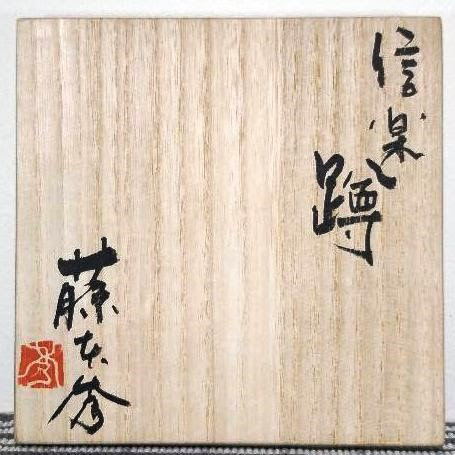
This came in a wooden box inscribed by Fujimoto in three lines: 信楽 / 藤本 Shigaraki / uzukumaru / Fujimoto Hide (Shigaraki / crouching / Fujimoto Hide), followed by the artist’s seal stamped in red. Included in the box was a short printed biography of the artist. 

I found a picture of a Muromachi-period Shigaraki "crouching" tsubo that has a similar decorative scheme of two lines running around the shoulders with a pattern of X's inscribed between them. The decoration on that piece is more regular, however, and the kiln effects are much more limited (chiefly hi-iro with some golden fly ash). See Samuel J. Lurie and Beatrice L. Chang, Fired with Passion: Contemporary Japanese Ceramics (2006), p. 110, fig. 82. 

Purchased from the Kura Monzen Gallery in Kyoto in September 2024, who received it directly from the potter in summer 2024. This was part of an exhibit entitled Shōka 昇華  (“sublime”), or Modern Masters in English, a show of fifteen currently active potters (invoice and shipping and customs documents).


Sunday, September 8, 2024

260. ŌIWA Tomoyuki, 1977- . black [Bizen-ware] sake-warming flask

260.  ŌIWA Tomoyuki 大岩智之. 1977- . Kuro tokkuri  黒徳利   (black [Bizen-ware] sake-warming flask)


For Ōiwa, see item no. 259. 

Dark gray clay. Fired unglazed, with natural ash glazing resulting in shiny black and matte black and dun colors. Weight: 426g (15 oz). Height: 13.8 cm (5-1/2 in).  Widths: rim, 3.5 cm (1-3/8 in); widest, 8.8 cm (3-1/2 in); base, 6 cm (2-3/8 in). 

This is shaped like a bottle gourd (瓢箪 hyōtan). It appears to have been molded on a wheel and then subsequently carved to form the belt, shoulders, neck, and rim. The main part of the body was then flattened slightly, leaving the piece longer from side to side. The maximum distance front to back is 8.2 cm, or about a quarter inch less the side-to-side dimension. 

The piece sits on the rim of the circular base, which was hollowed out in a shallow concavity. The remains of the three posts used to separate the piece from the kiln shelf during firing are visible on the bottom. The artist’s mark, a vertical line with a crossbar and a dot at the top right corner, is incised into the center of the base. The belt or waist begins about 5 cm (2 in) above the base and is one centimeter (3/8 in) wide. It consists of two horizontal grooves encircling the piece; the area between the two grooves was flattened with a carving tool. The lower bulge is a convex curve about 5 cm (2 in) in height, with the maximum width of 8.8 cm occurring 3.3 cm (1-1/4 in) above the base. The upper bulge is again a convex curve, with the maximum width of 7.5 cm (3 in) occurring 7 cm (2-3/4 in) above the base. Thus the widest area of both bulges is nearer the waist than the base or shoulders, respectively, of the piece. The shoulders begin 10.2 cm (4-1/8 in) above the base. The shoulder area is level, sloping slightly upwards toward the neck. At the neck’s lowest point, it is 2.5 cm (1 in) wide. The neck widens gradually up to the rim, which juts outward at a 90-degree angle and then slants slightly outward to the upper edge. The inside of the rim curves downward to the recessed mouth. It is impossible to see inside the piece. The surface of the exterior ranges from smooth over the heavily vitrified areas to a medium sandpaper grade on the relatively unglazed areas. 

This was fired unglazed. Some two-thirds of the exterior surface is covered with a vitrified ash glaze, with a dark black color. The base and some lower edges of the walls are a matte black color. Those portions of the exterior walls not covered with the vitrified ash glazing are a matte dun color.

 This came in a wooden box inscribed by Ōiwa in three lines: / 徳利 / sigil  kuro / tokkuri / sigil (black sake warmer-pourer / sigil), followed by the artist's seal stamped in red. See item no. 259 on the sigil. Included in the box were a gray wrapping cloth and a small card with a potted biography of the artist.  

This was sold as a unit with item no. 259, but the two pieces were not conceived as a set.  An online search found other similarly shaped tokkuri by Ōiwa. 

The irregularity of the main part of the body contrasts with the symmetry and precision of the pouring spout. The difference sets up a dialogue between the two parts. 

Purchased from the Kura Monzen Gallery in Kyoto in September 2024, who purchased it directly from the potter in June 2023 (invoice and shipping and customs documents).

Saturday, September 7, 2024

259. ŌIWA Tomoyuki. 1977- . black Bizen-ware drinking cup

 259. ŌIWA Tomoyuki 大岩智之. 1977- . Kuro guinomi 黒ぐい呑   (black [Bizen-ware] drinking cup)


Ōiwa Tomoyuki was born in Kobe, Hyogo prefecture, in 1977, and graduated from the Bizen Ceramic Center in 2004. The following year he became a student of the outsider Kakurezaki Ryūichi 隠崎隆一, with whom he would remain for eight years before going independent. In 2014 he built a half-submerged tunnel kiln (anagama), completing his first firing in 2015. He has since been featured widely and is known for his sake vessels. 

Glazed in dun brown and black. Weight: 158 g (5.6 oz). Height: 5.4 cm (2-1/8 in). Widths: mouth, 5.4 cm (2-1/8 in), widest, 6 cm (2-5/8 in); base, 5 cm (2 in). 

Any given horizontal cross-section of  this is roughly circular. The cup sits on a flat irregular foot ring. Before trimming, the base was probably completely flat. The inside of the base has been gouged out in a rough yin-ying pattern. The foot ring is level, and the cup rests stably on it. This came with a small white sticker with the number 11 on it attached to the base. Above the base the walls rise outward at about a 45-degree angle, to the widest point of the piece, about a centimeter (3/8 in) above the base. From the widest point to the mouth, the walls gradually sloped inward. There are wide, shallow horizontal grooves encircling the cup in this section. The mouth is generally even but has two small dips in it. There are tiny remnants of the three posts used to hold the piece away from the kiln shelves on the black side of the piece. The interior generally mirrors the exterior. The surface of the piece is smooth throughout and has the slight stickiness of a glazed work. 

The bottom, most of the interior, and half of the wall area were glazed in black. The other half of the walls and the lips of the mouth were glazed in a dun brown, which was allowed to drip into the black area of the walls along the horizontal grooves. Where the brown glaze thins out over the black glaze, it turned a light blue color. 

This came in a wooden box, inscribed by the artist in three lines: /ぐい呑 / sigil (black / small drinking cup //sigil), followed by the artist’s seal stampeed in red. Ōiwa’s sigil is indecipherable but appears to be the characters in his surname. Included in the box were a gray wrapping cloth and a small printed card with the artist’s potted biography. 

Purchased from the Kura Monzen Gallery in Kyoto in September 2024, who purchased it directly from the potter in June 2023 (invoice and shipping documents).


Friday, August 9, 2024

258. SUZUKI Gorō, 1941- . Painted Oribe-ware ceramic winter melon sculpture

258. SUZUKI Gorō 鈴木五郎 , 1941-  . E-Oribe Tō Tōgan  絵織部陶冬瓜   (Painted Oribe-ware ceramic winter melon), sculpture, 2003.


“Oribe keeps developing. It never stayed in one place. So I create whatever comes to my mind, one after another. I never stop. I feel like I’m playing with clay. The playfulness makes one’s life interesting.”                                                                                                                                                          --Suzuki Goro

Born in Toyota City, Aichi Prefecture, in 1941, the prolific Suzuki Gorō is known particularly for his Oribe-ware, as well as for Shino and ki-Seto pieces. Stylistically playful, Suzuki’s experiments with color and form result in works both sculptural and functional. His art is experimental and showcases a youthful and quirky approach to Mino and Seto ceramics. He has brought a fresh and innovative perspective to Oribe-ware. His works are held by, among others, the Los Angeles County Museum of Art, Metropolitan Museum in New York City, Minneapolis Institute of Art, Museum of Fine Arts in Boston, and Peabody Essex Museum in Salem, Massachusetts. 

A visit to a daughter living in Los Angeles inspired this piece and its drawings of buildings and a car. 

White clay. Glazed in Oribe green, cream, and dark brown; one unglazed spot near the base. Weight: 2.3 kg (5.1 lb). Height: 27 cm (10-5/8 in). Width: 18.5 cm (7-1/4 in). 

This is a rough cylinder with a rounded and flattened top and bottom. It sits on a flat base, with a central depression. The character go (the first character’s in Suzuki’s given name) was incised into the base. The body is roughly circular in cross-section, though with many bumps and dents. The widest point is about 7.5 cm (3 in) up from the base. The diameter gradually narrows to the shoulders to about 14 cm (5-1/2 in) some 25 cm (10 in) above the base. The top has a central depression, filled with a “stem” about 5 cm (2 in) long. The surface is smooth to the touch. 

For a piece of this size, it is remarkably light in weight. Suzuki must have trimmed it when it had partially dried until the walls were quite thin. There is no obvious escape hole for the air inside the pot, a necessity for the kiln. The stem has a central hole, but it extends only a short distance inward. Perhaps the vent was filled in after the firing. 

Except for the three oval picture areas, the pot is covered in the Oribe green glaze. This glaze is of varying thicknesses. The direction of the drips implies the piece lay on its side as this glaze was applied, although there is one long prominent vertical drip. The picture areas were covered with the Oribe cream glaze. The oval shapes are reminiscent of the picture areas on highly painted Ming and Qing vases. The pictures are drawn in the Oribe brown glaze. The first shows a boxy car with jagged shapes above it (mountains?).The second has a light bulb beneath a metal shade, with a rotating off-on switch, hanging from an electrical cord. Diagonal lines suggest rays of light. A brown line outlines the edges of this oval. The image is reminiscent of the motif of persimmons suspended by cords from the eaves of a house, a common image on classical Oribe pieces (see item no. 7 for an example). The third oval contains drawings of two skyscrapers with a helicopter. Similar images can be found on other pieces by Suzuki. 

This piece has all the playfulness and whimsy of classical Oribe-ware, with the updated images containing nods to classical styles of decoration. 

This came in a wooden box inscribed by Suzuki in two lines:  絵織部陶冬瓜   E-Oribe Tō Tōgan /  X (painted Oribe-ware ceramic winter melon / sigil Go). The sigil is indecipherable. Interestingly, Suzuki did not stamp the box with his seal. The same signature and the lack of a seal are found on online examples of boxes inscribed by Suzuki. 

Purchased in August 2024 from Dai Ichi Arts in New York City, which had it directly from the artist (invoice, shipping documents, postcard from seller, small brochure/catalogue of Suzuki’s works).


Thursday, July 18, 2024

257. SAKATA Keizō, 1949-2004, Hagi-ware bamboo-shaped vase

257.  SAKATA Keizō 坂田慶造  (十五代 坂田泥華 Sakata Deika XV), 1949-2004. Hagi XXha take hanaire  XX竹花入 (Hagi-ware broken bamboo-shaped vase)


The Sakata family is one of the ancient lineages of Hagi-ware potters. Keizō was the son of Sakata Deika XIV (1915-2010). After graduating from university, he studied sculpture and spent some time traveling in the United States before beginning work at the family kiln. This exposure outside the traditional world of Hagi-ware pottery is sometimes cited as setting him apart from other local potters. In 1978, he received an award at the First Exhibition of New Traditional Crafts (Dentō Kōgei Shinsaku Ten). In 1989, he became a member of the Japan Kōgei Association and exhibited with that organization, garnering a number of prizes as well as receiving awards at the Japan Traditional Crafts Exhibition (Dentō Kōgei Ten) and the Grand Prize at the Tanabe Museum Ceramics of Tea Exhibition. He was expected to make great advances as the next Sakata Deika but died in 2004 at the age of 54. He was posthumously named the 15th generation Sakata Deika. A brother is now Sakata Deika XVI. 

Gray clay, visible only on the bottom half of the interior. The color of the glaze is hard to pin down. In sunlight the exterior is a milky coffee color; in artificial light, it acquires a greenish hue. The glaze on the interior is whiter, with a bluish cast in some lights. Only the upper half or so of the interior was glazed. The base and a small patch at the bottom of the back side were left unglazed and show kiln-effect colors in a reddish tan and a dark red. Weight: 4.4 kg (9.7 lb). Height: 33.3 cm (13 in). Width: top. 12 cm (4-3/4 in); widest: 13.5 cm (5-1/4 in); base: 11.5 x 10.5 cm (4-1/2 x 4-1/8 in). 

The vase is shaped to resemble one of the dilapidated bamboo vases that often hang on the walls or pillars of a tea ceremony hut. It sits on a flat, eight-sided base, a rough rectangle with angled corners. The artist’s mark, the character , was incised into the base with shallow lines (on the lower left in the next to last picture). Comparison of the interior depth with the exterior walls shows that the base is about 1.3 cm (1/2 in) thick. The walls rise in irregular vertical slabs from each side of the base. The front (the side with the torn away section and the bamboo leaves) is more rounded than the back. The piece as a whole tilts backward slightly. A deep, rough gouge encircles the piece about 7 cm (2-3/4 in) above the vase. The widest point of the vase occurs at this point. The gouge is meant to mimic the joint between two sections of bamboo. On the front side, just above this horizontal gouge, Sakata made two bamboo-leaf shaped gouges. The clay surrounding these gouges was forced to the side to create jagged lines defining them. No apparent attempt was made to trim away the excess. Another notable feature of the piece is the rough, almost violent tearing away of a section of the front of the pot to suggest a portion of the bamboo wall that was ripped off. The margins of this opening are very rough and irregular. The walls themselves are quite thick, measuring from 2.5 to 3.0 cm (1 to 1-3/16 in) at the top. The clay is so thick that several shallow, vertical fissures opened up on the interior walls while the piece was drying/ The interior is roughly circular in cross-section. The surface is smoothest over the most heavily glazed sections. Elsewhere it is quite bumpy and rough. 

Glazed in a milky coffee color over most of the exterior surfaces. The glaze covers the surface unevenly. Most sections received only a light coating, allowing the clay beneath to show through as darker patches. The glaze is thickest and most uniform over the smoother panels, in the areas with a more textured surface, it is more broken, exposing the clay beneath. On the interior, the glaze is a bluish white, again with many darker streaks showing through. 

This came in a wooden box, inscribed by the artist in two lines:  XX竹花入  / 坂田慶造  Hagi XX ha take hanaire / Sakata Keizō (Hagi-ware broken bamboo-[shaped] vase / Sakata Keizō), followed by Sakata’s seal stamped in red. There are two characters in the line on the right that I cannot read, but from their position, they must modify “bamboo” and probably characterize the design of the vase. Included in the box was a leaflet with a potted biography of the artist. 

Purchased from Kura Monzen Gallery in Kyoto, Japan, July 2024 (invoice, shipping and customs documents).

Tuesday, July 9, 2024

256. KOGA Kenji, 1945- , Korean-style Karatsu-ware clam-shaped small dishes

256. KOGA Kenji 古賀賢治, 1945- , Chōsen Karatsu hamaguri mukōzuke 朝鮮唐津蛤向付  (Korean-style Karatsu-ware clam-shaped small dishes), set of five


Koga was born in 1945 in Fukuoka Prefecture. He came to potting rather later than most, at the age of 29 in 1974. He established his own kiln, the Koken Kama 古賢窯,  in Kita Kyūshū City in 1991. To judge from online pictures of other examples of works, he specializes in table ware. 

A coarse clay, the unglazed portions of the pieces are a light tan, with redder colors within the foot rings. Glazed in black and white, with the foot ring and the surrounding areas left unglazed. Each of the five pieces has different dimensions. Weight: 292 – 358 g (10.4 – 12.7 oz). Length: 15.2 – 15.6 cm (6 – 6-1/4 in). Width: 12.3 – 14.0 cm (4-7/8 – 5-1/2 in). Height: 5.4 -5.6 cm (2-1/8 – 2-1/4 in). 

These were shaped to resemble clam shell halves. Each piece sits on a roughly circular foot ring, again of variable diameters, ranging from 6.3 to 7.5 cm (2-1/2 – 3 in). The foot rings are about a centimeter (3/8 in) high on the outside. The inside of the rings was hollowed out very shallowly. The artist’s sigil was incised within the rings. Above the rings, the walls form two distinct zones. The first rises outward at a shallow angle above the foot ring to about a third of the way up. Above this, the second zone extends outward at a steeper angle in more or less straight lines to the rim. There is a bump on the exterior walls where the two zones meet, especially at the back of each piece. The back sides are flatter. It appears that the pieces were shaped as circular bowls. Koga then slit what would become the back side to the depth of the upper zone and pulled the right-hand side over the left-hand side to create a more vertical wall at the back. At the rear of these slits, he attached two wedges as if they were staples holding the slit shut.  Except in the center of the inside, where the glaze is thickest, the surface is bumpy. 

There were glazed in what is known as “Korean-style” Karatsu-ware. The front portion of the inside and the corresponding outside walls were glazed in black.The back portions of the pieces were then covered in a thin white glaze on both the inside and the outside. Due to the thinness of the glaze, it functioned almost as a luster glaze over most of this area, leading to a glossy, dun brown color on these parts. Where the white glaze pooled at the lower edges of the outside walls and in the back center of the insides, it showed up as white after firing. The outside edges of the white patches where it overlaps the black glaze and the glaze is thinner are blue. The lower portion of the external walls and the foot rings were left unglazed. 

Chōsen Karatsu refers to ware that has been glazed with both an ash glaze with a high iron content (black to amber) and a glaze made with the ashes of rice straw mix with a slip (white), applied separately top/bottom or left/right on the ware. The contrast of white and black glazes is quite striking, and the multihued waterfall effect of white, blue, purple, and yellow where the glazes melt together and flow is a defining characteristic of this style of Karatsu-ware. The color changes on the surface of this ware are unpredictable and reminiscent of natural landscapes. 

Mukōzuke is a sashimi course in a formal kaiseki dinner. 

This came in a wooden box, inscribed by Koga in three lines: 朝鮮唐津蛤向付  Chōsen Karatsu hamaguri mukōzuke  (Korean-style Karatsu-ware clam-shaped small dishes) / 唐津焼古賢窯Karatsuyaki Koken Kama  (Karatsu-ware Koken Kiln) / Koga Kenji 古賀賢治  followed by his seal stamped in red. A short, printed biography was included in the box. 

Robert Mangold, the owner of the Kura Monzen Gallery, had these directly from Koga and dates them to before 2000. 

Puchased from the Kura Monzen Gallery in Kyoto, Japan, in July 2024 (invoice, shipping and customs documents).


Pottery

Looking for suggestions

I need to dispose of my collection. I've tried to donate it to several local museums or schools with ceramics programs, but no one wants...