Showing posts with label Murakoshi Takuma. Show all posts

Wednesday, November 6, 2024

267. MURAKOSHI Takuma, 1954- , chawan (teabowl)

267. MURAKOSHI Takuma  村越琢磨, 1954- ,  chawan  茶碗  (teabowl)


For Murakoshi, see item no. 234.

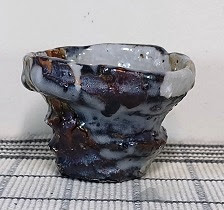
 Light gray clay from Shigaraki, with some small white stone flecks mixed into the clay. Partially glazed in light gray, brown, and black, with kiln effects: ­hi-iro colors in the red coral range on the unglazed sections and light green bidoro and white shiseki deposits. Weight: 404 g (14 oz). Height: 7.3 cm (2-7/8 in). Width: of rim (widest): 15.8 x 10.8 cm (6-1/4 x 4-3/8 in); foot ring: 6.3 x 5.8 cm (2-1/2 x 2-1/4 in). 

Like items 235 and 265, this was hand-built using flat ribbons of clay. It sits on the flat foot ring, a rough oval, with the interior hollowed out. The ring is about a centimeter (3/8 in) broad, and the hollowed-out portion is about 0.6 cm (1/4 in) deep in the middle. Any given cross-section of the piece is a rough oval, but with many dents and protrusions. The walls rise outward from the foot ring to the rim; overall the walls rise outward in a straightish line to about half the vertical distance and then flare outward slightly before rising, again in a straightish line, to the rim. This creates a ledge about halfway up the sides, a convenient place for the fingers when holding the cup. On the long sides of the cup, the walls are rolled inward somewhat. On the short ends, the walls slope outward more. The rim is beveled. Along the long front and back sides, it slopes inward toward the interior; along the ends, it slopes outward. Because of this, it would be better to drink from one of the ends rather than a side. The shape of the interior mirrors that of the exterior. The joins between the ribbons of clay are pronounced on the exterior but were flattened and smoothed on the interior. The surface of this is quite pitted, with many small bumps. Because the entire surface of the interior was glazed, its surface is smoother than that of the exterior, but it is still quite bumpy and rough. 

The artist’s sigil, a long line with a short bar at the top with two tear-drop indents near the bottom end was incised into the side of the cup. 

This was glazed first with a thin gray ash glaze covering all of the interior and the top two-three centimeters (inch) of the exterior walls. Some of this glaze dripped down on the exterior to form thicker beads. At places where this glaze is thin, the clay took on a reddish hi-iro hue, visible through the glaze. A heavy, iron-rich glaze was used on one of the long sides of the interior and both long sides of the exterior. In all these cases, this glaze was applied at the top and allowed to run down the sides to form a rough triangle of darker color. The edges of these triangles and the area at the bottom of the interior where this glaze pooled are black in color. On the interior, a drip of glaze ran along the beveled edge of the rim and then spilled down one of the short ends of the interior. Those portions of the exterior not covered by glazes exhibit hi-iro  colors in the red-coral range. The few horizontal surfaces have melted ash deposits that vitrified to form the green glass-like deposits known as bidoro. The foot ring and the area within have heavy deposits of a very glossy, thick black glazing.  The embedded stone chips show up as white spots; there are also many small, white ash deposits (shiseki) on both the interior and the exterior. A complex mixture of applied glazes and kiln effects. 

This came in a wooden box, inscribed by Murakoshi in his distinctive calligraphy, in two lines:  茶碗 / たくま chawan / takuma  (teabowl / Takuma). As is his habit, the inscription begins on the lid and continues on the front side, with the final stroke of the character 碗 extending onto the right-hand side of the box. The top is stamped in red with a seal with Murakoshi’s studio name: へうげも屋  (Hyōgemono-ya, “Jocular Fellow Studio”); interestingly he uses the kyūkanazukai, or old kana usage, to write hyō. Hyōgemono is also the name of a popular manga character. On the side of the box is another seal stamped in red, giving Takuma in characters, 琢磨. Included in the box were a brown wrapping cloth and a printed leaflet from Murakoshi. 

Purchased from the Kura Monzen Gallery in Kyoto in October 2024, who received it directly from the potter in summer 2024. This was part of an exhibit entitled Shōka 昇華  (“sublime”), or Modern Masters in English, a show of fifteen currently active potters (invoice and shipping and customs documents).


Tuesday, October 15, 2024

265. MURAKOSHI Takuma, 1954- , guinomi

265. MURAKOSHI Takuma  村越琢磨, 1954- , Sake-nomi  酒呑 (sake cup)


For Murakoshi, see item no. 234. 

Light gray clay from Shigaraki. A few splashes of dark brown glaze on the exterior and interior; otherwise fired unglazed, with kiln effects: hi-iro in coral colors; natural ash glazing in white spots and green glass-like bidoro deposits. Weight:  156 g (5.6 oz). Height: 5.4 cm (2-1/8 in). Widths: rim, 9.2 x 7.9 cm (3-5/8 x 3-1/8 in); base, 3.7 x 3.4 cm (1-1/2 x 1-3/8 in). Capacity: 82 ml (3.7 fl oz). 

This is similar in shape to item no. 234, but slightly smaller. Like item no. 235, it was hand-built using overlapping flat ribbons of clay. Any given cross-section is an oval, although there are many bimps and dents. It sits on a flat base, an irregular oval. The interior of the base is indented, perhaps by the tip of the artist’s thumb (mine fits comfortably in the dent). The walls flare outward from the base to the rim, with many ridges where the edges of the ribbons were joined. On one side of the piece is the artist’s sigil (see item no. 235 for a description), a long curved line with a short bar at the top and two lines off to the right side at the lower end of the long line. The shape of the interior mirrors that of the exterior, but the joins between the ribbons of clay are smoother and less pronounced. Given the rough modeling of the piece, the surface is quite smooth. 

Except for a few splashes of a dark brown glaze on the interior and exterior walls, this was fired unglazed. The exterior and the upper parts of the interior are dotted with the white beads sometimes referred to as shiseki 歯石 (tartar), the results of natural ash glazing. The interior has several patches of green glass-like bidoro drips. The portions of the walls not covered with brown glaze or affected by the natural ash glazing show hi-iro colors in the coral range. The natural clay color shows through only on the flat, oval base. 

This came in a wooden box inscribed by the artist in two lines: 酒呑 / たくま sake-nomi / takuma (sake cup / Takuma), followed by a seal bearing the characters for his given name stamped in red. As is his wont, Murakoshi began the inscription on the top of the box (actually on the back edge of the lid) and continued down the front of the box. Included in the box are a small printed leaflet (in Japanese and English) and a brown wrapping cloth. 

Purchased from the Kura Monzen Gallery in Kyoto in October 2024, who received it directly from the potter in summer 2024. This was part of an exhibit entitled Shōka 昇華  (“sublime”), or Modern Masters in English, a show of fifteen currently active potters (invoice and shipping and customs documents).


Sunday, April 7, 2024

246. MURAKOSHI Takuma, 1954- , guinomi

246. MURAKOSHI Takuma  村越琢磨, 1954- ,  Shunjū sake-nomi 春秋酒呑 (colorful sake cup)


For Murakoshi, see item no. 234. 

Light gray clay, with glazes in white, blue, black, and a dark reddish brown; a few spots on both the external and the internal walls are unglazed with kiln effects in light pink (much like the color on the mizusashi by Murakoshi (item no. 235) and a pool of vitrified green-glass-like deposit in the bowl of the cup. Weight: 276 g (10 oz). Height: 6.7 cm (2-5/8 in). Widths: rim, 8.7 x 7.8 cm (3-1/2 x 3-1/8 in), base, 5 cm (2 in). Capacity: 90 ml (6 tablespoons, or 3/8 cup). 

This was formed by hand in Murakoshi’s crude, chunky style. It sits on a flat, circular base. The remains of the three posts used to separate the piece from the kiln shelf are visible. The center of the base was pushed in to form a cavity about 1.3 cm (1/2 in) deep. The walls were formed into a pedestal that slopes upward and outward before flaring out into the bowl of the drinking cup, starting about 3.7 cm (1-1/2 in) above the base. The pedestal area consists of deep grooves bordered by sharp ridges; the pedestal is roughly circular in cross-section. The bowl is an oval. The interior of the bowl is about 4 cm (1-5.8 in) deep. The surface of the piece is smooth and glossy with a few sharp spots. 

Murakoshi makes many pieces, especially those used for eating and drinking, with this style of decoration, which he labels shunjū; this translates literally as “spring and autumn,” but here means something more like “colorful.”  It features a creamy white base, with splashes of blue and black and sometimes a dark brownish red. The glazes are made with iron, feldspar, and sawtooth oak (kunugi) ash. The iron creates the dark red glaze; the feldspar alone a thick white glaze; and the oak ash comibed with feldspar the blue/light green glaze. The glazes on this particular piece exhibit more carbon capture than on other pieces with the same decoration scheme (at least to judge from the pictures), and hence the colors are somewhat darker and more muted in tone. This piece also has a nice pool of the vitrified, green-glass-like bidoro at the bottom of the bowl that occurs when the ash deposits melt during the firing. This vitrified green-glass deposit may be the result of shizuku 雫, a natural, unplanned, and unpredictable kiln event when built-up ash, usually on the ceiling of the kiln or on the underside of a kiln shelf, melts and falls onto a piece, creating a droplet or drip.

This fits nicely in the hand—the grooves and ridges in the pedestal area create comfortable areas for the fingers to hold this piece. The chaos of the decoration matches the chaos of the shape. 

This came in a wooden box inscribed by Murakoshi in his distinctive calligraphy. As is his wont, the inscription begins on top of the box and continues down the front side. The inscription, in three lines, reads 春秋 / 酒呑 /たくま shunjū / sake-nomi / Takuma (colorful / drinking cup / Takuma). The top is stamped in red with a seal with Murakoshi’s studio name: へうげも屋  (Hyōgemono-ya, “Jocular Fellow Studio”). He uses the kyūkanazukai, or old kana usage, to write hyō. Hyōgemono is also the name of a popular manga character. On the side of the box is another seal stamped in red, giving Takuma in characters, 琢磨. Included in the box were a brown wrapping cloth and a printed leaflet from Murakoshi. 

A gift from the Kura Monzen Gallery in Kyoto, Japan, in March 2024 (customs and shipping documents)

Saturday, November 25, 2023

235. MURAKOSHI Takuma, 1954- , natural ash-glazed water container

235. MURAKOSHI Takuma  村越琢磨, 1954- ,  shizenyū mizusashi 自然釉水指 (natural ash-glazed water container for the tea ceremony)


For Murakoshi, see item 234. 

Light gray clay. Kiln effect colors in reds; natural ash glazing, with white, gray, and black colors. Weight 2.3 kg (5.2 lb). Height: overall, 16.4 cm (6-1/2 in); lid, 3.2 cm (1-1/4 in); bottom part, 15.7 cm (6-1/4 in). Width: lid, 9.2 cm (3-7/8 in); rim, 11 cm (4-3/8 in); neck, 11.3 cm (4-1/2 in); widest, 18.2 cm (7-1/4 in), base, 13.3 cm (5-1/4 in). 

This sits on the edges of the base, which is slightly concave. The artist’s sigil, a long line surmounted by a short stroke (rather like a "T" with a short bar and a long tail), with two shorter lines beside the other end of the long line, has been incised into the base. The base is otherwise randomly pitted. The sides of this appear to have been formed from long strips of clay wound around the circumference. (In a description of another piece, the seller explains that this was the process used to form a large vase.) On the exterior, the seams between the strips have been shaped to form prominent ridges. On the interior the seams have for the most part been smoothed over. The body of the bottom part is a highly irregular convex curve from the rim of the base to the neck. There are many bumps and bulges in this section, and the surface is very rough and pitted. The widest part of the body occurs about 5 cm (2 in) above the base. The neck is about 12.5 cm (5 in) above the base. Above the neck, the walls flare outward at about a 70-degree angle to the rim. The outer edge of the rim is roughly 1 cm (3/8 in) wide; it is a shallow concavity and rises upward at about a 30-degree angle. The mouth drops to a narrow gallery about 1.3 cm (1/2 inch) below the upper edge of the rim. The lid is a rough circle. The upper surface is concave, with a central pillar serving as a lifting point. The surface is grooved and bumpy. The underside of the lid is convex, mirroring the general shape of the top surface. There are remnants on the underside of the three posts used to separate the lid from the shelf during firing. When properly aligned, the lid fits within the mouth. 

This was fired unglazed. The colors derive from kiln effects and natural ash glazing. The base was largely unaffected by the firing and exhibits the natural color of the clay, with some reddish coloring and vitrification on one side. The side of the pot nearest the flames has a coating of vitrified natural ash glazing, mostly in gray, with some black spots. The opposite side shows red kiln effects, but less of the natural ash glazing. On this side, toward the base, the natural clay color shows through. The exterior surface is studded with the melted white dots from the ash glazing known as shiseki 歯石 in Japanese (it translates as “tartar”). The upper side of the lid has a thick coating of gray ash glazing; the underside shows the red kiln effect colors. With the exception of the lip of the mouth and the bottom, the interior exhibits mostly the natural clay color. The mouth has some reddening and vitrification; the bottom has some blackening from soot deposits.  

This came with a wooden box inscribed by Murakoshi. The calligraphy begins on the lid and continues down one side. The column on the right reads 自然釉  (shizenyū, “natural ash glazed”); the middle column, 水指し (mizusashi, “water container”); and on the left on the front panel たくま (Takuma). Included in the box were a brown wrapping cloth and small printed biography. The artist's seals (see item no 234 for description) were stamped on the top and side of the box.

Like all of Murakoshi’s pieces, this is highly irregular and individual. 

Purchased from the Kura Monzen Gallery in Kyoto, October 2023. The Gallery hosted an exhibition of Murakoshi’s works in October-November 2023. (Invoice, customs and shipping documents)


Monday, October 23, 2023

234. MURAKOSHI Takuma , 1954- , “Ganbaruman,” ash-glazed Shigaraki-ware vase

234. MURAKOSHI Takuma  村越琢磨, 1954- , “Ganbaruman がんばるまん” (Stick-with-it-Man) ash-glazed Shigaraki-ware vase 


To quote Robert Mangold of the Kura Monzen Gallery: “Murakoshi Takuma is one of those enigmas who simply lives to work with clay. He does not seek to make a living through pottery, but through his primal approach has earned a following which keeps his work in high demand. He was born in Shinshiro-shi in Aichi Prefecture in 1954 and began his stroll down the pottery path in 1980 under the tutelage of Kyoto potter Umehara Takehira. Favoring very rough Shigaraki clay, he established his own kiln in 1997 in the Kiyomizu pottery district of Kyoto, then moved to Nagaoka in 2002. Although eschewing the world of competitive exhibitions, he has been picked up by many of Japan’s preeminent galleries, including private exhibitions at the prestigious Kuroda Toen of Tokyo’s Ginza District.  

In a printed leaflet accompanying this piece, Murakoshi characterizes his approach to pottery as “First, the clay; second, the fire; third, the technique.” He uses clay from Shigaraki mixed with natural ash and fires his pieces in high heat. 

The piece is part of a series of similarly shaped pots all entitled “Ganbaruman.” The “man” here is the English word, as in Superman. Ganbaru means “to persevere,” but it is often used colloquially to encourage others and is equivalent to “Keep at it,”or “Stick with it,” or “Don’t give up.” So, “Stick-with- it-Man.” I don’t know the number of this particular iteration; a posting to Murakoshi’s Instagram account (@takuma.murakoshi) dated September 3, 2020 pictures no. 10 in the series. A posting dated to December 2019 shows nos 5 and 6. So he has been making these for a few years. The 2020 posting also refers to that pot as being part of the Jidai ni gyakkō shirizu 時代に逆行シリズ, or “Running counter to the times series.” This means something similar to Huysman’s À rebours and gets at the mindset behind the shaping of the pot. 

Gray clay, with natural ash glazing and kiln colors in the reddish-pink, brown, gray, and black ranges, with natural ash glazing across most of the surface. The only unaffected sections are the bases of the feet on which this sits. The ash melt and glazing are heavy, even on the interior. There is a pool of vitrified, dark green, glass-like glaze on the bottom of the interior. On the exterior similar accretions of bidoro glazing are found in the many grooves on the piece. Beads of this glaze are present on the underside of the body. 

Weight: 4.2 kg (9.4 lb). Height: 22.8 cm (9 in). Width (maximum): 24 x 16.5 cm (9-1/2 x 6-1/4 in). 

Any attempt to pin this piece down to exact measurements will fail. This sits on four flat tires positioned near the ends of an oval base. The base sags downward toward the center of the piece, as if the feet and base were being crushed by the weight of the body. The body is a rough oval in cross-section, moving inward to the narrowest point at the neck. Above the neck the walls flare outward toward the rim, again a rough oval 10.2 x 9 cm (4 x 3/12 in). The two handles, or Ganbaruman’s arms bow outward in a convex arc from the shoulders to the base (Ganbaruman’s hips). This is a caricature of the human body. Mangold describes it as “A frumpy vase in ash glaze, settled down on its haunches like some tough guy, hands on hips.” The surface is rough and pitted. 

Unglazed before firing, with kiln colors and natural ash glazing. 

This came in a wooden box inscribed by Murakoshi in his distinctive calligraphy. As is his wont, the inscription begins on top of the box and continues down one side. The inscription is written in hiragana and reads: がんばるまん (ganbaruman) and たくま (Takuma). The top is stamped in red with a seal with Murakoshi’s studio name: へうげも屋  (Hyōgemono-ya, “Jocular Fellow Studio”; interestingly he uses the kyūkanazukai, or old kana usage, to write hyō. Hyōgemono is also the name of a popular nanga character. On the side of the box is another seal stamped in red, giving Takuma in characters, 琢磨. Included in the box were a brown wrapping cloth and a printed leaflet from Murakoshi. 

Purchased from the Kura Monzen Gallery in Kyoto, October 2023. The Gallery hosted an exhibition of Murakoshi’s works in October 2023. 

Pottery

Looking for suggestions

I need to dispose of my collection. I've tried to donate it to several local museums or schools with ceramics programs, but no one wants...