Showing posts with label guinomi. Show all posts

Tuesday, October 15, 2024

265. MURAKOSHI Takuma, 1954- , guinomi

265. MURAKOSHI Takuma  村越琢磨, 1954- , Sake-nomi  酒呑 (sake cup)


For Murakoshi, see item no. 234. 

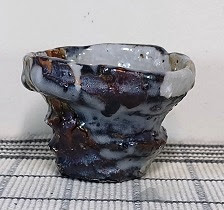
Light gray clay from Shigaraki. A few splashes of dark brown glaze on the exterior and interior; otherwise fired unglazed, with kiln effects: hi-iro in coral colors; natural ash glazing in white spots and green glass-like bidoro deposits. Weight:  156 g (5.6 oz). Height: 5.4 cm (2-1/8 in). Widths: rim, 9.2 x 7.9 cm (3-5/8 x 3-1/8 in); base, 3.7 x 3.4 cm (1-1/2 x 1-3/8 in). Capacity: 82 ml (3.7 fl oz). 

This is similar in shape to item no. 234, but slightly smaller. Like item no. 235, it was hand-built using overlapping flat ribbons of clay. Any given cross-section is an oval, although there are many bimps and dents. It sits on a flat base, an irregular oval. The interior of the base is indented, perhaps by the tip of the artist’s thumb (mine fits comfortably in the dent). The walls flare outward from the base to the rim, with many ridges where the edges of the ribbons were joined. On one side of the piece is the artist’s sigil (see item no. 235 for a description), a long curved line with a short bar at the top and two lines off to the right side at the lower end of the long line. The shape of the interior mirrors that of the exterior, but the joins between the ribbons of clay are smoother and less pronounced. Given the rough modeling of the piece, the surface is quite smooth. 

Except for a few splashes of a dark brown glaze on the interior and exterior walls, this was fired unglazed. The exterior and the upper parts of the interior are dotted with the white beads sometimes referred to as shiseki 歯石 (tartar), the results of natural ash glazing. The interior has several patches of green glass-like bidoro drips. The portions of the walls not covered with brown glaze or affected by the natural ash glazing show hi-iro colors in the coral range. The natural clay color shows through only on the flat, oval base. 

This came in a wooden box inscribed by the artist in two lines: 酒呑 / たくま sake-nomi / takuma (sake cup / Takuma), followed by a seal bearing the characters for his given name stamped in red. As is his wont, Murakoshi began the inscription on the top of the box (actually on the back edge of the lid) and continued down the front of the box. Included in the box are a small printed leaflet (in Japanese and English) and a brown wrapping cloth. 

Purchased from the Kura Monzen Gallery in Kyoto in October 2024, who received it directly from the potter in summer 2024. This was part of an exhibit entitled Shōka 昇華  (“sublime”), or Modern Masters in English, a show of fifteen currently active potters (invoice and shipping and customs documents).


Saturday, September 7, 2024

259. ŌIWA Tomoyuki. 1977- . black Bizen-ware drinking cup

 259. ŌIWA Tomoyuki 大岩智之. 1977- . Kuro guinomi 黒ぐい呑   (black [Bizen-ware] drinking cup)


Ōiwa Tomoyuki was born in Kobe, Hyogo prefecture, in 1977, and graduated from the Bizen Ceramic Center in 2004. The following year he became a student of the outsider Kakurezaki Ryūichi 隠崎隆一, with whom he would remain for eight years before going independent. In 2014 he built a half-submerged tunnel kiln (anagama), completing his first firing in 2015. He has since been featured widely and is known for his sake vessels. 

Glazed in dun brown and black. Weight: 158 g (5.6 oz). Height: 5.4 cm (2-1/8 in). Widths: mouth, 5.4 cm (2-1/8 in), widest, 6 cm (2-5/8 in); base, 5 cm (2 in). 

Any given horizontal cross-section of  this is roughly circular. The cup sits on a flat irregular foot ring. Before trimming, the base was probably completely flat. The inside of the base has been gouged out in a rough yin-ying pattern. The foot ring is level, and the cup rests stably on it. This came with a small white sticker with the number 11 on it attached to the base. Above the base the walls rise outward at about a 45-degree angle, to the widest point of the piece, about a centimeter (3/8 in) above the base. From the widest point to the mouth, the walls gradually sloped inward. There are wide, shallow horizontal grooves encircling the cup in this section. The mouth is generally even but has two small dips in it. There are tiny remnants of the three posts used to hold the piece away from the kiln shelves on the black side of the piece. The interior generally mirrors the exterior. The surface of the piece is smooth throughout and has the slight stickiness of a glazed work. 

The bottom, most of the interior, and half of the wall area were glazed in black. The other half of the walls and the lips of the mouth were glazed in a dun brown, which was allowed to drip into the black area of the walls along the horizontal grooves. Where the brown glaze thins out over the black glaze, it turned a light blue color. 

This came in a wooden box, inscribed by the artist in three lines: 黒 /ぐい呑 / sigil (black / small drinking cup //sigil), followed by the artist’s seal stampeed in red. Ōiwa’s sigil is indecipherable but appears to be the characters in his surname. Included in the box were a gray wrapping cloth and a small printed card with the artist’s potted biography. 

Purchased from the Kura Monzen Gallery in Kyoto in September 2024, who purchased it directly from the potter in June 2023 (invoice and shipping documents).


Sunday, April 7, 2024

246. MURAKOSHI Takuma, 1954- , guinomi

246. MURAKOSHI Takuma  村越琢磨, 1954- ,  Shunjū sake-nomi 春秋酒呑 (colorful sake cup)


For Murakoshi, see item no. 234. 

Light gray clay, with glazes in white, blue, black, and a dark reddish brown; a few spots on both the external and the internal walls are unglazed with kiln effects in light pink (much like the color on the mizusashi by Murakoshi (item no. 235) and a pool of vitrified green-glass-like deposit in the bowl of the cup. Weight: 276 g (10 oz). Height: 6.7 cm (2-5/8 in). Widths: rim, 8.7 x 7.8 cm (3-1/2 x 3-1/8 in), base, 5 cm (2 in). Capacity: 90 ml (6 tablespoons, or 3/8 cup). 

This was formed by hand in Murakoshi’s crude, chunky style. It sits on a flat, circular base. The remains of the three posts used to separate the piece from the kiln shelf are visible. The center of the base was pushed in to form a cavity about 1.3 cm (1/2 in) deep. The walls were formed into a pedestal that slopes upward and outward before flaring out into the bowl of the drinking cup, starting about 3.7 cm (1-1/2 in) above the base. The pedestal area consists of deep grooves bordered by sharp ridges; the pedestal is roughly circular in cross-section. The bowl is an oval. The interior of the bowl is about 4 cm (1-5.8 in) deep. The surface of the piece is smooth and glossy with a few sharp spots. 

Murakoshi makes many pieces, especially those used for eating and drinking, with this style of decoration, which he labels shunjū; this translates literally as “spring and autumn,” but here means something more like “colorful.”  It features a creamy white base, with splashes of blue and black and sometimes a dark brownish red. The glazes are made with iron, feldspar, and sawtooth oak (kunugi) ash. The iron creates the dark red glaze; the feldspar alone a thick white glaze; and the oak ash comibed with feldspar the blue/light green glaze. The glazes on this particular piece exhibit more carbon capture than on other pieces with the same decoration scheme (at least to judge from the pictures), and hence the colors are somewhat darker and more muted in tone. This piece also has a nice pool of the vitrified, green-glass-like bidoro at the bottom of the bowl that occurs when the ash deposits melt during the firing. This vitrified green-glass deposit may be the result of shizuku 雫, a natural, unplanned, and unpredictable kiln event when built-up ash, usually on the ceiling of the kiln or on the underside of a kiln shelf, melts and falls onto a piece, creating a droplet or drip.

This fits nicely in the hand—the grooves and ridges in the pedestal area create comfortable areas for the fingers to hold this piece. The chaos of the decoration matches the chaos of the shape. 

This came in a wooden box inscribed by Murakoshi in his distinctive calligraphy. As is his wont, the inscription begins on top of the box and continues down the front side. The inscription, in three lines, reads 春秋 / 酒呑 /たくま shunjū / sake-nomi / Takuma (colorful / drinking cup / Takuma). The top is stamped in red with a seal with Murakoshi’s studio name: へうげも屋  (Hyōgemono-ya, “Jocular Fellow Studio”). He uses the kyūkanazukai, or old kana usage, to write hyō. Hyōgemono is also the name of a popular manga character. On the side of the box is another seal stamped in red, giving Takuma in characters, 琢磨. Included in the box were a brown wrapping cloth and a printed leaflet from Murakoshi. 

A gift from the Kura Monzen Gallery in Kyoto, Japan, in March 2024 (customs and shipping documents)

Monday, January 30, 2023

200. HAMADA Junri, 1948-2022, black Oribe guinomi

200. HAMADA Junri  浜田純理, 1948-2022, black Oribe guinomi


Hamada’s studio name is Rojin  露人.  In 1981, he opened the Chuma-gama kiln in Tsururi, Gifu prefecture. He produced mainly tableware in the Kiseto and Oribe styles of Mino pottery.

Reddish-brown clay. Glazed in white and black, with dark red colors showing through on the unglazed spots. Weight: 136 g (5 oz). Height: 5.3 cm (2-1/8 in). Diameter of rim: 5.7 cm (2-1/4 in); of foot ring, 4.4 cm (1-3/4 in); maximum: 6.4 cm (2-1/2 in); minimum: 5.2 cm (2 in). Capacity: 80 ml (3 fl oz).

This sits on the roughly circular foot ring. The foot ring is 0.6 cm (1/4 in) high on the outside. The inside has been hollowed; the hollow is deepest just inside the ring, with a gentle mound toward the center. Above the foot ring, the walls move outward and upward at a shallow obtuse angle (110 degrees) in a straight line to a height of 1.3 cm (1/2 in) to reach the maximum width of the cup. Above this they move inward in a shallow arc to the minimum width 3.7 cm (1-1/2 in) above the base. Above this waist the walls continue upward in another shallow arc to the rim.  The exterior is ringed by shallow horizontal grooves and has many dents and bumps. The surface is fairly smooth. The interior walls do not mirror the exterior shape. They are fairly vertical, and there is a shallow bowl at the bottom. The interior walls are very smooth.

Wood-fired, using white and black Oribe glazes, with a fine luster all over from the ash glazing.

This came with a box. Inscribed on the lid in two columns in the upper right-hand corner are  黒織部 (black Oribe) and ぐい呑  (guinomi). In the lower right-hand corner, written over the artist’s red seal are the characters 露人 (Rojin, the artist’s studio name). The box includes an orange cloth and a short printed biography.

Judging from the online pictures of Hamada’s works, his output was typical of many working Japanese potters. The biography given above was taken from an online listing of Japanese potters; I’m guessing that “tableware” is a translation of the Japanese utsuwa, a catchall term for dishes and cooking vessels as well as other items used in preparing and eating food. Like most Japanese tableware meant for daily use, this fits well in the hand.

Purchased from Art on the Table, a company in Seattle specializing in Japanese products, in November 2022.


Sunday, September 12, 2021

150. Joseph Bounds, guinomi

150. Joseph Bounds,  guinomi


For Bounds, see item 149.

Light tan clay. Dark blue, tan, and white glazes; base left unglazed. Weight: 124 g (4.5 oz). Rim and maximum diameter: 5.4–5.7 cm (2-1/8–2-1/4 in). foot ring diameter: 3.2–3.6 cm (1-1/4–1-3/8 in). Height: 5.4 cm (2-1/8 in).

This appears to be a pinch pot. It sits on the base of the foot ring, which is a rough oval, about 0.3 cm (1/8 in) high on the outside wall and about half that distance on the inside. Above the foot ring, the walls slant outward at about a 45-degree angle to a height of 1.3 cm (1/2 in) and then continue upward in more or less a straight line to the rim. The exterior walls are very bumpy and gouged. The interior is quite smooth.

It appears that, with the exception of the foot ring and base, the cup was coated with a yellowish-brown slip or glaze; then a white (ash?) glaze was brushed over the exterior. A dark blue glaze was then applied to the interior and a narrow band at the top of the exterior and allowed to run down the exterior on one side.

Purchased from the artist in September 2021.

Thursday, September 2, 2021

146. Jason Edmonds, wood-fired tokkuri with two guinomi

146. Jason Edmonds, wood-fired tokkuri with two guinomi


Edmonds is a potter and ceramics teacher in Davis, California. His studio is called “of the dirt pottery.”  More of his work can be seen on his Instagram account @of­_the_dirt.

Dark chocolate clay, interior of tokkuri glazed; exterior colors from wood firing and clay. Tokkuri. Weight: 526 g (1.2 lb). Rim diameter: 3.5 cm (1-3/8 in); maximum diameter: 10 cm (4 in); base diameter: 6.3–7.0 cm (2-1/2 – 2-3/4 in). Height: 13.5 cm (5-3/8 in). Guinomi (each). Weight: 130 g (4.6 oz). Rim diameter: 4.7–5.3 cm (1-7/8 – 2-1/8 in); foot ring diameter: 3.3 cm (1-1/4 in). Height: 6 cm (2-3/8 in).

The tokkuri sits directly on the flat base, which has an irregular shape. The walls rise in a convex arc to the neck which begins 10 cm (4 in) above the base and is 3.3 cm (1-1/4 in) in diameter at that point. The walls reach the maximum diameter 5.7 cm (2-1/4 in) above the base. The neck is a shallow concave arc to the lip. This appears to have been thrown on a wheel.  There are four slightly irregular and angled vertical columns spaced more or less equally around the exterior, each about 0.6 cm (1/4 in) wide, creating four spaces. The clay in these spaces was cut out to varying depths, leaving ridges and flat areas of different sizes. The exterior is rough and unfinished. The guinomi appear to be thumb pots. Each has an irregular foot ring, 0.6–1.0 cm high on the exterior; the interiors have been hollowed out to a similar depth. The interiors are relatively smooth; the exteriors have been cut and gouged in the same way as the tokkuri.

The interior of the tokkkuri is glazed, presumably to make it waterproof. The colors come from the clay and the wood-firing. One area on the exterior of the tokkuri is a dark reddish-brown from the wood-firing; the rest is a dark brown color. One of guinomi has a shiny ash deposit on part of the foot ring.

This is brutalism in action; these very much illustrate the nature of the clay. When I unwrapped these, there was even a strong smell of mud. Although the inside of the tokkuri was glazed to make it waterproof, the surface of the guinomi is so rough that drinking from them would endanger the lips.

Purchased from the artist in August 2021.


Pottery

Looking for suggestions

I need to dispose of my collection. I've tried to donate it to several local museums or schools with ceramics programs, but no one wants...