Showing posts with label tsubo. Show all posts

Monday, September 30, 2024

262. FUJIMOTO Hide , 1954- , Shigaraki-ware collapsed pot

262.   FUJIMOTO Hide  藤本 秀,  1954- , Shigaraki kuzureta tsubo 信楽崩壺  (Shigaraki-ware collapsed pot)


For Fujimoto, see item no. 250. 

Light gray clay, with addition of many small white pebbles (quartz or feldspar). This was fired unglazed. The surface decoration results from kiln effects—ash deposits, natural ash glazing, hi-iro (fire colors), and vitrification, with patches and drops of bidoro green glass-like glazing. Weight: 2.2 kg (4.9 lb). Height: 13.8 cm (5-1/2 in). Widths: rim, 12 cm (4-3/4 in); widest, 22.5 cm (8-3/4 in); base, 14.8 cm (5-7/8 in). 

This sits on a flat base. The remnants of the five posts used to separate the piece from the kiln shelf during firing are visible on the base. The base is scored with many striations and much pitted. From the base the walls rise in a convex arc to the widest point, 7.6 cm (3 in) above the base. The piece collapsed above this point, more on one side (arbitrarily the front side), causing the mouth to sag downward on this side. The back side didn’t sag as much. It appears that this was to be a wide, relatively low jug. On the back side, there is an irregular hole surround by the remnants of a circular structure. To one side of this is another remnant, which appears to be a broken off protrusion of some sort. These may perhaps be remnants of a spout or a handle of some sort.  The mouth is wide and surrounded by a beveled rim. The surface of the pot is rough and broken. In one place on the back part, the surface fell off after firing, leaving the clay body exposed. 

This was fired unglazed. The back side has a dark gray ash deposit between the two remnants mention in the preceding paragraph. The upper part of the pot is covered with natural ash glazing, vitrified in places and with some bidoro green glass-like patches and a few tambo no me (green glass-like teardrops) running down the side. The lower half exhibits hi-iro in colors ranging from light red to mahogany. There are patches of vitrified cream-colored natural ash glazing on the base near the outside edge; most of the base has hi-iro colors in light red. 

This came in a wooden box, inscribed by the artist in three lines: 信楽 / 崩壺 / 藤本 秀  Shigaraki  / kuzureta tsubo / Fujimoto Hide (Shigaraki[-ware] / collapsed jug / Fujimoto Hide), with the artist’s seal stamped in red. Included in the box were a business card (meishi) and a short printed biography. 

The seller told me that the pot collapsed during firing and that Fujimoto viewed it as work of art resulting from a collaboration between nature and ceramics. The result is appealing and intriguing, and it’s understandable that Fujimoto would preserve this rather than toss it on the scrap heap. Sometimes the unexpected happens when pots are fired, and the accidents can be serendipitous. 

Purchased from the Kura Monzen Gallery in Kyoto in September 2024, who received it directly from the potter in summer 2024. This was part of an exhibit entitled Shōka 昇華  (“sublime”), or Modern Masters in English, a show of fifteen currently active potters (invoice and shipping and customs documents).


261. FUJIMOTO Hide, 1954- , Shigaraki-ware “crouching” vase

 261. FUJIMOTO Hide  藤本 秀,  1954- , Shigaraki uzukumaru [tsubo] 信楽蹲[壺]  (Shigaraki-ware “crouching” vase)


For Fujimoto, see item no. 250. 

The designation of this as a tsubo follows the usage for similar uzukumaru pots. For another example, see item no. 218, 

To judge from other examples of uzukumaru pots online, the term is reserved for a style of pots made in Shigaraki. They are roughly circular in cross-section. From a broad, flat base, the walls rise outwards in a more or less straight line to the widest diameter at the high shoulders. From there, the walls curve inward rapidly to a small, short vertical neck surmounted by jutting horizontal lips with beveled edges. 

Light gray clay. Fired unglazed, with heavy kiln effects--ash deposits in deep black, hi-iro (fire colors) in light red, melted ash glaze in a creamy brown, with some vitrification and bidoro green glass-like deposits and drips. Weight: 1.9 kg (4.3 lb). Height: 19 cm (7-1/2 in). Widths: rim, 8.2 cm (3-1/4 in); widest, 16.4 cm (6-1/2 in); base, 12 cm (4-3/4 in). 

This sits on the flat circular base. The remnants of the four posts used to separate the piece from the kiln shelf during firing are visible on the base. The body is roughly circular but with many shallow dents and bulges. The widest point occurs at the shoulders, 11.3 cm (4-1/2 in) above the base. The walls then curve inward to the neck, which is 16 cm (6-3/8 in) above the base and 5.7 cm (2-1/4 in) in diameter. The lip juts outward above the neck, Both the lower and the upper surfaces are beveled. Two lines scratched into the clay undulate around the vase, one positioned slightly below the shoulders and one above. The lines range from 2.5 to 5 cm (1-2 in) apart. A series of X’s was inscribed within these lines. Some of the lines in the X’s rise above the upper line. This is known as the “cypress fence pattern”  檜垣文  higakimon. The interior of the piece mirrors the exterior. The surface is rough and crusted. 

This was fired unglazed. One side (arbitrarily the back side) was covered with a heavy layer of ash, leaving a dark matte black surface, much pitted and very irregular. This layer is so thick that it largely obscures the undulating lines and X’s in this area. The portions of the exterior walls beside the neck on this side show some reddish-brown hi-iro. The front side, particularly the upper portions, were covered with a natural ash glazing, which ran down the front side to the base, leaving some portions uncovered and again showing hi-iro colors. The neck, rim, and mouth of the piece are also covered with natural ash glazing in the creamy brown color. Some areas of the natural ash glazing shows vitrification. Unusually the base is also encrusted with ash deposits and has one tambo no me bead of green glass-like melted ash glazing. This must have been fired near the front of the kiln and received a full blast of ash deposits and heat. 

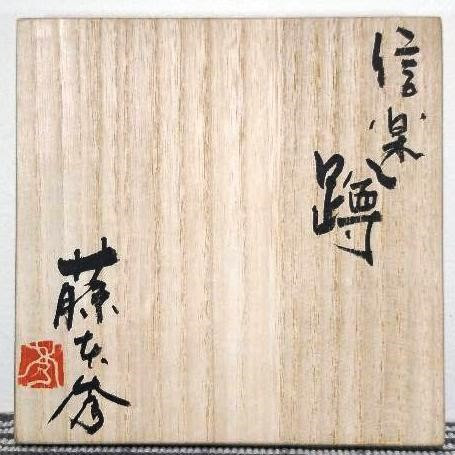
This came in a wooden box inscribed by Fujimoto in three lines: 信楽 / 蹲 / 藤本 秀 Shigaraki / uzukumaru / Fujimoto Hide (Shigaraki / crouching / Fujimoto Hide), followed by the artist’s seal stamped in red. Included in the box was a short printed biography of the artist. 

I found a picture of a Muromachi-period Shigaraki "crouching" tsubo that has a similar decorative scheme of two lines running around the shoulders with a pattern of X's inscribed between them. The decoration on that piece is more regular, however, and the kiln effects are much more limited (chiefly hi-iro with some golden fly ash). See Samuel J. Lurie and Beatrice L. Chang, Fired with Passion: Contemporary Japanese Ceramics (2006), p. 110, fig. 82. 

Purchased from the Kura Monzen Gallery in Kyoto in September 2024, who received it directly from the potter in summer 2024. This was part of an exhibit entitled Shōka 昇華  (“sublime”), or Modern Masters in English, a show of fifteen currently active potters (invoice and shipping and customs documents).


Sunday, April 14, 2024

247. KIM Hono, 1958­- , tsubo

247. KIM Hono 金憲鎬 김헌호, 1958­- , tsubo 地球のためいき  “Chikyū no tameiki” (jug, “The Earth Sighs”)


Kim was born in 1958 in Seto City in Aichi Prefecture. He graduated from the Prefectural Ceramics School in 1977 and became an apprentice at a local kiln before establishing himself as an independent artist in 1982. He held his first solo exhibition in Nagoya in 1985. He has been exhibited at the Nihon Tōgeiten National Ceramics Exhibition, National Traditional Crafts Exhibition, Asahi Tōgeiten Exhibition, and Chūnichi Kokusai Tōgeiten, and his works have been shown in some of Japan's top galleries.  Hohnoho Magazine, a leading Japanese magazine on ceramics, once profiled fifty of the country’s emerging ceramicists and asked them to define their work. Most of the respondents wrote a few paragraphs. Kim cryptically replied only: kaze wo kanjiru koto (feeling the wind). 

Light tan clay. The interior has a patch of aquamarine glaze; the exterior is unglazed with mottled shades of tan and brown. Height: 42 cm (16-1/4 in): width: 40 x 34 cm (16 x 13-1/2 in). 

This sits on a flattish, roughly circular base. The artist’s name is written on the base in cursive roman script, “Kim Hono.” The walls are roughly a centimeter (3/8 in) thick. The pot is globular, with longer dimensions from right to left. Part of the clay was torn away to form a rectangular opening in the front. At the top end of the opening an irregular flap of clay was tilted upwards. 

The clay body is rough and unfinished; The surface is cracked and pitted. The pot emphasizes its origins as clay, muddy, coarse. It does, however, ping musically when tapped. 

This was unglazed, except for a patch of much cracked, glassy aquamarine glaze on one wall of the interior. The mottled surface probably results from a lighter colored slip.

This came in a box with a brown wrapping cloth. On the front of the box Kim drew a picture of the pot in rough outline, with a lotus seedpod on a long stem extending from the interior of the piece up and across the top of the box. He inscribed the top and the left side of the box in three lines: 地球の / ためいき / 김헌호 chikyū no / tameiki /kim heonho (the earth / sighs / Kim Heonho).  He wrote his name in the Korean hangul script, with the symbols for Kim in the upper right-hand corner of the left side of the box and continuing in a horizontal line with his given name in the lower left-hand corner of the lid of the box. To judge from other examples of his work online, this is how he decorates his tomobako. Given both the Chinese characters and the hangul, his given name in Japanese is read “hon-o.” 

Purchased from the Kura Monzen Gallery in Kyoto, Japan, in April 2024 (invoice, customs and shipping documents) 


Saturday, May 1, 2021

4. ŌTA Tomio 太田富夫 , 1949- , Bizen tsubo (Bizen-ware jug)

4. ŌTA Tomio 太田富夫,1949- , Bizen tsubo (Bizen-ware jug), 1989


Ōta Tomio is a potter working in Oku-cho Town, Okayama Prefecture. He apprenticed at the Prefectural Ceramic Arts Center and studied under Uragami Zenji. In 1973, he built his own kiln. In 1976, he built a noborigama (climbing) kiln, the Wakamiya-gama  若宮窯, named after a local shrine deity.  In 1981, he enlarged the capacity of the kiln to be capable of holding 3,000 pieces. His works have been selected for prefectural exhibitions and for the Traditional Craft Association’s  Chūgoku Branch exhibitions. He received the Genga-kai Honorable Mention award and the Bi-gei-kai Sanyo Newspaper award.

Brown clay; unglazed, colors from wood firing. Weight: 1722 g (3.8 lb). Rim diameter: 7 cm (2-7/8 in); base diameter: 10 cm (3-3/4 in); maximum diameter: 15 cm (6-1/4 in). Height: 25 cm (8-1/2 in). 

Bizen-ware (Japanese 備前焼, Bizenyaki) is made in Okayama Prefecture, which borders the Inland Sea, west of Osaka. Bizen-ware is characterized by significant hardness due to high-temperature firing, an earthen-like, reddish-brown color, an absence of glaze (although the firing may result in natural ash glazing), and markings resulting from wood-burning kiln firing. The clay is sticky and fine, with a high iron content and copious organic matter that makes it poor for glazing. The high strength of the clay, however, causes it to retain its form, making it tough even without glaze. Because of the clay composition, Bizen-wares are fired slowly over 10–14 days using red pine. The finish is determined by how the potter controls the fire. If less firewood is used, the flame will become oxidizing, turning the vessels reddish brown. The molten ash also creates the sprinkles of yellow called goma, or "sesame seed," effects, seen on this pot.

The potter’s mark is incised on the bottom of the pot. The mark is Ōta’s kao 花押 sigil, a highly stylized character used by practitioners of the tea ceremony.

This came in a wooden box, with characters in black ink and a red seal stamp on the lid. The two characters on the upper right of the lid are a highly calligraphic rendering of Bizen. Next to this is the character 壷. (tsubo, jug). In the lower left corner, the long line of characters on the right gives the date June 11, 1989, in Japanese style using the then-emperor’s reign name: 平成元年六月十一日. The line on the left has the potter’s kao sigil. This is followed by the character 作 saku, meaning “made.” Below this is the character Tomi 富 in an archaic style stamped in red by a seal. Included in the box were an orange wrapping cloth, with the kao sigil and the character 作 written in ink and the potter’s stamp in red, and a leaflet with the artist’s biography and a short essay on Bizen-ware.

I received this as a gift. It was purchased in Japan. 


Pottery

Looking for suggestions

I need to dispose of my collection. I've tried to donate it to several local museums or schools with ceramics programs, but no one wants...