Showing posts with label vase. Show all posts

Friday, January 17, 2025

268. KUMAKURA Junkichi ,1920-1985, Irabo tsubo (pot with Irabo glaze)

 268.  KUMAKURA Junkichi 熊倉順吉, 1920-1985, Irabo tsubo  伊羅保壺  (pot with Irabo glaze)


Kumakura was a major figure in the world of Japanese sculptural ceramics. He was born in 1920 in Kyoto and graduated in 1942 from the Kyoto Institute of Technology as a design major. From 1946 to 1947, Kumakura was an assistant to Tomimoto Kenkichi (1886-1963) at the Shōsai Tōen kiln, where he was greatly influenced by Tomimoto’s techniques and his concept of the role of ceramist-artist. Throughout his career, Kumakura was attracted to and inspired by the improvisational character of jazz and its then-marginalized position in the world of music. Equally unusually for the period, much of his work is boldly and explicitly focused on sexuality and eroticism.  

He was awarded the first Japan Ceramic Society Prize in 1954 and soon thereafter he was invited to submit works to innumerable national and international exhibitions including the Brussels World Exposition in 1958, where he took the grand prize, and the International Ceramics Exhibition in Prague in 1962, where he took the silver prize. In 1989 a major retrospective exhibition, Kumakura Junkichi: Organs That Provoke, was held at the National Museum of Modern Art, Tokyo. His works are part of the permanent collections of the Japanese National Museum of Modern Art and the National Museum of Modern Art, Kyoto. 

In the late 1940s, Kumakura became a core member of the avant-garde Sōdeisha 走泥社 (Crawling Through Mud Association; for more on this group of ceramicists, see the Wikipedia article, s.v. Sodeisha). Core to his practice were the aesthetic tenets of Sōdeisha that sought to elevate the status of the nonfunctional clay object. The beginnings of this philosophical exploration are manifested in his frequent use of two-dimensional geometric compositions on the flat surfaces of his functional wares. Early in his career, he used molds, a practice learned from Hamada Shōji and the folk arts movement. Later, his work became boldly sculptural. Kumakura was a pioneer of sculptural and avant-garde ceramics, which became a formal category in Japanese ceramics during the mid-twentieth century. His interest in sculptural, figurative, and organic forms bled into his functional wares, with their geometric and abstract shapes. 

White clay. Irabo glaze in muddy yellow and brown shades on all sides; bottom left unglazed. Weight: 840 g (1.9 lb). Height: 18.3 cm (7-1/4 in). Diameter of mouth: 2.5 cm (1 in). Dimensions of base: 20 x 11.7 cm (7-7/8 x 4-5/8 in). 

This is classed as an ichirin-sashi  一輪挿 , a vase for one flower. The piece rests on the flat margins of the base. The base is an oblong with pointed ends, slightly concave in the middle. Next to one of the pointed ends, Kumakura stamped a small square version of his seal, consisting of the first character of his given name, 順 jun. The edges of the base are slightly beveled upward. Above the base the walls form a shallow convex arc, moving upward and inward to the neck, which begins about 14.5 cm (5-3/4 in) above the base. The long neck is about 3.3 cm (1-1/4 in) wide at the bottom and slants inward slightly as it rises to the mouth, which is 2.5 cm (1 in) in diameter. There are pronounced seams where the front and back are joined, beginning at the pointed ends of the base and continuing to the mouth.  The surface of the piece is bumpy. The main body of the work is quite symmetrical; the neck less so. 

The sides of this were glazed using the Irabo glaze, resulting in colors in the brownish yellow to dark brown range. Irabo is one of the traditional ash glazes of Japan. According to one source, the glaze is made by combining equal parts of wood ash and an iron-rich clay such as ochre. Other sources say it made by combining equal parts of washed wood ash and feldspar. In an oxidizing firing using the second formula, this produces a yellow-brown glaze; in a reduction firing, the colors range from olive to a deep blue-green. The base, including the beveled edges, was left unglazed. The unglazed beveled edges present as a visible line of white at the bottom of the piece. 

For Kumakura, this is a relatively staid composition. For other examples of his work, see Figs. 49-53 in Samuel J. Lurie and Beatrice L. Chang, Contemporary Japanese Ceramics: Fired with Passion (New York, 2006). 

This came in a wooden box, inscribed by Kumakura in three lines: 伊羅保  / 壺  / 熊倉順  Irabo / tsubo / Kumakura Jun  (Irabo[-glazed] / pot / Kumakura Jun), followed by the artist’s seal stamped in red (a larger version of the same seal stamped on the base of the pot). A small paper label with the handwritten number 117 is affixed to one side of the box. Included in the box was a short biography; the last year noted is 1970, which dates this piece between 1970 and 1985. 

Purchased from the Kura Monzen Gallery, Kyoto, Japan, in January 2025 (invoice, shipping and customs documents)

Sunday, October 13, 2024

263. FUJIMOTO Hide 1954- , Shigaraki-ware pillar vase

263.  FUJIMOTO Hide  藤本秀,  1954- , Shigaraki tagui-enchū  信楽 類円柱  (Shigaraki-ware pillar [vase])


For Fujimoto, see item no. 250.  Fujimoto often finds inspiration in building materials (see also no. 250). Here the piece is shaped after a central pillar with notched holes near the top for holding the ends of a series of radiating support beams. 

Light gray Shigaraki clay, fired unglazed, with kiln effects, including hi-iro in red colors, natural ash glazing, with vitrification and bidoro, light gray with a greenish tint; ash deposits in dark gray to black. Weight: 3.5 kg (7-3/4 lb). Height: 24 cm (9-7/8 in). Diameter: 15.3 cm (6 in). 

This sits on a flat base, about 2 cm (3/4 in) thick. The remnants of the three posts used to separate the piece from the kiln shelf during firing are visible on the base. In shape this is a cylinder, roughly the same diameter throughout. There is an upward sloping ridge on the back side beginning at the base and extending upwards for about half the height. There are six windows near the top, each around 4.5 cm (1-3/4 in) square. The top and bottom sides of each square are level; the right and left sides angle inward. The lower edge of each square begins 17.8 cm (7 in) above the base. Within these windows, the flat surface moves inward toward a vertical, circular central wall 3.2 cm (1-1/4 in) high and 5.8 cm (2-1/4 in) in diameter. The top is a flat disk 1.5 cm (5/8 in) thick, with a central hole 5.8 cm (2-1/4 in) wide. There is a space of approximately 0.6 cm (1/4 in) between the inner central wall and the flat disk at the top, leaving the area within the windows open. The shape of the interior mirrors that of the exterior. The surface of this is quite rough. 

This was fired unglazed. The top and one side (arbitrarily designated the front) have a thick layer of vitrified natural ash glazing, with many small patches of green, glass-like bidoro deposits, light gray in color with a strong greenish tint. The upper part of the back side, to just below the square openings has a similar coating of natural ash glazing. Below this is a heavy layer of ash deposits, colored dark gray to black. The base has areas of vitrification across most of the surface, with a patch of hi-iro colors in light red. The original clay shows through in the areas of the base where the wads were placed during firing. The interior is hard to see but appears to have a good coating of natural ash glazing on the bottom and along the lower sides. 

This came in a wooden box inscribed by the artist in three lines: 信楽 / 類円柱 /  藤本秀  Shigaraki / tagui-enchū  / Fujimoto Hide (Shigaraki[-ware vase] resembling a pillar), followed by the artist’s seal stamped in red. 

Purchased from the Kura Monzen Gallery in Kyoto in October 2024, who received it directly from the potter in summer 2024. This was part of an exhibit entitled Shōka 昇華  (“sublime”), or Modern Masters in English, a show of fifteen currently active potters (invoice and shipping and customs documents).


Thursday, July 18, 2024

257. SAKATA Keizō, 1949-2004, Hagi-ware bamboo-shaped vase

257.  SAKATA Keizō 坂田慶造  (十五代 坂田泥華 Sakata Deika XV), 1949-2004. Hagi XXha take hanaire  萩XX破竹花入 (Hagi-ware broken bamboo-shaped vase)


The Sakata family is one of the ancient lineages of Hagi-ware potters. Keizō was the son of Sakata Deika XIV (1915-2010). After graduating from university, he studied sculpture and spent some time traveling in the United States before beginning work at the family kiln. This exposure outside the traditional world of Hagi-ware pottery is sometimes cited as setting him apart from other local potters. In 1978, he received an award at the First Exhibition of New Traditional Crafts (Dentō Kōgei Shinsaku Ten). In 1989, he became a member of the Japan Kōgei Association and exhibited with that organization, garnering a number of prizes as well as receiving awards at the Japan Traditional Crafts Exhibition (Dentō Kōgei Ten) and the Grand Prize at the Tanabe Museum Ceramics of Tea Exhibition. He was expected to make great advances as the next Sakata Deika but died in 2004 at the age of 54. He was posthumously named the 15th generation Sakata Deika. A brother is now Sakata Deika XVI. 

Gray clay, visible only on the bottom half of the interior. The color of the glaze is hard to pin down. In sunlight the exterior is a milky coffee color; in artificial light, it acquires a greenish hue. The glaze on the interior is whiter, with a bluish cast in some lights. Only the upper half or so of the interior was glazed. The base and a small patch at the bottom of the back side were left unglazed and show kiln-effect colors in a reddish tan and a dark red. Weight: 4.4 kg (9.7 lb). Height: 33.3 cm (13 in). Width: top. 12 cm (4-3/4 in); widest: 13.5 cm (5-1/4 in); base: 11.5 x 10.5 cm (4-1/2 x 4-1/8 in). 

The vase is shaped to resemble one of the dilapidated bamboo vases that often hang on the walls or pillars of a tea ceremony hut. It sits on a flat, eight-sided base, a rough rectangle with angled corners. The artist’s mark, the character 慶, was incised into the base with shallow lines (on the lower left in the next to last picture). Comparison of the interior depth with the exterior walls shows that the base is about 1.3 cm (1/2 in) thick. The walls rise in irregular vertical slabs from each side of the base. The front (the side with the torn away section and the bamboo leaves) is more rounded than the back. The piece as a whole tilts backward slightly. A deep, rough gouge encircles the piece about 7 cm (2-3/4 in) above the vase. The widest point of the vase occurs at this point. The gouge is meant to mimic the joint between two sections of bamboo. On the front side, just above this horizontal gouge, Sakata made two bamboo-leaf shaped gouges. The clay surrounding these gouges was forced to the side to create jagged lines defining them. No apparent attempt was made to trim away the excess. Another notable feature of the piece is the rough, almost violent tearing away of a section of the front of the pot to suggest a portion of the bamboo wall that was ripped off. The margins of this opening are very rough and irregular. The walls themselves are quite thick, measuring from 2.5 to 3.0 cm (1 to 1-3/16 in) at the top. The clay is so thick that several shallow, vertical fissures opened up on the interior walls while the piece was drying/ The interior is roughly circular in cross-section. The surface is smoothest over the most heavily glazed sections. Elsewhere it is quite bumpy and rough. 

Glazed in a milky coffee color over most of the exterior surfaces. The glaze covers the surface unevenly. Most sections received only a light coating, allowing the clay beneath to show through as darker patches. The glaze is thickest and most uniform over the smoother panels, in the areas with a more textured surface, it is more broken, exposing the clay beneath. On the interior, the glaze is a bluish white, again with many darker streaks showing through. 

This came in a wooden box, inscribed by the artist in two lines:  萩XX破竹花入  / 坂田慶造  Hagi XX ha take hanaire / Sakata Keizō (Hagi-ware broken bamboo-[shaped] vase / Sakata Keizō), followed by Sakata’s seal stamped in red. There are two characters in the line on the right that I cannot read, but from their position, they must modify “bamboo” and probably characterize the design of the vase. Included in the box was a leaflet with a potted biography of the artist. 

Purchased from Kura Monzen Gallery in Kyoto, Japan, July 2024 (invoice, shipping and customs documents).

Thursday, June 6, 2024

251. ATARASHI Manabu, 1973- , Iga-ware hanging vase

251.  ATARASHI Manabu 新学, 1973-  , Iga kakehanaire  伊賀掛花入  (Iga-ware hanging vase)


For Atarashi, see item no. 222.  To quote Robert Mangold, the owner of the gallery that sold this piece, “Intensely fired multiple times to achieve the bidoro glass puddles and landscape effects which define his aesthetic, the geometric works add a contemporary sensibility to the traditional Iga style and transcend the realm of utilitarian crafts breaking into the sculptural domain. His work has proven innovative and challenging to the norm, taking his father’s tradition into the 21st century." 

Light gray clay, with many very small feldspar pebbles. Fired unglazed. Surface colors and effects in the gray to black range, with patches of dark reddish brown hi-iro 火色. A few spots of vitrified ash glaze. Weight: 1260 g (2.8 lb). Height: 36.5 cm (14-1/4 in). Width: 12.5 cm (4-7/8 in). 

This is roughly triangular in cross-section. The back is flatter in the center and nearer the top, with the edges curving to meet the side seams. The front side is bisected by a rough, irregular spine running vertically slightly left of center. To the left of this spine the wall is flattish; to the right and beginning at the top, several areas have been scooped out to form shallow concavities. Towards the bottom of the front side, the spine becomes less prominent, disappearing altogether just above the bottom. Here the two sides join to form a convex swelling. The bottom has a jutting promontory on both sides, the left one more pronounced and longer. At each side of the top at the seams between the front and back (the widest point of the piece) is a pointed, triangular protuberance. The interior is very irregular; it extends to about 2.5 cm (an inch) above the center bottom. The hole at the top is a rough oval, measuring 3.8 x 2.5 cm (1-1/2 x 1 in). The surface is smoothish, with some rough patches. There is a small metal hook on the upper back side for hanging the piece. This was inserted through a hole in the wall of the vase. 

This was fired unglazed. The remains of the posts used to separate the piece from the kiln shelves suggests that this was positioned with the back side up during the firing. The back side received a coating of ash, leaving it a mottled gray and black in color. The concavities on the right side of the front are reddish brown in color (hi-iro effects). The rest of the front is again a mottled gray and black. There are a few vitrified areas on the front of the vase, with a few streams of melted ash glaze on the right side. Except around the top, the interior of the piece lacks kiln effects. 

This came in a wooden box, inscribed by the artist, in three lines:  伊賀 / 掛花入 / 新学  (Iga / kakehanaire / Atarashi Manabu;  Iga-ware / hanging vase / Atarashi Manabu), followed by the artist’s seal stamped in red. Included in the box were a light blue wrapping cloth, also stamped in red with the artist’s seal, and a short printed biography of the artist in both Japanese and English. 

Purchased from Kura Monzen Gallery in Kyoto, Japan, May 2024 (invoice, shipping and customs documents).

Thursday, April 4, 2024

245. NISHIHATA Tadashi, 1948- . Tamba-ware bucket-shaped vase

245. NISHIHATA Tadashi  西端正, 1948- . 丹波窯変桶形花入 Tamba yōhen okegata hanaire (Tamba-ware bucket-shaped vase)


Nishihata was born in the old castle town of Sasayama in the mountains of Hyōgo in 1948. He began potting in 1969, focusing on items for use. In 1986 he first entered the realm of public exhibitions with his entry into the Nihon Dentō Kōgeiten National Traditional Crafts Exhibition. He has received numerous awards at this and other exhibitions. He now resides in the ancient ceramics center of Tamba. 

Light gray clay, with some small white feldspar particles. Colors from kiln effects and ash deposits in the dark reddish brown to black range. Weight: 4.4 kg (9.8 lb). Height: 31 cm (12-1/4 in). Widths: top, 6.4 x 10.1 cm (2-1/2 x 4 in); widest, 21.5 cm (8-1/2 in); bottom, 17.5 x 19 cm (7 x 7-1/2 in). 

The base and any given cross-section of this are squarish. The piece itself has four walls. The positioning of the handle across the diagonal of the square reorients the piece, however. Viewed from the front or back, or the sides, each side is formed of two planes, with a seam running down the middle. 

This sits on a flat base; the sides of the base vary in length from 12.5 cm (5 in) to 14 cm (5-1/2 in). A flat scraping tool was used to make long, wide shallow indentations in the base. The artist’s sigil was incised into the base. The sides of the base rise outward at a 45-degree angle to a height of 1.3 cm (1/2 in). The four walls of the piece are long triangles, with the top lopped off. At the bottom each wall is about 15.3 cm (6 in) wide; at the lowest point of the opening, 25.4 cm (10 in) above the base, each is about 9.5 cm (3-3/4 in) wide; and at the top, the width is 7 cm (2-3/4 in). A long, vertical rib is positioned in the center of each wall, wider at the bottom and narrowing as it runs upward. The base of each rib is beveled upward at a 45-degree angle, continuing the movement of the sides of the base. These ribs continue as the sides of the chevrons at the top of the piece. The opening at the top is formed of evenly cut verticals and horizontals. It is a square, but again because of the positioning of the handle, it appears to be a diamond shape. The handle imitates the crosspiece at the top of a wooden bucket. It is 16.4 cm (6-1/2 in) wide. One end of the handle apparently became damaged after the firing, exposing the unaffected clay. The surface of this is rough, with some sharp edges at the seams joining the walls. 

Unglazed, with kiln effect colors in the reddish brown to black range. The blacker areas are stronger on one side, revealing the orientation of the piece in the kiln. All surfaces of the piece show kiln effects, except for the one end of the handle that was chipped after the firing. 

This came in wooden box, inscribed on the top by the artist, in two lines: 窯変桶形花入 / 丹波正造 yōhen okegata hanaire / Tamba Tadashi zō (bucket-shaped vase with kiln effects / made by Tadashi of Tamba), followed by the artist’s seal stamped in red. Included in the box were a short printed biography and a dark blue wrapping cloth. 

Purchased from the Kura Monzen Gallery in Kyoto, Japan, in March 2024 (invoice, customs and shipping documents)

Friday, January 19, 2024

239. MIWA Eizō, 1946‒99, Hagi-ware vase

239. MIWA Eizō 三輪栄造, 1946‒99, Hagi hanaire  萩花入 (Hagi-ware vase)


Miwa Eizō was the second son of Living National Treasure Miwa Kyūsetsu XI 十一代 三輪休雪. He graduated from the private Musashino Art University and was a member of the Japanese Traditional Crafts Society and often displayed his works at their national exhibitions (Nihon Dentō Tōgeiten). He was the recipient of the top prize at the Tanabe Museum’s prestigious Modern Tea Forms Exhibition (Gendai Cha no Yu Zōkeiten). ). Unfortunately, he died in 1999 at the early age of fifty-two. His brother Ryōsaku 龍作 succeeded to the family name as Miwa Kyūsetsu XII 十二代休雪. His works are held in the collections of, among others, the British Museum and the National Museum of Modern Art in Tokyo. For more on this artist, see The Ceramic Works of Eizo Miwa (2001), published posthumously by the Kuroda Tōen art gallery of Tokyo. 

Dark gray clay, glazed on four sides with the white Hagi glaze, with two of these sides tinged pink from the flames (hi-iro); two of the sides and the bottom are a reddish brown; the lower parts of three of the sides were blackened by a build-up of ash deposits. Weight: 3.9 kg (8.7 lb). Height: 29.2 cm (11-1/2 in). Dimensions: of base, 13.8 cm (5-1/2 in) square; of top, 20 x 10 cm (8 x 4 in). 

This is a six-sided figure, sitting on a square base. The remnants of the four posts used to separate the piece from the shelf during firing are visible on the bottom. The base is slightly less than a centimeter (3/8 in) high. The edges are beveled outwards to form a square 15.7 cm (6-1/4 in) on a side. Four of the walls rest on the base. The vase began as a square; two of the corners were then sliced away to form long triangles, 11 cm (4-3/8 in) wide at the top and tapering down to a narrow ledge 3.2 cm (1-1/4 in) wide at the bottom, sited about 3.2 cm above the base. This left the remaining four sides with three 90-degree angles and one long sloping side; these are about 7 cm (2-3/4 in) wide at the top and 15.7 cm at the bottom. The top is a six-sided figure, a lozenge with two pointed ends, forming equilateral triangles joined to a longer rectangle. The hole, 4.7 cm (2-7/8 in) wide is a circular opening to a vertical shaft about 2.5 cm (1 in) long. The top slopes inward from all sides toward the opening. It’s impossible to get accurate measurements, but the walls appear to be about a centimeter thick. The surface of this varies from very smooth in the glazed areas to rough and pitted in the sections with ash buildup. 

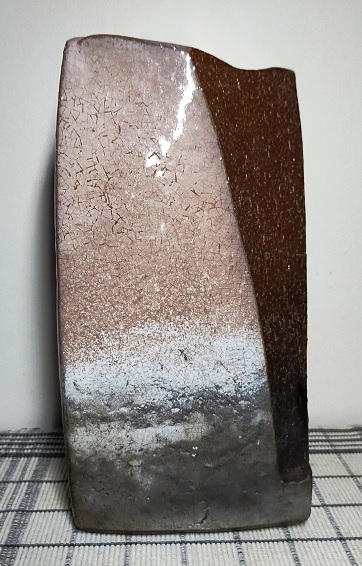
The four-sided walls were glazed with the white Hagi glaze (Wikipedia has good information on this glaze; see under “Hagi ware”). On the front side (arbitrarily designated as the side with the most kiln effects), the glaze turned pink because of the kiln effects. On the back side and the top, the glaze remained white and exhibits much crackling. The two triangular sides are rich reddish brown. The bottoms of the two front four-sided panels were blackened by ash deposits during the firing and are mottled black, bluish gray, and white; the base of one of the back panels was lightly blackened during the firing. The interior was unglazed. 

This came in a wooden box inscribed in two lines, 萩花入 (Hagi hanairei, Hagi-ware vase) and 栄造 (Eizō), followed by the artist’s seal stamped in red. 

The appearance of this varies considerably depending on the side from which it is viewed. From the sides it appears to be a tall, rectangular vase, with dramatic contrasts of light and dark. Viewed from the front or back, with the triangular portions centered, the shape becomes much more complex. From the back side, it appears to be a highly glazed, mostly white piece; from the front, a richly colored vase dominated by a blush pink hue. A very substantial work. 

Purchased from the Kura Monzen Gallery in Kyoto, Japan, in January 2024 (invoice, shipping and customs documents).

Wednesday, January 3, 2024

238. SAKATA Jinnai, 1943­- , white clay colored, wave-patterned, flattened vase)

238.  SAKATA Jinnai 坂田甚内 , 1943­- , Hakudeisai hajō henko  白泥彩波状扁壺  (white clay colored, wave-patterned, flat-sided vase)


Sakata Jinnai was born in Tokyo in 1943 and apprenticed under Kamoda Shōji in 1964, establishing his first kiln in 1966. His work was selected for display at the Nihon Dentō Kōgei Shinsakuten (National Traditional New Crafts Exhibition) in 1969, and the following year at the Nihon Dentō Kōgeiten (National Traditional Crafts Exhibition). In 1971 his work was exhibited at the first Nihon Tōgeiten National Ceramics Exhibition. This event toured the United States and Canada as well. Two years later he was seen there again, and this time the show toured South America. In 1977 he moved away from the competitive world of mass exhibitions and focused more on private galleries. He was the first artist selected for display at the newly opened Takashimaya Gallery in New York in 1993. Work by him is held in the collections of the British Museum, Rockefeller Foundation, Sakuma Museum, and Waseda University Museum, as well as some of Japan's holiest sites such as the Ise Shrine, Izumo Shrine, Takachiho Shrine, Yakushiji in Nara, and both Kodaiji and Enryakuji in Kyoto. Not limited to clay, he also works in painting, washi handmade paper (from 1995), and glass (from 2000). 

White clay, with kiln effects in coral and brown on the sides and top; the base is largely free of color; the interior is blackened with soot. Weight: 4 kg (8.9 lbs). Height: 31 cm (12-1/4 in). Length: 22.7 cm (8-7/8 in). Width: 9.8 cm (3-7/8 in). 

This is a rectangular box, with longer front and back wall panels, and narrower side wall panels. The wall panels are about a centimeter (3/8 in) thick. The piece sits on the bottom edges of the walls. The bottom of the piece is recessed 2 cm (3/4 in) from the lower edges of the exterior walls. The joins where the bottom meets the side panels have been filled in with clay rounded in concave arcs. The artist’s seal, a square cartouche with the seal-script form of the character 甚, was impressed into the center of the bottom panel. The front and back panels have the same shape. At the bottom of each of these panels are three irregularly shaped indents. The sides of the panels rise in roughly straight lines to a height of 23 cm (9 in) and then curve inward. A rectangular piece was cut out of the tops of both panels, centered across the width, 13.4 cm (5-1/4 in) wide and 2.7 cm (1-1/16 in) deep. This creates four “horns” at the top. The two end sides are recessed about 1.3 cm (1/2 in) from the outer edges of the front and back panels. As with the bottom, the joins between the panels were filled in with clay rounded in concave arcs. At the top, the side panels curve inward, ending just before the peaks of the “horns.”  The top opening has two panels bordering the exterior walls, recessed 1.3 cm (1/2 in) below the lower edge of the rectangular cutout on the front and back panels. The two recessed panels measure roughly 9.2 x 3.8 cm (3-5/8 x 1-1/2 in), leaving an opening into the interior 8.8 x 7.3 cm (3-5/8 x 2-3/8 in). On the interior of the vase is a rectangular panel, running between the front and the back walls and from the center of the bottom to roughly two-thirds of the way up the piece, perhaps serving as a brace to strengthen the exterior walls. 

The exterior of the piece, including the bottom and the recessed panels at the top were scored with a metal comb-like tool to create wave patterns. These patterns are irregular and random. The surface of this piece is coarse and unfinished.

Kiln effects randomly colored the clay coral, with many patches of the white clay body showing through, creating a mottled effect. There are a few darker brown blotches. 

This came in a wooden box inscribed by Sakata, along with an orange covering cloth and a printed biography. The upper side of the lid is inscribed, in two lines, 白泥彩 hakudeisai (white clay, colored)  波状扁壺 hajō henko  (wave-patterned, flat-sided vase)/ The bottom side of the lid is inscribed 甚内  Jinnai, with Sakata’s seal in red.

 Purchased from the Kara Monzen Gallery in Kyoto, Japan, in December 2023. (Invoice, shipping and customs documents)

Pottery

Looking for suggestions

I need to dispose of my collection. I've tried to donate it to several local museums or schools with ceramics programs, but no one wants...