Showing posts with label Shigaraki-ware. Show all posts

Sunday, October 13, 2024

263. FUJIMOTO Hide 1954- , Shigaraki-ware pillar vase

263.  FUJIMOTO Hide  藤本秀,  1954- , Shigaraki tagui-enchū  信楽 類円柱  (Shigaraki-ware pillar [vase])


For Fujimoto, see item no. 250.  Fujimoto often finds inspiration in building materials (see also no. 250). Here the piece is shaped after a central pillar with notched holes near the top for holding the ends of a series of radiating support beams. 

Light gray Shigaraki clay, fired unglazed, with kiln effects, including hi-iro in red colors, natural ash glazing, with vitrification and bidoro, light gray with a greenish tint; ash deposits in dark gray to black. Weight: 3.5 kg (7-3/4 lb). Height: 24 cm (9-7/8 in). Diameter: 15.3 cm (6 in). 

This sits on a flat base, about 2 cm (3/4 in) thick. The remnants of the three posts used to separate the piece from the kiln shelf during firing are visible on the base. In shape this is a cylinder, roughly the same diameter throughout. There is an upward sloping ridge on the back side beginning at the base and extending upwards for about half the height. There are six windows near the top, each around 4.5 cm (1-3/4 in) square. The top and bottom sides of each square are level; the right and left sides angle inward. The lower edge of each square begins 17.8 cm (7 in) above the base. Within these windows, the flat surface moves inward toward a vertical, circular central wall 3.2 cm (1-1/4 in) high and 5.8 cm (2-1/4 in) in diameter. The top is a flat disk 1.5 cm (5/8 in) thick, with a central hole 5.8 cm (2-1/4 in) wide. There is a space of approximately 0.6 cm (1/4 in) between the inner central wall and the flat disk at the top, leaving the area within the windows open. The shape of the interior mirrors that of the exterior. The surface of this is quite rough. 

This was fired unglazed. The top and one side (arbitrarily designated the front) have a thick layer of vitrified natural ash glazing, with many small patches of green, glass-like bidoro deposits, light gray in color with a strong greenish tint. The upper part of the back side, to just below the square openings has a similar coating of natural ash glazing. Below this is a heavy layer of ash deposits, colored dark gray to black. The base has areas of vitrification across most of the surface, with a patch of hi-iro colors in light red. The original clay shows through in the areas of the base where the wads were placed during firing. The interior is hard to see but appears to have a good coating of natural ash glazing on the bottom and along the lower sides. 

This came in a wooden box inscribed by the artist in three lines: 信楽 / 類円柱 /  藤本秀  Shigaraki / tagui-enchū  / Fujimoto Hide (Shigaraki[-ware vase] resembling a pillar), followed by the artist’s seal stamped in red. 

Purchased from the Kura Monzen Gallery in Kyoto in October 2024, who received it directly from the potter in summer 2024. This was part of an exhibit entitled Shōka 昇華  (“sublime”), or Modern Masters in English, a show of fifteen currently active potters (invoice and shipping and customs documents).


Monday, September 30, 2024

262. FUJIMOTO Hide , 1954- , Shigaraki-ware collapsed pot

262.   FUJIMOTO Hide  藤本 秀,  1954- , Shigaraki kuzureta tsubo 信楽崩壺  (Shigaraki-ware collapsed pot)


For Fujimoto, see item no. 250. 

Light gray clay, with addition of many small white pebbles (quartz or feldspar). This was fired unglazed. The surface decoration results from kiln effects—ash deposits, natural ash glazing, hi-iro (fire colors), and vitrification, with patches and drops of bidoro green glass-like glazing. Weight: 2.2 kg (4.9 lb). Height: 13.8 cm (5-1/2 in). Widths: rim, 12 cm (4-3/4 in); widest, 22.5 cm (8-3/4 in); base, 14.8 cm (5-7/8 in). 

This sits on a flat base. The remnants of the five posts used to separate the piece from the kiln shelf during firing are visible on the base. The base is scored with many striations and much pitted. From the base the walls rise in a convex arc to the widest point, 7.6 cm (3 in) above the base. The piece collapsed above this point, more on one side (arbitrarily the front side), causing the mouth to sag downward on this side. The back side didn’t sag as much. It appears that this was to be a wide, relatively low jug. On the back side, there is an irregular hole surround by the remnants of a circular structure. To one side of this is another remnant, which appears to be a broken off protrusion of some sort. These may perhaps be remnants of a spout or a handle of some sort.  The mouth is wide and surrounded by a beveled rim. The surface of the pot is rough and broken. In one place on the back part, the surface fell off after firing, leaving the clay body exposed. 

This was fired unglazed. The back side has a dark gray ash deposit between the two remnants mention in the preceding paragraph. The upper part of the pot is covered with natural ash glazing, vitrified in places and with some bidoro green glass-like patches and a few tambo no me (green glass-like teardrops) running down the side. The lower half exhibits hi-iro in colors ranging from light red to mahogany. There are patches of vitrified cream-colored natural ash glazing on the base near the outside edge; most of the base has hi-iro colors in light red. 

This came in a wooden box, inscribed by the artist in three lines: 信楽 / 崩壺 / 藤本 秀  Shigaraki  / kuzureta tsubo / Fujimoto Hide (Shigaraki[-ware] / collapsed jug / Fujimoto Hide), with the artist’s seal stamped in red. Included in the box were a business card (meishi) and a short printed biography. 

The seller told me that the pot collapsed during firing and that Fujimoto viewed it as work of art resulting from a collaboration between nature and ceramics. The result is appealing and intriguing, and it’s understandable that Fujimoto would preserve this rather than toss it on the scrap heap. Sometimes the unexpected happens when pots are fired, and the accidents can be serendipitous. 

Purchased from the Kura Monzen Gallery in Kyoto in September 2024, who received it directly from the potter in summer 2024. This was part of an exhibit entitled Shōka 昇華  (“sublime”), or Modern Masters in English, a show of fifteen currently active potters (invoice and shipping and customs documents).


261. FUJIMOTO Hide, 1954- , Shigaraki-ware “crouching” vase

 261. FUJIMOTO Hide  藤本 秀,  1954- , Shigaraki uzukumaru [tsubo] 信楽蹲[壺]  (Shigaraki-ware “crouching” vase)


For Fujimoto, see item no. 250. 

The designation of this as a tsubo follows the usage for similar uzukumaru pots. For another example, see item no. 218, 

To judge from other examples of uzukumaru pots online, the term is reserved for a style of pots made in Shigaraki. They are roughly circular in cross-section. From a broad, flat base, the walls rise outwards in a more or less straight line to the widest diameter at the high shoulders. From there, the walls curve inward rapidly to a small, short vertical neck surmounted by jutting horizontal lips with beveled edges. 

Light gray clay. Fired unglazed, with heavy kiln effects--ash deposits in deep black, hi-iro (fire colors) in light red, melted ash glaze in a creamy brown, with some vitrification and bidoro green glass-like deposits and drips. Weight: 1.9 kg (4.3 lb). Height: 19 cm (7-1/2 in). Widths: rim, 8.2 cm (3-1/4 in); widest, 16.4 cm (6-1/2 in); base, 12 cm (4-3/4 in). 

This sits on the flat circular base. The remnants of the four posts used to separate the piece from the kiln shelf during firing are visible on the base. The body is roughly circular but with many shallow dents and bulges. The widest point occurs at the shoulders, 11.3 cm (4-1/2 in) above the base. The walls then curve inward to the neck, which is 16 cm (6-3/8 in) above the base and 5.7 cm (2-1/4 in) in diameter. The lip juts outward above the neck, Both the lower and the upper surfaces are beveled. Two lines scratched into the clay undulate around the vase, one positioned slightly below the shoulders and one above. The lines range from 2.5 to 5 cm (1-2 in) apart. A series of X’s was inscribed within these lines. Some of the lines in the X’s rise above the upper line. This is known as the “cypress fence pattern”  檜垣文  higakimon. The interior of the piece mirrors the exterior. The surface is rough and crusted. 

This was fired unglazed. One side (arbitrarily the back side) was covered with a heavy layer of ash, leaving a dark matte black surface, much pitted and very irregular. This layer is so thick that it largely obscures the undulating lines and X’s in this area. The portions of the exterior walls beside the neck on this side show some reddish-brown hi-iro. The front side, particularly the upper portions, were covered with a natural ash glazing, which ran down the front side to the base, leaving some portions uncovered and again showing hi-iro colors. The neck, rim, and mouth of the piece are also covered with natural ash glazing in the creamy brown color. Some areas of the natural ash glazing shows vitrification. Unusually the base is also encrusted with ash deposits and has one tambo no me bead of green glass-like melted ash glazing. This must have been fired near the front of the kiln and received a full blast of ash deposits and heat. 

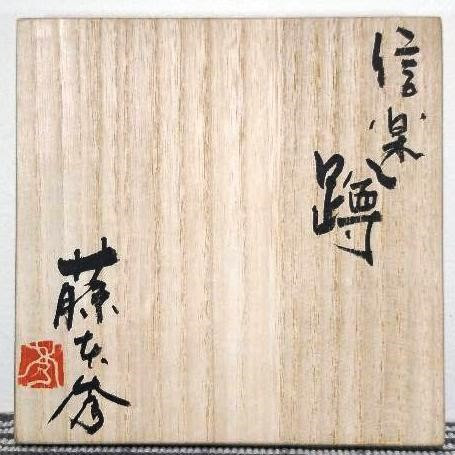
This came in a wooden box inscribed by Fujimoto in three lines: 信楽 / 蹲 / 藤本 秀 Shigaraki / uzukumaru / Fujimoto Hide (Shigaraki / crouching / Fujimoto Hide), followed by the artist’s seal stamped in red. Included in the box was a short printed biography of the artist. 

I found a picture of a Muromachi-period Shigaraki "crouching" tsubo that has a similar decorative scheme of two lines running around the shoulders with a pattern of X's inscribed between them. The decoration on that piece is more regular, however, and the kiln effects are much more limited (chiefly hi-iro with some golden fly ash). See Samuel J. Lurie and Beatrice L. Chang, Fired with Passion: Contemporary Japanese Ceramics (2006), p. 110, fig. 82. 

Purchased from the Kura Monzen Gallery in Kyoto in September 2024, who received it directly from the potter in summer 2024. This was part of an exhibit entitled Shōka 昇華  (“sublime”), or Modern Masters in English, a show of fifteen currently active potters (invoice and shipping and customs documents).


Saturday, May 25, 2024

250. FUJIMOTO Hide , 1954- , Shigaraki-ware sculpture, 塊 Katamari (“Mass”)

250.  FUJIMOTO Hide  藤本秀,  1954- , Shigaraki 信楽-ware sculpture, 塊 Katamari (“Mass”)


Fujimoto was born in 1954 in Shigaraki. From 1973, he worked in several potteries and industrial kilns, studying firing techniques and glazes. He established his own kiln, 雲居窯  (Kumoi kama), in the foothills above Shigaraki in 1995. Fujimoto is "inspired by the natural world around him, and the return to nature of the discarded and redundant remains of our civilization." He told Robert Mangold, the owner of the gallery from which I bought this piece, that it was influenced by pier blocks he had seen covered in moss half buried in the earth. For more on Fujimoto, consult his website:

Ceramic artist - Hide Fujimoto Official Site (jimdofree.com).

Light gray Shigaraki clay. Unglazed; all surface colors the result of kiln effects and natural ash glazing. Weight: 5.2 kg (11.3 lb). Height: 16.3 cm (6-1/2 in). Length: 23 cm (9 in). Width: 17.5 cm (6-3/4 in). 

This was formed from a solid brick of Shigaraki clay. It has roughly six sides, but each side has many surfaces, formed either of excavated areas or protrusions. The base is flat throughout most of its area but curves up to meet the back side at the rear. There are two spots on the bottom where the unaffected clay shows through. One of these has some incised lines that may be the artist’s sigil. Because of the shape of the bottom, the piece tilts forward. A large cavity was excavated on the top side. The left and right sides also have cavities. The top cavity is rough and irregular. The cavities on the sides are smoother and more regular, perhaps excavated using a chisel or similar tool. The surface texture is rough.

This was unglazed. In addition to the two unaffected areas on the bottom side, the back side also has a spot without kiln effects. There are a few areas colored red, but most of the surface shows colors in the gray to black ranges. The front and back sides have areas of vitrified natural-ash glazing. The bottom side has one of the green glass-like beads known as tambo no me. 

This came with a wooden box inscribed by Fujimoto in three lines: 信楽 / 塊 / 藤本秀,  Shigaraki  /  Katamari (“Mass”) / Fujimoto Hide, followed by his seal stamped in red. Included with the piece were an orange wrapping cloth, a short biography in English, and a statement in Japanese about the association between Shigaraki and pottery and Fujimoto’s approach to potting. 

Purchased from the Kura Monzen Gallery in Kyoto, Japan, May 2024 (invoices, customs and shipping documents)


Monday, October 23, 2023

234. MURAKOSHI Takuma , 1954- , “Ganbaruman,” ash-glazed Shigaraki-ware vase

234. MURAKOSHI Takuma  村越琢磨, 1954- , “Ganbaruman がんばるまん” (Stick-with-it-Man) ash-glazed Shigaraki-ware vase 


To quote Robert Mangold of the Kura Monzen Gallery: “Murakoshi Takuma is one of those enigmas who simply lives to work with clay. He does not seek to make a living through pottery, but through his primal approach has earned a following which keeps his work in high demand. He was born in Shinshiro-shi in Aichi Prefecture in 1954 and began his stroll down the pottery path in 1980 under the tutelage of Kyoto potter Umehara Takehira. Favoring very rough Shigaraki clay, he established his own kiln in 1997 in the Kiyomizu pottery district of Kyoto, then moved to Nagaoka in 2002. Although eschewing the world of competitive exhibitions, he has been picked up by many of Japan’s preeminent galleries, including private exhibitions at the prestigious Kuroda Toen of Tokyo’s Ginza District.  

In a printed leaflet accompanying this piece, Murakoshi characterizes his approach to pottery as “First, the clay; second, the fire; third, the technique.” He uses clay from Shigaraki mixed with natural ash and fires his pieces in high heat. 

The piece is part of a series of similarly shaped pots all entitled “Ganbaruman.” The “man” here is the English word, as in Superman. Ganbaru means “to persevere,” but it is often used colloquially to encourage others and is equivalent to “Keep at it,”or “Stick with it,” or “Don’t give up.” So, “Stick-with- it-Man.” I don’t know the number of this particular iteration; a posting to Murakoshi’s Instagram account (@takuma.murakoshi) dated September 3, 2020 pictures no. 10 in the series. A posting dated to December 2019 shows nos 5 and 6. So he has been making these for a few years. The 2020 posting also refers to that pot as being part of the Jidai ni gyakkō shirizu 時代に逆行シリズ, or “Running counter to the times series.” This means something similar to Huysman’s À rebours and gets at the mindset behind the shaping of the pot. 

Gray clay, with natural ash glazing and kiln colors in the reddish-pink, brown, gray, and black ranges, with natural ash glazing across most of the surface. The only unaffected sections are the bases of the feet on which this sits. The ash melt and glazing are heavy, even on the interior. There is a pool of vitrified, dark green, glass-like glaze on the bottom of the interior. On the exterior similar accretions of bidoro glazing are found in the many grooves on the piece. Beads of this glaze are present on the underside of the body. 

Weight: 4.2 kg (9.4 lb). Height: 22.8 cm (9 in). Width (maximum): 24 x 16.5 cm (9-1/2 x 6-1/4 in). 

Any attempt to pin this piece down to exact measurements will fail. This sits on four flat tires positioned near the ends of an oval base. The base sags downward toward the center of the piece, as if the feet and base were being crushed by the weight of the body. The body is a rough oval in cross-section, moving inward to the narrowest point at the neck. Above the neck the walls flare outward toward the rim, again a rough oval 10.2 x 9 cm (4 x 3/12 in). The two handles, or Ganbaruman’s arms bow outward in a convex arc from the shoulders to the base (Ganbaruman’s hips). This is a caricature of the human body. Mangold describes it as “A frumpy vase in ash glaze, settled down on its haunches like some tough guy, hands on hips.” The surface is rough and pitted. 

Unglazed before firing, with kiln colors and natural ash glazing. 

This came in a wooden box inscribed by Murakoshi in his distinctive calligraphy. As is his wont, the inscription begins on top of the box and continues down one side. The inscription is written in hiragana and reads: がんばるまん (ganbaruman) and たくま (Takuma). The top is stamped in red with a seal with Murakoshi’s studio name: へうげも屋  (Hyōgemono-ya, “Jocular Fellow Studio”; interestingly he uses the kyūkanazukai, or old kana usage, to write hyō. Hyōgemono is also the name of a popular nanga character. On the side of the box is another seal stamped in red, giving Takuma in characters, 琢磨. Included in the box were a brown wrapping cloth and a printed leaflet from Murakoshi. 

Purchased from the Kura Monzen Gallery in Kyoto, October 2023. The Gallery hosted an exhibition of Murakoshi’s works in October 2023. 

Sunday, October 15, 2023

232. FURUTANI Hiromu, 1922­-2012, Shigaraki-ware water container for the tea ceremony

 232. FURUTANI Hiromu 古谷弘, Chūroku 忠六 I, 1922­-2012, Shigaraki shizenyū mentoru mizusashi 信楽自然釉面取水指  (Shigaraki-ware natural ash-glazed, faceted water container for the tea ceremony)


As evident in this piece, Furutani Hiromu was fascinated by the possibilities of koge 焦 (charring), hi-iro 火色  (flame color), and other kiln effects of Shigaraki-ware. He devoted himself to the recovery of pre-Edo firing techniques. He was on the forefront of research into ancient kiln construction and re-created both an anagama and a noborigama (climbing kiln). He was the first artist named a Dentō Kōgeishi (traditional craftsman) in Shigaraki, accepting that honor in 1976. After that his works were exhibited throughout Japan, as well as internationally. Breaking from tradition however, he also worked to create carved and modeled pieces with animated creatures writhing across the surfaces or arching to form handles. Furutani Hiromu was the father of Furutani Hirofumi 博文 (Chūroku  忠六 II) and grandfather of Furutani Taketoshi (see items nos. 218 and 224), all potters in the Shigaraki tradition. 

Light gray clay, unglazed before firing, with kiln effects in the gray and red ranges. Weight: 3.45 kg (7.7 lb). Height: overall, 22 cm (8-3/4 in); lid, 4.2 cm (1-5/8 in); bottom section, 19.3 cm (7-5/8 in). Width: lid, 11.7 cm (4-5/8 in); mouth, 16.8 cm (4-1/4 in), rim, 14.5 cm (5-3/4 in), base (maximum), 18.4 cm (7-1/4 in). 

This sits on the flat base. Remnants of the wads used during the firing to separate the piece from the kiln shelf are evident on the bottom. The characters 忠六 in a cursive script were incised into the base. The white sticker with the number 58 is from the exhibition of the works of the three Furutani generations at the Kura Monzen Gallery in Kyoto in 2023. Measurement of the depth of the interior reveals that the base is 2 cm (3/4 in) thick. The edges of the base follow the contours of the faceted walls. 

The walls were shaped by the mentoru process up to a height of 14.5 cm (5-3/4 in), where a narrow ridge of clay, hereafter the “collar,” circles the piece. Mentoru is usually translated “faceted,” but the English word seems too adjectival to me. The Japanese word is a verbal compound and implies a process of forming a face by removing or taking something away. This section has eight facets extending from the collar down to the base formed by slicing away the clay. Each section is slightly concave toward the center. The borders between the facets are sharp, bumpy ridges. The bottom of each facet between these vertical borders has been curved upward to form a curved indent, creating a series of scallops between sharp points beneath the ridges. Each facet has a series of closely spaced, shallow vertical grooves running from the collar to the scallops, perhaps made by a metal comb. The scallops were formed after these grooves were made and cover the grooves near the base. The grooves are most apparent on the side with almost no ash deposits (arbitrarily, the “back side”). The heavy ash deposits on the front side mostly obscures the grooves. Furutani dug deeper and larger grooves in an “M” pattern across the front facets. 

There are two “handles” vertically centered on the collar, on opposite sides of the piece, roughly between the front and back sides. The handles are more bumps with which one can grasp the piece rather than handles proper. They are rough wads of clay. The one on the left appears to have been damaged after the firing; it is hollow and the rough unglazed clay is exposed.

Above the collar, there is an indented section, and above this a section with horizontal grooves and rings that juts out a bit. Each of these sections occupies roughly half of the space between the collar and the rim. The lip has groove running around the circumference. The gallery on which the lid sits is recessed about 1.3 cm (1/2 in) below the lip. 

The lid has a central knob, which appears to have been shaped from a flattish piece of clay formed into a rough, open cylinder, with the top edges folded inward around an irregular opening. The top side of the lid is fairly flat, with concentric circular grooves radiating from the center. The underside of the lid is slightly convex toward the center. The lid doesn’t sit very securely on the gallery. 

The interior of the piece is an irregular cylinder, with some finger marks from the shaping. 

The surface of the piece is very rough and broken. 

What is visible of the clay body reveals that Furutani used a fine-grained clay for this. This was unglazed before firing. The front side and the top side of the lid acquired a thick layer of ash during the firing, resulting in a heavy deposit of vitrified gray glaze with some green bidoro on the grooves of the lid, the underside of the lid near the edges, and the bottom edges of the M across the front. The other side of the body became a coral red as a result of the firing; the back side also has droplets of vitrified glaze in a cream color strewn randomly over the surface. Some portions of the base and the underside of the lid and most of the interior show the unaltered clay; the interior exhibits some pink coloring on the walls and some natural ash glazing on the bottom.

This came in a wooden box, with an orange wrapping cloth and a potted biography of the artist. The lid of the box was inscribed by Furutani Taketoshi, in four lines, from right to left: 信楽 Shigaraki  /  自然釉  shizenyū (natural ash glaze) /  面取水指 mentoru mizusashi (faceted water container) / 初代 shodai (first generation) 忠六  Chūroku, followed by the artist’s seal in red (again reading 忠六  Chūroku).  The seller also included a copy of the exhibition booklet.

The results imply that Furutani sited this piece very carefully in the kiln so that the kiln effects resulted in well-delineated front and back sides.

Purchased from the Kura Monzen Gallery, Kyoto, Japan, September 2023. (Invoice, shipping and customs documents)

Pottery

Looking for suggestions

I need to dispose of my collection. I've tried to donate it to several local museums or schools with ceramics programs, but no one wants...