Showing posts with label Yellow Seto-ware. Show all posts

Wednesday, December 8, 2021

160. Yellow Seto-ware (kiseto) chawan, mid-twentieth century
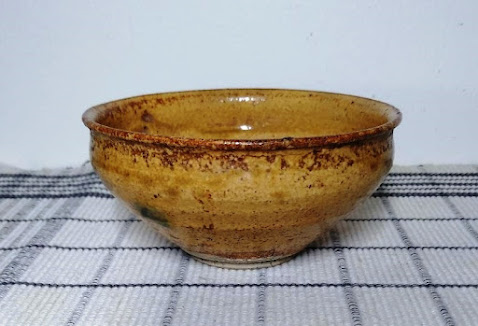
160. Yellow Seto-ware (kiseto) chawan, mid-twentieth century


Gray clay, with yellow and green glazes, base left unglazed. Weight: 236 g (8.5 oz). Rim and maximum diameter: 13 cm (5-1/8 in); foot ring diameter: 5 cm (2 in). Height: 6 cm (2-3/8 in).

This sits on the foot ring, which is 0.5 cm (3/16 in) on the outside. The area inside the foot ring was hollowed out to about two-thirds of this distance. The walls just above the foot ring jut out in a straight horizontal line for a distance of about 0.5 cm. The walls then rise upward in more or less a straight line to a height of 4.2 cm (1-5/8 in) above the base. Above this is a concave groove about a finger’s width wide leading to the rim. A rectangular seal with three characters (see last picture) was stamped into the outer wall of the piece just above the base. The first two characters appear to be 津島 (Tsushima); the last character is illegible. I can’t find any potter or kiln associated with this name, although there is a Tsushima in Aichi-ken, near Seto. A circular emblem containing three “comma”-like shapes chasing one another’s tails (see second and third pictures) was pressed into the outer wall of the piece.  The surface of this is pitted but not particularly rough.

With the exception of the base, this was glazed using the yellow Seto-ware glaze. Both the interior and the exterior have three blobs of an Oribe-style copper-green glaze. Spots and streaks of brown colors show through much of the yellow glaze.

This fits nicely in the hands. The groove just under the rim makes it easy to hold. The splashes of green color break up what otherwise might be a monotonous yellow. This shows evidence of much use.

Purchased from Treasures of Old Times in Bangkok in November 2021.


Saturday, May 1, 2021

3. SHIBATA Masumi, 1952- , ki-Seto hachi (yellow Seto-ware serving bowl)

3. SHIBATA Masumi  柴田増三  (1952-  ), ki-Seto hachi (yellow Seto-ware serving bowl


Shibata comes from a family of potters in Gifu Prefecture. He graduated from Tajimi Technical High School, Department of Ceramics, and completed the course at Gifu Prefectural Ceramics Research Institute. He established the Jōgama  城窯   kiln in Mizunami City while assisting his family’s pottery-making business. He has received awards at the Japan Traditional Craft Exhibition, Japan Ceramic Art Exhibition, Chūnichi International Exhibition, Asahi Ceramic Art Exhibition, among others. He produces large works in tenmoku and iron glaze, and tableware and vases in the Oribe, Shino, and ki-Seto traditions. He is a member of Japan Kogei Association.  The pronunciation of Shibata’s given name as “Masumi” is based on the Dictionary of Japanese Potters  (online). The certificate of authenticity from the seller (see below) gives the name as “Masuzō,” which would be a common reading for the name.

Fine white clay, with yellow and green glazes. The bottoms of the three small feet attached to the base of the bowl were left unglazed. The bottom of the bowl is circular. At the rim of the bowl, the sides were squared off, creating a rough four-sided figure with curved corners and sides. Weight: 818 g (1.8 lb); Rim dimensions: 18.5 x 18.5 cm (7-1/4 x 7-1/4 in); base diameter: 19 cm (7.5 in). Height: 8 cm (3-1/8 in). 

The clay available in Seto is a high-quality kaolin and porcelain stone, which turns white when fired. Ki-Seto (黄瀬戸) , or “yellow Seto,” is one of the typical glazes of the Seto kilns. The outline of the turnip and the edges and veins of the leaves were incised into the clay with a sharp, narrow-tipped tool. The turnip was drawn only in outline; the leaves were painted with the green glaze, which pooled into the incised lines of the edges and the veins, creating darker areas.

The piece came in a wooden box with 黄瀬戸鉢  (ki-Seto  hachi, yellow Seto bowl) written in black ink on the upper right side of the lid.  In the lower left-hand side is 増三,  the given name of the potter, written in both black ink and stamped in red with a seal.  Included with the box was a stamped certificate of authenticity in English from the Ma-shi-ko Folkcraft gallery in San Francisco and a small printed sheet from Shibata with details about the Jōgama kiln and a short biography and a list of rewards he has received.

Purchased in the late 1980s at Ma-shi-ko Folkcraft, in the Japan Trade Center in San Francisco.

Pottery

Looking for suggestions

I need to dispose of my collection. I've tried to donate it to several local museums or schools with ceramics programs, but no one wants...