Showing posts with label MudRocks Studio. Show all posts

Monday, December 13, 2021

163. Kari Wojtanik, pit-fired vase, 2021

163. Kari Wojtanik, pit-fired vase, 2021


For Wojtanik, see item 91.

White clay, colors from pit-firing. Weight: 425 g (15 oz). Mouth diameter, 3.8 cm (1-1/2 in); maximum diameter, 11.3 cm; base diameter, 7 cm (2-3/4 in). Height: 8.8 cm (3-1/2 in).

This sits directly on the flat base. A large capital “K” followed by, in much smaller size, “ari,” was incised into the bottom. The walls rise from the base in a very shallow convex arc to the maximum width 7 cm (2-3/4 in) above the base and then curve inward to the mouth at a sharp pace. The exterior appears to have been burnished and is quite smooth except in a few places where the pit-firing left rough deposits.

The colors come from the pit-firing and range from black to a smoky gray to shades of reddish browns. The interior was less affected by the fumes from the pit-firing and is mostly a dull gray with some patches of black and red.

Another splendid piece from Wojtanik. A new shape for her, at least among the vases in my collection.    

Purchased at Feet of Clay Pottery’s semiannual sale in December 2021.


Sunday, May 23, 2021

100. Kari Wojtanik, black-and-white pit-fired pot

100. Kari Wojtanik, black-and-white pit-fired pot


For Wojtanik, see item 91.

White clay, colors from pit-firing. Weight: 270 g (9.5 oz). Rim diameter: 1.8 cm (3/4 in); maximum diameter: 7.3 cm (2-7/8 in); base diameter: 3.7 cm (1-1/2 in). Height: 11.7 cm (4-5/8 in).

The pot sits directly on the base. “Kari” was incised into the base. The walls rise in a convex arc to the neck. The maximum diameter lies 5.7 cm (2-1/4 in) above the base.  The diameter of the neck is 1.5 cm (9/16 in); it is 10.3 cm (4-1/8 in) above the base. From the neck, the walls angle out in a straight line to the rim. The surface of the pot is smooth on the black side (the fourth photo), but rough on the opposite side (the second photo).

Colors—blacks, grays, dark reds, orange—come from the pit-firing. The patches of white are areas unaffected by the fumes and smoke and show the white of the clay. The neck is too narrow to see the interior.

Wojtanik’s works exemplify what I love about pit-firing with their marriage of perfect form and random decoration. The two ought to work against each other, but the unpredictable results of pit-firing make for fascinating juxtapositions of color and shape. I find that when I try to find a pot’s “best” side for display, I keep turning it around and around. Each aspect presents a surprise, something that catches the eye. This is pottery at its best.

For her pit-firings, Wojtanik uses as wide variety of organic materials such as sawdust, wood shavings, manure, and food items such as coffee grounds, banana peels, and salt. She also uses items such as metal wire, steel wool, copper scouring pads, and strips of paper soaked in chemical salts. She does her pit-firing in Maine. See items 95 and 99 for pictures of pots prepared for firing. She provided this picture of the aftermath of a firing.

Purchased at the annual spring sale at Feet of Clay Pottery, Brookline, Massachusetts, May 2020.


99. Kari Wojtanik, multicolored pit-fired pot

99. Kari Wojtanik, multicolored pit-fired pot


For Wojtanik, see item 91; for more on her techniques of pit-firing, see item 100.

White clay, colors from pit-firing. Weight: 220 g (8 oz). Rim diameter: 1.2 cm (3/8 in); maximum diameter: 6.3 cm (2-1/2 in); base diameter: 4 cm (1-9/16 in). Height: 12.5 cm (5 in).

This sits directly on the flat base. The walls rise in a gentle convex arc up to the shoulders, which are 8.7 cm (3-3/8 in) above the base. The shoulders are only slightly narrower than the maximum diameter, which is 7.5 cm (3 in) above the base. From the shoulders the walls slant in at an angle in more or less a straight line to the rim.  The rim is slanted and chipped.  The surface is smooth, with a few rough spots.

The colors—reds, gray, black—derive from the pit-firing. The last photo shows the pot as prepared for firing resting on the aluminum foil saggar used to enclose the pot during firing; the metal band visible in the photo survives as black lines on the finished pot. The mouth is so narrow that’s it impossible to see the interior.

Purchased at the annual spring sale at Feet of Clay Pottery, Brookline, Massachusetts, May 2021.


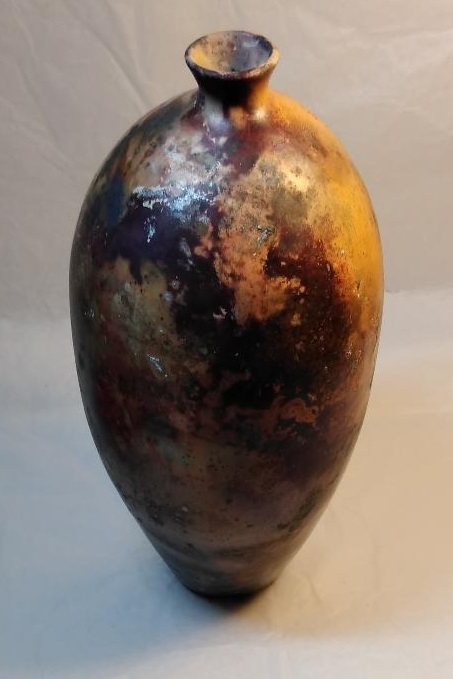
98. Kari Wojtanik, tall pit-fired narrow-mouthed pot

 98. Kari Wojtanik, tall pit-fired narrow-mouthed pot


For Wojtanik, see item 91; for more on her pit-firing techniques, see item 100.

White clay, colors from pit-firing. Weight: 858 g (1.9 lb). Rim diameter: 2.7 cm (1-1/8 in); maximum diameter: 10 cm (4 in); base diameter: 4.7 cm (1-7/8 in). Height: 24.5 cm (9-3/4 in).

This sits directly on the flat base. From the base, the walls angle outward in a straight line to a height of 6.5 cm (2-1/2 in). From there they move upward in a continuous convex arc to the neck. The maximum diameter lies 15 cm (6 in) above the base. The neck is 2 cm (7/8 in) in diameter and is 23.2 cm (9-1/4 in) from the base. From the neck, the walls angle outward in a straight line to the rim. The surface of the pot is mostly smooth, with a few rough spots. The pot is stable on its base if left undisturbed. Its high center of gravity, however, means that it would tip over easily.

The colors—black, grays, reds, copper, yellow—come from the pit-firing. In a few spots, the white clay is visible. The interior of the pot is white and was not affected by the fumes from the firing.

A magical work. It has the rich and varied colors and the patina pots acquire after centuries of burial.

Purchased from the artist in May 2020.


97. Kari Wojtanik, multicolored pit-fired pot

97. Kari Wojtanik, multicolored pit-fired pot 


For Wojtanik, see item 91; for more on her pit-firing techniques, see item 100.

White clay, colors from pit-firing. Weight: 564 g (1.2 lb). Rim diameter 4.3 cm (1-11/16 in); maximum diameter: 11.2 cm (4-3/8 in); base diameter: 6.7 cm (2-5/8 in). Height: 13 cm (5-1/8 in).

This sits directly on the flat base. “Kari” was incised into the base. The walls rise from the base in a convex arc to the neck. The maximum diameter is 7 cm (2-3/4 in) above the base. The neck is 3.5 cm (1-3/8 in) in diameter and is 12 cm (4-3/4 in) above the base. From the neck the walls curve outward and upward to the rim. The surface is smooth, with a few rough spots, particularly in the large black area.

The colors—reds, black, gray—come from the pit-firing. In only a few spots is the white clay visible. The interior is white and largely unaffected by the fumes from the firing.

Purchased from the artist in May 2020.


96. Kari Wojtanik, multicolored pit-fired pot

96. Kari Wojtanik, multicolored pit-fired pot


For Wojtanik, see item 91; for more on her pit-firing techniques, see item 100.

White clay, colors from pit-firing. Weight: 504 g (18 oz). Rim diameter: 5 cm (2 in); maximum diameter: 10 cm (4 in); base diameter: 6.8 cm (2-3/4 in). Height: 11.7 cm (4-5/8 in).

This sits directly on the flat base. “Kari” was incised into the base. The walls rise from the base in a continuous convex arc to the neck. The maximum diameter is 5.7 cm (2-1/4 in) above the base, roughly at midpoint. The neck is 3.7 cm (1-1/2 in) in diameter and 10.7 cm (4-1/4 in) from the base. From the ncek the walls slant upward and outward to the rim in a straight line.  The surface of the outside wall is encircled by fine horizontal lines from a finishing tool. The surface is rough in places, especially in the dark black areas.

The colors—reds, grays, black—result from the pit firing. There are areas where the white clay shows through. The interior is mostly white; there is one large red spot.

This is a solid pot, much heavier than one might expect.

Purchased from the artist in May 2020.


Pottery

Looking for suggestions

I need to dispose of my collection. I've tried to donate it to several local museums or schools with ceramics programs, but no one wants...