Showing posts with label Vermont potters. Show all posts

Monday, March 14, 2022

172. Lauryn Axelrod, three pieces from her “Sheddings” series

172. Lauryn Axelrod, three pieces from her “Sheddings” series

For Axelrod, see item 147.

The “Sheddings” series is about things left behind when they are no longer useful. The series was inspired by fragments of seashells Axelrod saw on a beach in the Galapagos Islands. All the pieces were made from wild clay she harvested in Texas and wood-fired for 48 hours in a train kiln, also in Texas. These were intended to be hung on a wall from one of the grooves on the back side using a screw or nail head. 


A. Fine-grained gray clay. Colors from wood-firing. Weight: 354 g (13 oz). Width at top: 13.6 x 12.7 cm (5-1/4 x 5 in); at base: 6 cm (2-3/8 in). Height: 2.8 cm (1-1/8 in).

The flat area on the back side has four grooves intended to be used in hanging the piece. In the center of this area is a small circular stamped artist’s mark, the Japanese character “mori”  森, or Three Trees, the name of Axelrod’s studio. The walls rise in a convex arc to the rim. The rim itself is highly irregular and broken. The interior bears deep circular grooves made by the fingertips as this was shaped. The surface is smooth except on the ridges and edges.

The flashing colors of red and light gray come from the wood-firing. There are four small area on the back where the raw clay shows through, the remnants of the posts used to support the piece during firing. The front surface is gray with occasional glossy areas from melted ash. The back side is red and gray; most of the back side has a glossy finish.


B. A medium-coarse reddish tan clay. Colors from wood-firing. Weight: 392 g (14 oz). Width at rim: 14.5 x 12.5 cm (5-7/8 x 4-3/4 in); at base: 6.3 x 7 cm (2-1/2 x 2-3/4 in). Height: 5.3 cm (2-1/8 in).

The flat area on the back side has four grooves intended to be used in hanging the piece. In the center of this area is a small circular stamped artist’s mark (see above). The walls rise outward in a slightly bowed straight line to the rim. The rim is highly irregular. The interior bears deep circular grooves made by the fingertips as this was shaped.  The texture of the interior is rough; that of the exterior is smoother in most places.

The flashing colors of red and gray come from the wood-firing. The flat area on the back was uncolored by the firing and must have been resting on a shelf or floor. Most of the interior was similarly left uncolored by the firing and shows the reddish tan color of the bare clay; only the edges have gray flashing. The exterior exhibits both red and gray flashing.  There are only a few areas of wood-ash melt, chiefly along the rim.


C.  A coarse dark clay. Colors from wood-firing. Weight: 730 g (26 oz, 1.6 lb). Width at rim: 17.5 x 16.7 cm (7 x 6-1/2 in); at base: 7.5 x 8.2 cm (3 x 3-3/4 in). Height: 5.8 cm (2-1/2 in).

The flat area on the back side has four grooves intended to be used in hanging the piece. In the center of this area is a small circular stamped artist’s mark (see above).  The walls expand outward in a slightly bowed convex arc to the midpoint and then flare outward in a straight line to the irregular rim. The interior bears shallow circular grooves made by the fingertips. The surface of this is very rough.

The colors, black, a dark red, and a few streaks of gray, come from the wood-firing. There are heavy deposits of ash and cinders on all surfaces. The base has a few areas of melted wood-ash glazing.


The three pieces are related in shape and design, but each is still individual. The first is almost a plate; the last one almost a bowl.  Hanging these on a wall would obscure their three-dimensionality. Too much would be hidden if the back side were not visible, and too much of the tactile exuberance of the clay would be lost if it were difficult to handle them.

Purchased from the artist in late 2021.


Monday, November 8, 2021

154. Lauryn Axelrod, “Nike,” wood-fired ceramic sculpture

154. Lauryn Axelrod, “Nike,” wood-fired ceramic sculpture


For Axelrod, see item 147.

Gray clay, colors from wood-firing and ash glaze. Base: made from a 4 x 4 beam of wood; 15.3 x 9 x 9 cm (6 x 3-1/2 x 3-1/2 in). Height: overall 28.5 cm (11-1/4 in). Sculpture proper: height: 19.5 cm (7-3/4 in); width across front: 17.6 cm (7 in); width across side: 17 cm (6-3/4 in).

The wooden base was painted black. The sculpture appears to be glued to the base. The sculpture was made of one piece of clay, bent into two “wings” roughly in the middle. The sculpture is about 5 cm (2 in) thick in the center. The centers of the wings are about 2.5 cm (1 in) thick; the thickness decreases toward the edges, reaching about 0.2 cm (1/16 in) at the ends. The outer surface appears to have been rolled on a patterned surface, or perhaps with a patterned roller.  The edges are much torn and broken. The exteriors of the wings are much smoother than the interiors.

The color and the sheen derive entirely from the wood-firing. The colors range from reds through russets to a dark brown. The sheen is primarily present on the higher surfaces of the wings.

Purchased from the artist in 2021.


Friday, September 10, 2021

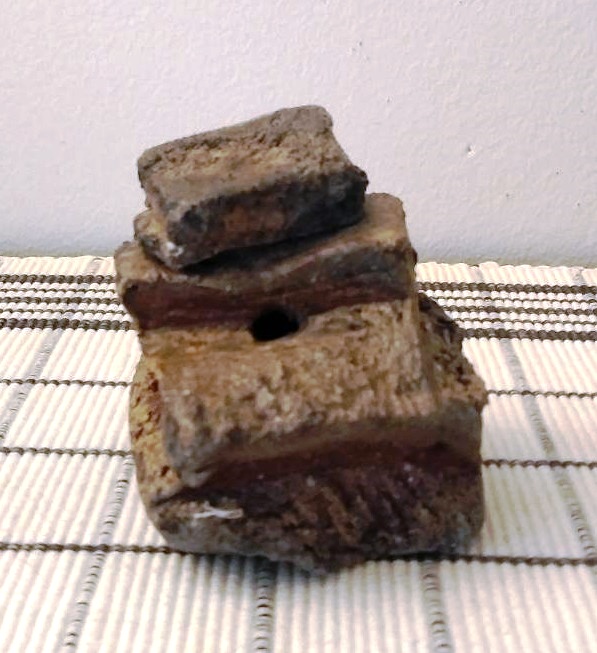
147. Lauryn Axelrod, lidded incense burner

147. Lauryn Axelrod, lidded incense burner, wood-fired, made of wild clay


Axelrod lives in West Pawlet, Vermont. For more on her and pictures of other work, see threetreespottery.com or her Instagram account, @threetreepottery.

Light brown clay, unglazed, colors from wood-firing. Weight: 516 g (18 oz). Maximum width: 8.2 cm (3-1/4 in). Height (overall): 7.7 cm (3 in).

This sits directly on the base. It is highly irregular in shape. The bottom section consists of two roughly rectangular lumps of clay. The lower section is a trapezoid about 7.7 cm (3 in) on a side and 4.5 cm (1-3/4 in) high; one corner of the bottom has been rounded and another has been cut back to slant upward. The upper section is a smaller rectangle, about 7 cm (2-3/4 in) by 4.5 cm (1-3/4 in) and 1.2 cm (1/2 in) high. It sits toward the back side of the lower section. The exposed area at the top of the lower section is scored and pitted. At the front, where the two sections meet, a hole about 0.6 cm (1/4 in) wide has been punched through to the interior (visible in the first picture above; "front" is an arbitrary designation with this piece). An irregular rectangle about 2.9 cm (1-1/8 in) by 1.6 cm (5/8 in) has been hollowed out through both sections of the base; it is about 4.5 cm (1-3/4 in) deep. The lid is a rough rectangle about 5.1 cm (2 in) by 3.3 cm (1-1/4 in) and 2 cm (3/4 in) high. There is a rectangular flange on the bottom to anchor the lid inside the base. The lid fits loosely on the base. The texture of this is very rough and unfinished.

This was unglazed. The colors derive from three days of wood-firing in an anagama-style kiln. The colors range from dark russet through brown into dark gray and black. There is some ash melt, particularly in the russet-colored areas.

A rough-hewn, brutalist statement of solidity and mass, unmistakably clay.

Purchased from the artist in September 2021.


Monday, May 10, 2021

40. Robert Compton, large wood-fired vase

40. Robert Compton, large wood-fired vase


For Compton, see item 38.

Gray clay, yellowish-green glaze; base left unglazed. Weight: 1036 g (2.3 lb). Rim dimensions: 12 x 8.2 cm (4-3/4 x 3-1/4); maximum width: 14 cm (5-1/2 in); base diameter: 7.5 cm (3 in). Height: 19.5 cm (7-3/4 in).

Compton describes this pot as a “Korean celadon.”  Hand-thrown and then altered. This sits directly on the base. The marks of the string used to cut the pot free from the wheel are visible on the base. For about an eighth of an inch, the sides of the pot above the base were left unglazed, and “COMPTON” was stamped into the unglazed side of the base. The walls of the pot rise in a gentle arc to the maximum width, which is about 15 cm (6 in) above the vase. The walls then curve inward to the rounded lip, about 18.5 cm (7-1/4 in) above the base. At the neck the pot is about 11.5 cm (4-1/2 in) wide. Two lines were incised around the circumference of the pot at about 6.5 cm (2.5 in) and 15.3 cm (6 in) above the base. After throwing, the walls and mouth of the pot were shaped into an oval. Up to the lower incised line, the pot has a circular cross-section. The oval shape extends from about this line to the lip. The artist’s mark was stamped into one side of the pot (Compton explains that the mark derives from the shape of the ceramic fountains that were his specialty early in his career).

The pot is yellowish-green in color. The glaze was allowed to run down the sides of the pots, creating streaks in some places. The glaze appears darker where it pooled in the incised areas.

Purchased at the artist’s studio in Bristol, Vermont, May 2017.


39. Robert Compton, large, wood-fired and salt-glazed vase

39. Robert Compton, large, wood-fired and salt-glazed vase


For Compton, see item 38.

Light gray clay, green glaze, with salt-fired finish; base left unglazed. Weight: 1084 g (2.4 lb). Rim diameter: 9.5 cm (2-3/4 in); maximum diameter: 13 cm (5-1/8 in); base diameter: 7.2 cm (2-3/4 in). Height: 17.7 cm (7 in).

Hand thrown and altered. The pot sits directly on the base. The marks of the string used to cut the pot free from the wheel are visible on the bottom. For about an eighth of an inch, the sides of the pot above the base were left unglazed, and “COMPTON” was stamped into the unglazed side of the base. The pot rises in a gentle curve to the maximum diameter about 10 cm (4 in) above the base. The walls then curve inward in a sharper arc to the neck of the vessel, which is some 16 cm (6-1/4 in) above the base; the pot is about 7.7 cm (3 in) in diameter at the bottom of the neck. The pot then flares outward at a steep angle to the rim. Pairs of parallel lines running around the circumference of the vase have been incised into the pot roughly 5 cm (2 in) and 12.5 cm (5 in) above the base. Within the area defined by these lines, the shape of the pot was altered into a rough square, with slightly curved sides.  The artist’s mark was stamped into one side of the pot.

The piece is glazed both inside and out. The coverage is uneven, giving the pot a mottled appearance. There are many lighter spots. There are light red scorch marks from the wood-firing on the unglazed base of the pot. The salt-glaze is responsible for the sheen. In natural light, the color of the pot is a dark green. In some artificial light, particularly LEDs, the color ranges from gray to black.

Purchased at the artist’s studio in Bristol, Vermont, May 2017.


38. Robert Compton, small wood-fired and salt-glazed cup

38. Robert Compton, small wood-fired and salt-glazed cup


A full-time potter since 1972, Compton lives and works on a small farm in Bristol, Vermont. He has published articles on potting and given lectures in many countries. He has informative discussions of his shaping and firing methods on his website (www.robertcomptonpottery.com).

Light gray clay, green glaze with salt-fired finish; foot ring unglazed. Weight: 120 g (4 oz). Rim diameter: 5 cm (2 in), maximum diameter: 5.8 cm (2-1/4 in), foot ring diameter: 3.3 cm (1-1/4 in). Height: 6.8 cm (2-5/8 in).

The foot ring is a 0.6 cm (1/4 in) on the outside, slightly less on the inside. The marks of the wads used to separate pottery in the kiln are visible on the foot ring. “COMPTON” has been stamped on the inside of the rim. Above the foot ring, the cup angles sharply outward to the sides of the cup; this area is circular in cross-section, and varies from 0.9 cm to 1.2 cm (3/8 to 1/2 in) above the base. The maximum diameter is about 2.5 cm (1 in) above the base; above this the cup slopes gently inward at a shallow angle to the rim. The sides of the cup have been divided into eight panels with a flat blade, running from the rim of the cup to the circular area above the base. The panels are unevenly shaped and slant to the right. Every other panel is incised with a pattern of wavy vertical lines. The artist’s mark was stamped into one of the plain panels.

The piece is glazed both inside and out. The salt-glaze is responsible for the sheen. In natural light the piece is a dark green; under some artificial light, particularly LEDs, it appears black.

Purchased at the artist’s studio in Bristol, Vermont, May 2017.


Pottery

Looking for suggestions

I need to dispose of my collection. I've tried to donate it to several local museums or schools with ceramics programs, but no one wants...