Showing posts with label tokkuri. Show all posts

Sunday, September 8, 2024

260. ŌIWA Tomoyuki, 1977- . black [Bizen-ware] sake-warming flask

260.  ŌIWA Tomoyuki 大岩智之. 1977- . Kuro tokkuri  黒徳利   (black [Bizen-ware] sake-warming flask)


For Ōiwa, see item no. 259. 

Dark gray clay. Fired unglazed, with natural ash glazing resulting in shiny black and matte black and dun colors. Weight: 426g (15 oz). Height: 13.8 cm (5-1/2 in).  Widths: rim, 3.5 cm (1-3/8 in); widest, 8.8 cm (3-1/2 in); base, 6 cm (2-3/8 in). 

This is shaped like a bottle gourd (瓢箪 hyōtan). It appears to have been molded on a wheel and then subsequently carved to form the belt, shoulders, neck, and rim. The main part of the body was then flattened slightly, leaving the piece longer from side to side. The maximum distance front to back is 8.2 cm, or about a quarter inch less the side-to-side dimension. 

The piece sits on the rim of the circular base, which was hollowed out in a shallow concavity. The remains of the three posts used to separate the piece from the kiln shelf during firing are visible on the bottom. The artist’s mark, a vertical line with a crossbar and a dot at the top right corner, is incised into the center of the base. The belt or waist begins about 5 cm (2 in) above the base and is one centimeter (3/8 in) wide. It consists of two horizontal grooves encircling the piece; the area between the two grooves was flattened with a carving tool. The lower bulge is a convex curve about 5 cm (2 in) in height, with the maximum width of 8.8 cm occurring 3.3 cm (1-1/4 in) above the base. The upper bulge is again a convex curve, with the maximum width of 7.5 cm (3 in) occurring 7 cm (2-3/4 in) above the base. Thus the widest area of both bulges is nearer the waist than the base or shoulders, respectively, of the piece. The shoulders begin 10.2 cm (4-1/8 in) above the base. The shoulder area is level, sloping slightly upwards toward the neck. At the neck’s lowest point, it is 2.5 cm (1 in) wide. The neck widens gradually up to the rim, which juts outward at a 90-degree angle and then slants slightly outward to the upper edge. The inside of the rim curves downward to the recessed mouth. It is impossible to see inside the piece. The surface of the exterior ranges from smooth over the heavily vitrified areas to a medium sandpaper grade on the relatively unglazed areas. 

This was fired unglazed. Some two-thirds of the exterior surface is covered with a vitrified ash glaze, with a dark black color. The base and some lower edges of the walls are a matte black color. Those portions of the exterior walls not covered with the vitrified ash glazing are a matte dun color.

 This came in a wooden box inscribed by Ōiwa in three lines: 黒 / 徳利 / sigil  kuro / tokkuri / sigil (black sake warmer-pourer / sigil), followed by the artist's seal stamped in red. See item no. 259 on the sigil. Included in the box were a gray wrapping cloth and a small card with a potted biography of the artist.  

This was sold as a unit with item no. 259, but the two pieces were not conceived as a set.  An online search found other similarly shaped tokkuri by Ōiwa. 

The irregularity of the main part of the body contrasts with the symmetry and precision of the pouring spout. The difference sets up a dialogue between the two parts. 

Purchased from the Kura Monzen Gallery in Kyoto in September 2024, who purchased it directly from the potter in June 2023 (invoice and shipping and customs documents).

Thursday, September 2, 2021

146. Jason Edmonds, wood-fired tokkuri with two guinomi

146. Jason Edmonds, wood-fired tokkuri with two guinomi


Edmonds is a potter and ceramics teacher in Davis, California. His studio is called “of the dirt pottery.”  More of his work can be seen on his Instagram account @of­_the_dirt.

Dark chocolate clay, interior of tokkuri glazed; exterior colors from wood firing and clay. Tokkuri. Weight: 526 g (1.2 lb). Rim diameter: 3.5 cm (1-3/8 in); maximum diameter: 10 cm (4 in); base diameter: 6.3–7.0 cm (2-1/2 – 2-3/4 in). Height: 13.5 cm (5-3/8 in). Guinomi (each). Weight: 130 g (4.6 oz). Rim diameter: 4.7–5.3 cm (1-7/8 – 2-1/8 in); foot ring diameter: 3.3 cm (1-1/4 in). Height: 6 cm (2-3/8 in).

The tokkuri sits directly on the flat base, which has an irregular shape. The walls rise in a convex arc to the neck which begins 10 cm (4 in) above the base and is 3.3 cm (1-1/4 in) in diameter at that point. The walls reach the maximum diameter 5.7 cm (2-1/4 in) above the base. The neck is a shallow concave arc to the lip. This appears to have been thrown on a wheel.  There are four slightly irregular and angled vertical columns spaced more or less equally around the exterior, each about 0.6 cm (1/4 in) wide, creating four spaces. The clay in these spaces was cut out to varying depths, leaving ridges and flat areas of different sizes. The exterior is rough and unfinished. The guinomi appear to be thumb pots. Each has an irregular foot ring, 0.6–1.0 cm high on the exterior; the interiors have been hollowed out to a similar depth. The interiors are relatively smooth; the exteriors have been cut and gouged in the same way as the tokkuri.

The interior of the tokkkuri is glazed, presumably to make it waterproof. The colors come from the clay and the wood-firing. One area on the exterior of the tokkuri is a dark reddish-brown from the wood-firing; the rest is a dark brown color. One of guinomi has a shiny ash deposit on part of the foot ring.

This is brutalism in action; these very much illustrate the nature of the clay. When I unwrapped these, there was even a strong smell of mud. Although the inside of the tokkuri was glazed to make it waterproof, the surface of the guinomi is so rough that drinking from them would endanger the lips.

Purchased from the artist in August 2021.


Monday, May 3, 2021

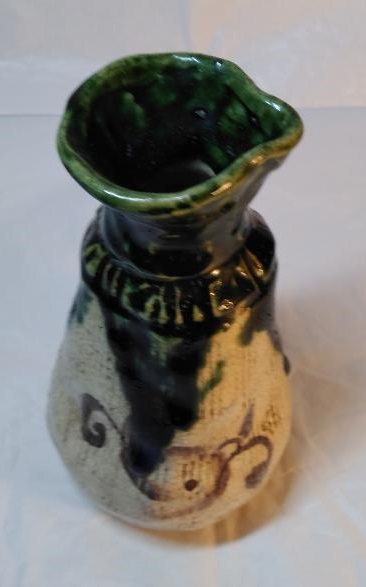
10. Oribe sake-warming flask (tokkuri)

10. Oribe sake-warming flask (tokkuri) 


Coarse gray clay, glazed in cream, white, green, and brown colors; base left unglazed. Weight: 312 g (11 oz). Width of lip: 3.7--5.5 cm (1-3/8 - 2-1/8 in); base diameter: 6 cm (2-1/4 in); widest diameter: 7.7 cm (3 in). Height: 14.5 cm (5-3/4 in).

This sake-warming flask (Japanese: 徳利  tokkuri) is very typical of modern Oribe ware. It can be divided into four sections.  The topmost is a truncated cone roughly 2.5 cm (1 in) tall, flaring outward; the lip of the cone is an irregular circle, with a pouring spout formed on one side. Below this is a narrow neck about 1 cm (1/2 in) tall and 3.7 cm in diameter (1-3/8 in). Below this a shoulder, about 1 cm wide, slopes outward; at the lower end, this section is about 5 cm (2 in) in diameter. Rough, thickish, irregularly spaced vertical grooves have been incised in this section. Below this is the body of the flask; it is roughly pear-shaped, with the widest part being about 2.5 cm (1 in) above the base. The body has been pinched in at several places to form concave spots; the surface is very rough and irregular (oddly this makes it easier to lift and hold than smoother-side flasks such as item 9). Something like a metal comb was used to score the surface of the body with narrow vertical lines from the shoulders down to the widest point.

The body of the vessel was glazed in cream with curving designs added in brown using a brush. The green glaze was applied over this and allowed to ooze down the sides creating thick drips ("tears"), some of which cover the design elements. A thick blob of white glaze was splashed over one of the design elements (visible in the first photo).

Purchased at the Japan Trade Center in San Francisco in the late 1980s or early 1990s.


Sunday, May 2, 2021

9. MIYAKE Kihō 三宅紀保, Oribe sake-warming flask (tokkuri)

9. MIYAKE Kihō 三宅紀保, Oribe sake-warming flask (tokkuri)


Light tan clay; glazed in green, tan, and brown. Weight: 228 g (8 oz). Rim width: 4.5 cm (1-3/4 in); base diameter: 6 cm (2-3/8in). Height: 11.75 cm (4-5/8 in). 

This sake-warming flask (Japanese: 徳利  tokkuri) features a darker and a thinner green glaze than is usual for Oribe ware. The design is drawn with a brush using a brown glaze (probably an iron-rich slip). The criss-crossing lines with circles at the intersections derive from a textile pattern. To the right of this are a partial leaf shape and two sinuous lines. To the left is another partial leaf shape. The lip of the flask has been shaped into a triangle with rounded corners, Each corner can serve as a pouring spout.

This came in a wooden box, with characters in black ink and two red seal stamps on the lid. In the upper left-hand corner of the box are the two characters for Oribe written in a highly cursive form of “grass” characters.  The red stamp beneath these characters is carved in the ancient forms now commonly called “seal” characters for their use on seals and is probably the stamp of the kiln where this was made. The center row contains the characters for tokkuri. The row of characters on the left, again written in highly cursive forms, is the potter’s name. The red stamp is the potter’s seal. The seals and the signature are unique and function as stamps of authenticity. A slip of paper that came with this identifies the kiln name as Tamaki 玉樹窯 in Seto City in Aichi Prefecture and the artist's name as Miyake Kihō  三宅紀保.

Purchased at the Japan Trade Center in San Francisco in the late 1980s or early 1990s.


Pottery

Looking for suggestions

I need to dispose of my collection. I've tried to donate it to several local museums or schools with ceramics programs, but no one wants...