Showing posts with label teabowl. Show all posts

Thursday, January 23, 2025

269. KIMURA Moriyasu , 1935- , Teabowl with Tenmoku glaze

 269. KIMURA Moriyasu 木村盛康, 1935- , Tenmokuyū chawan 天目釉茶盌  (Teabowl with Tenmoku glaze)


Kimura was born into the Kimura family of potters in Kyoto, the youngest of four children. After learning the basics of ceramics at the Kyoto Municipal Industrial High School, he studied under his eldest brother, Morikazu (1921-2015), and learned decorating techniques from his father, Shigeji (1895-1971) . Soon after graduating high school, he saw the National Treasure “yuteki 油滴 (oilspot)  tenmoku teabowl” (see below) in the Atake collection of the Museum of Oriental Ceramics in Osaka and decided to devote himself to Tenmoku glazes, for which he is now famous. 


In 1959, at the age of 24, Moriyasu gained national attention when he was selected as a participant in the Modern Ceramics of Japan exhibition at the National Museum of Art. In the 1960s he began exhibiting at the Nihon Dentō Kōgeiten (National Traditional Crafts Exhibition). His works are held in several important public collections, including the Boston Museum of Fine Arts, Dallas and Houston museums, Peabody Essex Museum, National Palace Museum in Taiwan, and the collection of the Ise Shrine. In 2019-2020, his works were featured in the Iridescent Sparkles of Tenmoku – Works by Kimura Moriyasu exhibition at the Museum of Oriental Ceramics in Osaka. 

Light tan clay. “Oilspot Tenmoku” glaze; oilspots black; area between oilspots, ranging from cream through coral to a dark chocolate colors; foot ring and surrounding area unglazed. Weight: 325 g (11.6 oz). Height: 7.5 cm (3 in). Widths: rim (the widest point), 12 cm (4-3/4 in); of foot ring, 3.3 cm (1-1/4in). 

This sits on the base of the foot ring, which is quite bumpy and irregular and roughly a centimeter wide (3/8 in). On the outside the foot ring measures about one centimeter high; the interior of the ring, which is 3.3 cm (1-1/4 in) in diameter, was only slightly hollowed out. In the unglazed area of the wall beside the foot ring, the artist impressed a rectangular seal into the clay, leaving the seal character version of his given name stamped into the clay (see the third photo from the end). The body of the bowl is a rough circle in cross-section. Above the foot ring, the walls proper extend outward and upward in a very shallow convex arc to a height of around 3.3 cm (1-1/4 in). At this point, the bowl is about 10 cm (4 in) in diameter. Above this the walls extend upward vertically. There is a shallow horizontal groove extending around the bowl about halfway up. Above the groove the walls move outward gradually to the rim, the widest point of the piece. As can be seen in the unglazed portion, the clay body is rather pitted. The surface of the glazed portion is bumpy from the indentations of the oilspots but otherwise smooth to the touch. 

The Tenmoku glaze combines feldspar, limestone, and iron oxide.  The more quickly a piece is cooled, the blacker the glaze becomes. A long firing process and a clay body heavily colored with iron increase the opportunity for iron from the clay to be drawn into the glaze. While the glaze is molten, iron can migrate within the glaze to form surface crystals, as in the “oilspot” glaze, or remain in solution deeper within the glaze for a rich glossy color. Oilspots are more common in an oxidation firing. A longer cooling time allows for maximum surface crystals. For more on this glaze, see Wikipedia, s.v. “Tenmoku.” 

Covered with a Tenmoku glaze except for the foot ring and the area surrounding it.  The surface is densely covered with black “oilspots.” These form circular dimples within the glaze (see the fourth photo). The center of each oilspot reflects light, making the surface appear spotted with glowing dots. The glaze between the oilspots is raised, forming elevated rivulets variously colored cream, coral, and shades of brown. 

This came in a wooden box inscribed by the artist on the topside of the lid in two lines: 天目釉 / 茶盌 tenmokuyū / chawan (Tenmoku glaze / teabowl); the underside of the lid is inscribed 盛康作  Moriyasu saku (made by Moriyasu). The third character is written over the artist’s seal in red ink. showing his given name in seal script.  The same seal was stamped in red on a blue wrapping cloth included in the box. 

Purchased from the Kura Monzen Gallery, Kyoto, Japan, in January 2025 (invoice, shipping and customs documents, jointly with item 270)

Wednesday, November 6, 2024

267. MURAKOSHI Takuma, 1954- , chawan (teabowl)

267. MURAKOSHI Takuma  村越琢磨, 1954- ,  chawan  茶碗  (teabowl)


For Murakoshi, see item no. 234.

 Light gray clay from Shigaraki, with some small white stone flecks mixed into the clay. Partially glazed in light gray, brown, and black, with kiln effects: ­hi-iro colors in the red coral range on the unglazed sections and light green bidoro and white shiseki deposits. Weight: 404 g (14 oz). Height: 7.3 cm (2-7/8 in). Width: of rim (widest): 15.8 x 10.8 cm (6-1/4 x 4-3/8 in); foot ring: 6.3 x 5.8 cm (2-1/2 x 2-1/4 in). 

Like items 235 and 265, this was hand-built using flat ribbons of clay. It sits on the flat foot ring, a rough oval, with the interior hollowed out. The ring is about a centimeter (3/8 in) broad, and the hollowed-out portion is about 0.6 cm (1/4 in) deep in the middle. Any given cross-section of the piece is a rough oval, but with many dents and protrusions. The walls rise outward from the foot ring to the rim; overall the walls rise outward in a straightish line to about half the vertical distance and then flare outward slightly before rising, again in a straightish line, to the rim. This creates a ledge about halfway up the sides, a convenient place for the fingers when holding the cup. On the long sides of the cup, the walls are rolled inward somewhat. On the short ends, the walls slope outward more. The rim is beveled. Along the long front and back sides, it slopes inward toward the interior; along the ends, it slopes outward. Because of this, it would be better to drink from one of the ends rather than a side. The shape of the interior mirrors that of the exterior. The joins between the ribbons of clay are pronounced on the exterior but were flattened and smoothed on the interior. The surface of this is quite pitted, with many small bumps. Because the entire surface of the interior was glazed, its surface is smoother than that of the exterior, but it is still quite bumpy and rough. 

The artist’s sigil, a long line with a short bar at the top with two tear-drop indents near the bottom end was incised into the side of the cup. 

This was glazed first with a thin gray ash glaze covering all of the interior and the top two-three centimeters (inch) of the exterior walls. Some of this glaze dripped down on the exterior to form thicker beads. At places where this glaze is thin, the clay took on a reddish hi-iro hue, visible through the glaze. A heavy, iron-rich glaze was used on one of the long sides of the interior and both long sides of the exterior. In all these cases, this glaze was applied at the top and allowed to run down the sides to form a rough triangle of darker color. The edges of these triangles and the area at the bottom of the interior where this glaze pooled are black in color. On the interior, a drip of glaze ran along the beveled edge of the rim and then spilled down one of the short ends of the interior. Those portions of the exterior not covered by glazes exhibit hi-iro  colors in the red-coral range. The few horizontal surfaces have melted ash deposits that vitrified to form the green glass-like deposits known as bidoro. The foot ring and the area within have heavy deposits of a very glossy, thick black glazing.  The embedded stone chips show up as white spots; there are also many small, white ash deposits (shiseki) on both the interior and the exterior. A complex mixture of applied glazes and kiln effects. 

This came in a wooden box, inscribed by Murakoshi in his distinctive calligraphy, in two lines:  茶碗 / たくま chawan / takuma  (teabowl / Takuma). As is his habit, the inscription begins on the lid and continues on the front side, with the final stroke of the character 碗 extending onto the right-hand side of the box. The top is stamped in red with a seal with Murakoshi’s studio name: へうげも屋  (Hyōgemono-ya, “Jocular Fellow Studio”); interestingly he uses the kyūkanazukai, or old kana usage, to write hyō. Hyōgemono is also the name of a popular manga character. On the side of the box is another seal stamped in red, giving Takuma in characters, 琢磨. Included in the box were a brown wrapping cloth and a printed leaflet from Murakoshi. 

Purchased from the Kura Monzen Gallery in Kyoto in October 2024, who received it directly from the potter in summer 2024. This was part of an exhibit entitled Shōka 昇華  (“sublime”), or Modern Masters in English, a show of fifteen currently active potters (invoice and shipping and customs documents).


Monday, March 18, 2024

240. BUNKYŌ Masaki (fl. 1772-89), “Hinode jūrō” chawan (Sunrise Longevity [God] teabowl)

240. BUNKYŌ Masaki  文京柾, fl. 1772-89. “Hinode jūrō” chawan 日の出壽老茶盌 (Sunrise Longevity [God] teabowl)


Description provided by seller: 

“This extraordinary tea bowl, eloquently named ‘Sunrise and Longevity,’ emerges as a masterful creation by the tea master Bunkyō Masaki. A visual symphony unfolds within the bowl, as a pristine white glaze delicately cascades over a vibrant reddish canvas, echoing the gentle hues of the morning sun. Amidst this enchanting surface, the discerning eye can trace the graceful figure of Jūrōjin 壽老神, the deity symbolizing longevity.

“Indeed, this tea bowl stands as a resplendent masterpiece, encapsulating the very essence of a sunrise. Bunkyō Masaki's meticulous craftsmanship and artistic vision radiate, transforming this piece into a profound testament to the beauty and artistry inherent in his pottery.

“Residing in Miyamachi near Nagoya Castle during the An’ei-Tenmei era (1772-89), Bunkyo Masaki was not merely a doctor but also a dedicated practitioner of the tea ceremony. His renown extended beyond medical expertise to encompass exceptional pottery craftsmanship, notably in the creation of tea utensils such as chawan (tea bowls), mizusashi (water jars), kōrō (incense burners), and lid holders. Notably, Bunkyō Masaki's approach embraced the artisanal technique of handcrafting (te-giri  手切 ) rather than relying on a wheel.

“Bunkyo Masaki's creative palette extended to various glazes, including Kisetō, Oribe, as well as traditional Setō iron and ash glazes. His aspiration to emulate Momoyama pieces, coupled with experimentation in glazing techniques, attests to the depth of his artistic exploration.

“Of particular intrigue is the indirect revelation within Bunkyō Masaki's work, shedding light on the rich tapestry of pottery techniques in Setō during his era. Remarkably, his pottery endeavors predate Katō Shuntai's birth by 20-30 years, the renowned artisan celebrated for his impeccable replicas of Momoyama pottery. This chronological distinction suggests that the techniques for Momoyama imitations had already taken root in Setō during the latter half of the 1700s. Bunkyō Masaki's contributions to the art form, coupled with his commitment to replicating historical styles, contribute significantly to the cultural legacy of Setō pottery.”

Dark brown clay. Glazed in orangish-pink and white with black figures; base and a narrow band around base left unglazed. Weight: 272 g (9.7 oz). Width top, 11.8 cm (4-5//8 in); base, 5 cm (2 in). Height: 6.3 cm (2-1/2 in). 

This was handmolded by pinching. It sits on an uneven base, roughly circular. The interior of the base was gouged out in an irregular shape. Because of the unevenness of the base, the bowl wobbles a bit. From the base, the walls rise in convex arc to roughly two-thirds the height and then continue in a straight line to the rim, flaring outwards slightly. The walls are quite bumpy and vary considerably in thickness. The rim is very irregular. A small chip in the rim was repaired at some point using red lacquer. On the back side, just above the base, a round stamp was pressed into the wall. It is slightly large in diameter than a quarter. There appear to be raised figures of characters within the stamp, but they may just be protrusions in the clay. There is a circle of the same size on the interior of the bowl, in a different location. The surface is quite smooth to the touch. 

A glaze that fired in the color range of orangish-pink to rusty pink was first applied to the interior and exterior of the pot. The figure of Jūrōjin was drawn in black (probably the iron-rich glaze used in Japanese pottery for such drawings) on the front. On the right-hand side of the pot a small circular squiggle was drawn just above the unglazed portion. A white glaze was then splashed over the exterior wall, largely obscuring the drawing of Jūrōjin. Some of this white glazed dripped down the interior. 

This came in a box, with two old wrapping cloths. The top of the box is inscribed, in two lines, 文京柾 / 日の出壽老茶盌文京柾  (Bunkyō Masaki  /  Hinode jūrō chawan).  The underside of the lid has a long inscription in larger characters, followed on the extreme left with lines in smaller characters. Both are written in Classical Chinese, and each is followed by the personal seal of the writer stamped in red. The first inscription is dated “the first ten-day period, September 1915.”  I am unable to read all the characters. The first inscription praises Bunkyō’s skills in general terms. The second supplies the correct character for “kyō” in the potter’s name.

Purchased from Treasures of Old Times, in Bangkok, Thailand, February 2024. (Purchase receipt)

Sunday, September 10, 2023

229. Kutsugata kuro Oribe chawan (clog-shaped black Oribe teabowl)

229.  Kutsugata  kuro Oribe chawan  沓形黒織部茶碗  (clog-shaped black Oribe teabowl)


Gray clay; glazed in black and cream with added decorations in brown; foot ring and base left unglazed. Weight: 398 g (14 oz). Width of rim: 14 x 11 cm (5-1/2 x 4-3/8 in); of foot ring: 5.4 x 5.2 cm (2-3/16 x 2 in). Height. 6.6 cm (2-5/8 in). 

This is a kutsugata, or “clog-shaped” teabowl. It sits on the foot ring, which is an irregular oval, about 0.5 cm (1/4 in) high on the exterior; the interior of the foot ring was hollowed out to slightly less than this depth. Above the foot ring, the bottom rises at a shallow angle to the junction with the vertical walls, which begin 1.7 cm (5/8 in) above the base. An artist’s mark was inscribed on the bottom. There could be characters inscribed within the foot ring, but that may just be my eye trying to find patterns in the scratches. The bottom dimensions of the sides are slightly narrower than the rim but generally mirror the shape of the rim. There is a horizontal groove a finger’s width wide running around the piece, centered just below the midpoint of the walls. Below this the walls are shaped in a shallow convex arc; above it, the walls swell gently outward to the rim in a straightish line. The walls have many horizontal lines running around the piece. The rim is rounded. The interior follows the contours of the exterior but is much smoother. Overall the surface is quite smooth, including the unglazed sections. The clay looks coarse, but it is actually fine-grained. The base is pitted but otherwise smooth to the touch. 

The foot ring and most of the base were left unglazed. The outer edges of the base have some spillover black glaze on one side. The interior and most of the exterior were coated in a thick black glaze. Two sections of the walls were covered in a cream glaze (probably put on before the black glaze was applied). Portions of the cream glaze have a rosy orange tint, somewhat like the effects found with the Shino glaze. A brown glaze was used to draw patterns in the cream areas. 

This came in an old wooden box, inscribed in two lines. The line on the right reads: 沓形 (kutsugata, or “clog-shaped”; the line on the left:  黒織部茶碗  (kuro Oribe chawan, or “black Oribe teabowl”). 

The seller dated this piece to the Meiji era. 

Purchased from Treasures of Old Times), Bangcock, Thailand, September 2023. 

Saturday, September 9, 2023

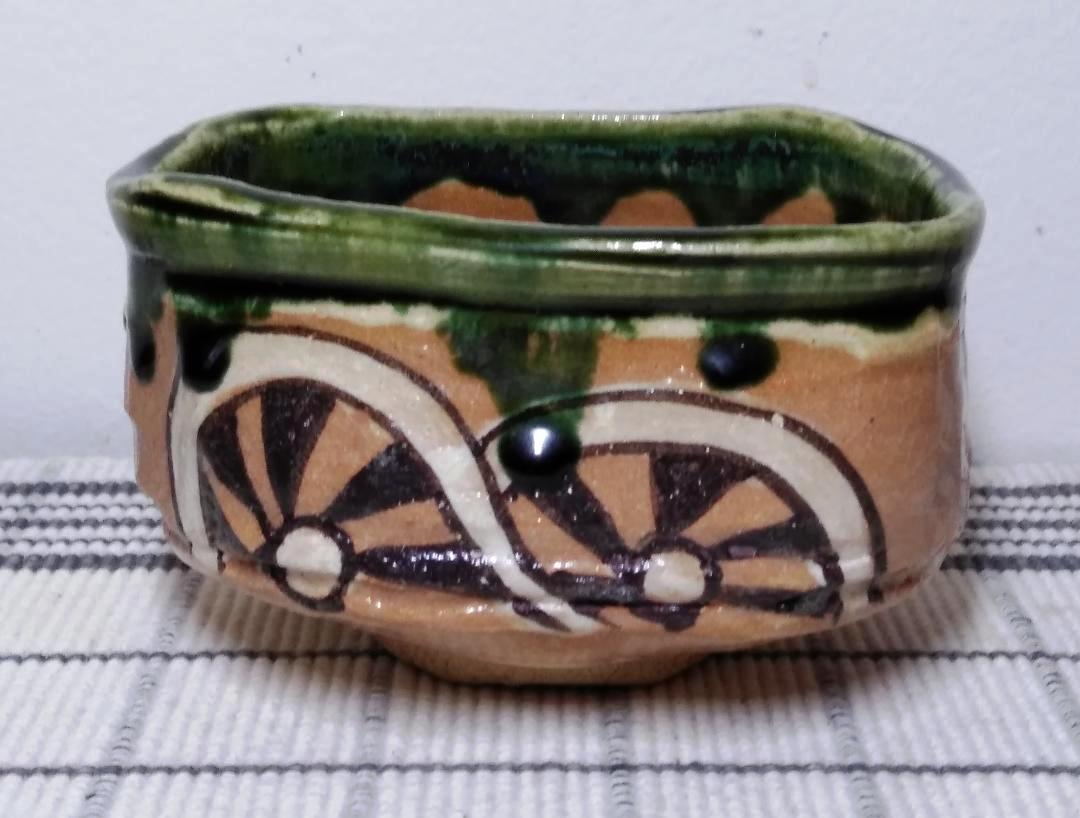
228. TAKIGUCHI Kiheiji, 1937- , aka Oribe chawan (red Oribe teabowl)

228. TAKIGUCHI Kiheiji  瀧口喜兵爾,  1937- ,  赤織部茶盌 aka Oribe chawan (red Oribe teabowl)


Takiguchi was born in the Asakusa district of Tokyo and graduated from the Faculty of Agriculture at Tamagawa University. He studied under the renowned Mino-ware master KATŌ Jūemon (see items 184 and 227), before venturing out on his own in 1965. His artistic pursuits took him to Kyoto's Shinroku Tsuji pottery studio and later led him to establish his kiln in Ogaya, Mino. A move to the U.S. in 1971 led him to Malborough, Vermont, where he set up an anagama kiln in 1973 and followed with a climbing kiln in 1975. He is a specialist in red and black Oribe-ware.  His works are in the collections of the Brooklyn Museum and the Minneapolis Museum of Art. 

Light reddish-tan and white clays, with a slip glaze and added decoration in green, cream, and brown glazes; foot ring and surrounding areas left unglazed. Weight: 334 g (12 oz). Width of rim: 13 x 10 cm (5 x 4 in); of foot ring: 5.6 x 5.3 cm (2-3/8 x 2 in). Height: 6.6 cm (2-5/8 in). 

This is a kutsugata , or “clog-shaped” teabowl. It sits on the foot ring, which is an irregular oval, about 0.4 cm (3/16 in) high on the exterior; the interior of the foot ring was hollowed out to about the same depth. Above the foot ring, the walls rise in a straight line at about a 30-deegree angle to a height of 1.2 cm (1/2 in) and approximately the width and shape of the rim. The potter’s mark was incised into the clay of the base. There is a sharp break in direction at this point. Above this, the walls rise vertically to about 1.2 cm (1/2 in) below the rim in a straightish line. Just above the base, there is a circular groove around the exterior of the piece. Then the walls bulge outward slightly in a convex arc ending in a shallow concave groove, about a finger’s width wide, encircling the piece. This area of the walls contains many short vertical and horizontal grooves and bulges. Above this, the walls angle outward slightly to the rim, which is curved. The interior of the piece mirrors the exterior, but the walls are much smoother. The clay is finely grained, and even the unglazed portions are smooth. 

Another piece using the Narumi technique. The lower section of this was formed with a light reddish-tan clay; the rim with a whitish clay. With the exceptions of the foot ring and an area of the base surrounding it, the piece was covered in a slip, which became glossy during firing. The front side was decorated in two cartwheels using cream and brown glazes. On the back side are two squares—the outline and an interior area are marked off with borders drawn with the brown glaze. The area between the borders was filled in the cream glaze. The rim and the upper section of both the interior and the exterior was covered with the heavy green Oribe copper glaze, which was allowed to run down the sides in several beads, partially covering the other decorations. A narrow line of white clay is occasionally visible at the base of the green glaze. 

This came in a wooden box, with a short printed biography and an orange wrapping cloth. One side of the box is inscribed, in two columns:  on the right--赤織部茶盌 (aka Oribe chawan, “red Oribe teabowl”; a variant character for wan is used); and on the left--喜兵爾 (Kiheiji), followed by the artist’s seal in red ink. 

The seller labeled this a “Momoyama-style” teabowl. It is strikingly similar to item 227 both in construction and decoration. This piece is much more lively, however. In  the Hayashi version, the triangles within the cartwheels were drawn with straight lines; here the sides of the triangles are curved, which imparts a sense of motion to the wheels. The greater abandon with which the green glaze was applied here also makes this a more free-wheeling piece. Item 227 is static in comparison. 

Purchased from Shogun Pottery (a new branch of Treasures of Old Times), in Hobarth, Australia, September 2023. (Joint receipt with item 227).

Friday, September 8, 2023

227. HAYASHI Eiji, 1931- , aka Oribe chawan (red Oribe teabowl)

 227. HAYASHI Eiji 林英仁, 1931- , 赤織部茶碗 aka Oribe chawan (red Oribe teabowl)


From Tajimi City, Gifu Prefecture, Hayashi is the grandson of the esteemed Katō Juemon (see item 184), a designated Gifu prefectural intangible cultural property. Under the guidance of his grandfather, he underwent rigorous training in the traditional art of pottery. He specializes in old-style Mino-, Shino-, and Kiseto-wares. He graduated from Tamagawa University, where he subsequently was an assistant professor. In 1968, Hayashi returned to his hometown and dedicated himself primarily to tea pottery. 

White and reddish-tan clays using the Narumi technique (see item 217); slip glazed with added decorations in Oribe green, cream, and brown; foot ring and surrounding areas left unglazed. Weight: 392 g (14 oz).Width of rim: 14 x 10 cm (5-1/2 x 4 in); of foot ring: 5.7 x 5.5 cm (2-3/8 x 2-1/8 in). Height: 7.5 cm (2-7/8 in). 

This is a kutsugata , or “clog-shaped” teabowl. It sits on the foot ring, which is an irregular oval, about 0.6 cm (1/4 in) high on the exterior; the interior of the foot ring was hollowed out to about a third of that on the interior. Above the foot ring, the walls rise in a straight line at a shallow angle to a height of 1.8 cm (5/8  in). The potter’s mark was incised into the clay at this point. There is a sharp break in direction at this point. Above this, the wall rise vertically to the rim in a straightish line. Just above the base, there is a circular groove around the exterior of the piece. Then the walls tilt slightly outward as they rise to around 1.8 cm below the rim. This area of the walls is flatter but still retains the shallow grooves and ridges created by the potter’s fingers as he shaped the piece. Above this, there is another groove encircling the piece before the walls flare outward at a sharper angle to meet the rim.  This area has several shallow grooves running around the circumference. The interior of the piece mirrors the exterior, but the walls are much smoother. The clay is finely grained, and even the unglazed portions are smooth. 

With the exception of the foot ring and the area of the base surrounding it, the piece was covered with a slip, which, when the piece was fired, created a glossy surface. The upper portion of the piece (roughly the first 2 cm [3/4 in]) was formed from a white clay. The top part of this section were covered with a thin layer of the green copper Oribe glaze. The white clay is visible elsewhere beneath the slip. Beneath this, the piece was made from a reddish-tan clay. This section was decorated in cream and brown. The front has two cartwheels. The back side has two square and three circular elements. Each is outlined in brown, with the interior filled in with cream, with added lines in brown. 

This came in a wooden box with an inscription in three lines, reading from right to left: 赤織部 (aka Oribe, “red Oribe); 茶碗 (chawan, “teabowl”); 英仁 (Eiji), followed by the artist’s seal stamped in red with the characters for his “studio name,” or sobriquet. The characters in the seal are 桃山, which can be read tōsan or tōzan or momoyama. They translate literally as “peach mountain.” The second reading might be a pun on 登山, “climbing the mountain,” an important ritual in some sects of Japanese Buddhism. “Momoyama” is the name given to a period of Japanese history; item 228, which has a similar decorative scheme, was identified by the seller as a Momoyama-style piece  If the latter is the correct interpretation, it may be Hayashi’s claim to be making old-style pieces. Of course, all these meanings could be invoked simultaneously. The wooden box was further enclosed in a cardboard box with a label identifying the contents. 

Purchased from Shogun Pottery (a new branch of Treasures of Old Times), in Hobarth, Australia, September 2023 (receipt).

Pottery

Looking for suggestions

I need to dispose of my collection. I've tried to donate it to several local museums or schools with ceramics programs, but no one wants...