Showing posts with label Kevin Viens. Show all posts

Wednesday, May 19, 2021

73. Kevin Viens, vase

73. Kevin Viens, vase


For Viens, see item 69.

Light brown clay, black, yellow, brown, red, dark blue, and light blue glazes; base left unglazed. Weight: 822 g (1.8 lb). Rim diameter: 8.5 cm (3-3/8 in); maximum diameter: 10.3 cm (4-1/8 in); foot ring diameter: 5.7 cm (2-1/4 in). Height: 17 cm (6-3/4 in).

The sits on the base of the foot ring. The foot ring is 0.3 cm (1/8 in) high on the exterior; the interior has been hollowed to a depth of 0.6 cm (1/4 in).  The artist’s surname, “VIENS,” is incised into the base. From the base the walls rise in a long shallow arc to the shoulders, which are 8.8 cm (3-1/2 in) in diameter and 13.2 cm (5-1/4 in) above the base. The maximum diameter lies 7.5 cm (3 in) above the base. There is a groove around the circumference of the pot at the shoulder. Above this, there are two concentric semi-circular ridges in the walls of the pot. The neck of the pot is directly above the second ridge; it is 7.5 cm (3 in) in diameter and begins 14.6 cm (5-7/8 in) above the base. The rounded rim of the pot is directly over this.

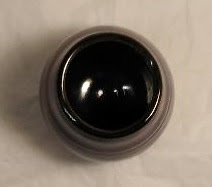
The base and the foot ring were left unglazed. A resist technique was used to create the red dots. They are so uniform in size and so circular that Viens must have used something like gummed circular tags to create them. It isn’t apparent in the pictures, but the dots are red around their perimeters; the interiors tend to be the same tan color as the clay. To judge from the splashes of other colors on the red glaze, it was the first coat laid down. Besides the red dots, the red is also visible in a narrow band just above the groove that marks the shoulder. From this groove down to the foot ring, the walls of the pot were covered in the dark blue glaze. The long, light blue lines were added over the dark blue glaze. A horizontal band encircling the neck was colored yellow and brown. Finally, the interior of the pot, the rim, and the upper portion of the neck were glazed in black.

In a pattern repeated in all the pots by Viens, a formal, well-modeled shape is combined with free-wheeling decoration. The complex color scheme works to emphasize the different parts of the pot.

Purchased at the annual spring sale at Feet of Clay Pottery, Brookline, Massachusetts, April 2019.


72. Kevin Viens, bottle vase

 72. Kevin Viens, bottle vase


For Viens, see item 69.

Reddish brown clay(?; see below); white, blue, mustard, and black glazes. Weight: 1206 g (2.7 lb). Rim diameter: 3.7 cm (1-1/2 in); maximum diameter: 8.7 cm (3-3/8 in); base diameter: 5.3 cm (2-1/8). Height: 25.2 cm (10 in).

I’m not sure about the color of the clay; the base appears to have been covered with a white slip, but in a few places small patches of red are visible in areas the slip didn’t cover.

This sits directly on the flat base. The artist’s surname “VIENS” is barely visible beneath the slip. From the base the walls rise in a shallow arc to a height of 17.5 cm (7 in) at the shoulder. The maximum diameter is reached about 8.8 cm (3-1/2 in) above the base. A break is sensible to the touch at the shoulder, but visible to the eye only as a slight bump in the direction of reflected light. From the shoulder the walls narrow up to the neck, which is 3.2 cm (1-1/4 in) in diameter and 22.7 cm (9 in) above the base. The walls flare out a bit as they approach the rim.

On the exterior, the ground is a thick, white glaze. A blue glaze was applied (with cheesecloth?  with a brush?) in an ascending spiral of varying width and density around the circumference of the pot from the base up to the break at the shoulder. The neck, shoulders, and part of the upper walls of the body were covered with a semi-transparent dark-mustard-colored (think Gulden’s rather than French’s) glaze. The ends of the blue spiral are visible under this glaze. Finally, the neck, rim, and interior of the pot were covered with a black glaze.  The base of the piece is not glazed but appears to be covered with a white slip.

A heavy pot with good use of shape to define areas for decoration. The lines of the pot are disrupted by the decoration, however, unsettling the impact of the piece in a good way.

Purchased at the annual spring sale at Feet of Clay Pottery, Brookline, Massachusetts, April 2019.


71. Kevin Viens, miniature pot

71. Kevin Viens, miniature pot


For Viens, see item 69.

Off-white clay, green and black glazes; base left unglazed. Weight: 172 g (6 oz). Rim and maximum diameters: 6.3 cm (2-1/2 in); base diameter: 3.7 cm (1-1/2 in). Height: 7 cm (3 in).

This sits directly on the base. The interior of the base has been hollowed out to a depth of about 03. cm (1/8 in). “VIENS” is lightly incised into the base.  From the base the walls arc in a convex shape, reaching the widest diameter of 3.2 cm (1-1/4 in) above the base and ending about 5 cm (2 in) above the base. Just below the end of this convex arc, a groove was incised around the circumference of the pot. Above the arc, the walls rise in more or less a straight line to the neck, which is 5 cm (2 in) wide and 6 cm (2-3/8 in) above the vase. From the neck the walls curve outward in a concave arc to the rim.

The base and a bit of the exterior wall above the base was left unglazed. Up to the neck, the exterior of the pot is covered with a light green glaze. The interior and the neck of the exterior were glazed in black.

Purchased at the annual spring sale at Feet of Clay Pottery, Brookline, Massachusetts, April 2019.

70. Kevin Viens, miniature pot

70. Kevin Viens, miniature pot


For Viens, see item 69.

Off-white clay, black, blue/red glazes; base left unglazed. Weight: 188 g (6.5 oz). Rim diameter: 4.7 cm (1-7/8 in); maximum diameter: 6 cm (2-3/8 in); base diameter: 3.5 cm (1-3/8 in). Height: 7.5 cm (3 in).

This sits on the base, which has been hollowed out to a depth of 0.3 cm (1/8 in). “VIENS” was incised shallowly into the base. From the base the walls rise outward to the maximum diameter 3.7 cm (1-1/2 in) above the base. They then slant inward in more or less a straight line to the neck, which is 4.5 cm (1-3/4 in) in diameter and 7 cm (2-3/4 in) above the base. There is a groove around the circumference 5 cm (2 in) above the base. About 1.3 cm (1/2 in) above this, there is a slight bulge outward in the walls. From the neck the walls rise at a steep angle to the rim.

The base and a bit of the exterior walls above the base were left unglazed. Up to the neck a glaze that sometimes shows as blue and sometimes as red depending on the temperature and air currents in the kiln was applied. Because of the nature of the blue/red glaze, the exterior is a mix of colors. The neck and the interior of the pot were glazed in black.

Purchased at the annual winter sale at Feet of Clay Pottery, Brookline, Massachusetts, December 2018.


69. Kevin Viens, miniature pot

69. Kevin Viens, miniature pot


Viens is a Boston-area potter. I’ve not been able to find out much about him. His pieces feature excellent shapes and a strong sense of design. The interiors of all the pots shown here were glazed in black, which seems to be a preference of his. For more examples of his work, see his page at www.feetofclaypottery.com and his website, www.kevinviensceramics.com.

Off-white clay, black glaze, red and tan slips; base left unglazed. Weight: 186 g (6.5 oz). Rim diameter: 6 cm (2-3/8 in); maximum diameter: 7 cm (2-3/4 in); base diameter: 3.7 cm (1-1/2 in). Height: 6 cm (2-3/8 in).

This sits directly on the base, which has been hollowed out to a very shallow depth. “VIENS” was incised into the base. From the base, the walls rise outward in more or less a straight line to the maximum diameter 3.7 cm (1-1/2 in) above the base. There the walls break and slant inward at a shallow angle before rising briefly to another break 4.7 cm (1-7/8 in) from the base. There is a narrow shoulder at this point, and from there the walls slant inward to the neck, which is 4.7 cm (1-7/8 in) wide and 5.7 cm (2-1/4 in) above the base. From there the walls arc upward and outward to the underside of the rim.

The base and a bit of the exterior above the base were left unglazed. A red slip was applied to the rest of the exterior. This was covered with a tan slip. The red shows through the tan just above the base and at the breaks in the exterior wall, creating narrow red circles around the circumference of the pot at these points. The red also shows through at random places. The neck and interior of the pot were covered with a thick black glaze.

For such a small object, this has a complicated shape, which the decoration outlines and emphasizes.

 Purchased at the annual winter sale Feet of Clay Pottery, Brookline, Massachusetts, December 2018.


Pottery

Looking for suggestions

I need to dispose of my collection. I've tried to donate it to several local museums or schools with ceramics programs, but no one wants...