Showing posts with label Iga-ware. Show all posts

Thursday, June 6, 2024

251. ATARASHI Manabu, 1973- , Iga-ware hanging vase

251.  ATARASHI Manabu 新学, 1973-  , Iga kakehanaire  伊賀掛花入  (Iga-ware hanging vase)


For Atarashi, see item no. 222.  To quote Robert Mangold, the owner of the gallery that sold this piece, “Intensely fired multiple times to achieve the bidoro glass puddles and landscape effects which define his aesthetic, the geometric works add a contemporary sensibility to the traditional Iga style and transcend the realm of utilitarian crafts breaking into the sculptural domain. His work has proven innovative and challenging to the norm, taking his father’s tradition into the 21st century." 

Light gray clay, with many very small feldspar pebbles. Fired unglazed. Surface colors and effects in the gray to black range, with patches of dark reddish brown hi-iro 火色. A few spots of vitrified ash glaze. Weight: 1260 g (2.8 lb). Height: 36.5 cm (14-1/4 in). Width: 12.5 cm (4-7/8 in). 

This is roughly triangular in cross-section. The back is flatter in the center and nearer the top, with the edges curving to meet the side seams. The front side is bisected by a rough, irregular spine running vertically slightly left of center. To the left of this spine the wall is flattish; to the right and beginning at the top, several areas have been scooped out to form shallow concavities. Towards the bottom of the front side, the spine becomes less prominent, disappearing altogether just above the bottom. Here the two sides join to form a convex swelling. The bottom has a jutting promontory on both sides, the left one more pronounced and longer. At each side of the top at the seams between the front and back (the widest point of the piece) is a pointed, triangular protuberance. The interior is very irregular; it extends to about 2.5 cm (an inch) above the center bottom. The hole at the top is a rough oval, measuring 3.8 x 2.5 cm (1-1/2 x 1 in). The surface is smoothish, with some rough patches. There is a small metal hook on the upper back side for hanging the piece. This was inserted through a hole in the wall of the vase. 

This was fired unglazed. The remains of the posts used to separate the piece from the kiln shelves suggests that this was positioned with the back side up during the firing. The back side received a coating of ash, leaving it a mottled gray and black in color. The concavities on the right side of the front are reddish brown in color (hi-iro effects). The rest of the front is again a mottled gray and black. There are a few vitrified areas on the front of the vase, with a few streams of melted ash glaze on the right side. Except around the top, the interior of the piece lacks kiln effects. 

This came in a wooden box, inscribed by the artist, in three lines:  伊賀 / 掛花入 / 新学  (Iga / kakehanaire / Atarashi Manabu;  Iga-ware / hanging vase / Atarashi Manabu), followed by the artist’s seal stamped in red. Included in the box were a light blue wrapping cloth, also stamped in red with the artist’s seal, and a short printed biography of the artist in both Japanese and English. 

Purchased from Kura Monzen Gallery in Kyoto, Japan, May 2024 (invoice, shipping and customs documents).

Sunday, March 31, 2024

244. KOJIMA Kenji , 1953- , Iga-ware vase

244.  KOJIMA Kenji  小島憲二,1953- , 伊賀耳付花入  Iga mimitsuki hanaire (Iga-ware vase with ear-lugs)


Kojima Kenji was born in Aichi Prefecture in 1953 and graduated from the Tokoname Ceramics Vocational High School in 1971. In 1973 he spent a year in Iga before moving to Bizen for a five-year apprenticeship with Konishi Tōzō. He returned to Iga in 1979 and built an anagama. He has exhibited with the Nihon Tōgeiten National Ceramics Exhibition, Asahi Tōgeiten Ceramics Art Exhibition, and Chūnichi International Ceramics Exhibition, as well as an impressive list of solo exhibitions in some of Japan’s top galleries. Pictures of many of his works can be found online. 

Light gray clay, with the addition of many small feldspar-sand pebbles; kiln effects in the reddish brown range (hi-iro coloration) and natural-ash glazing in the cream to black range, with a glossy sheen on all parts of the exterior and some bidoro formation particularly on horizontal surfaces; the interior has some drips of natural-ash glazing and reddish-brown coloration from kiln effects, with very little sheen. Weight: 3.4 kg (7.7 lb). Height: 28.5 cm (11-1/4 in). Width: of rim, 12.7 cm (5 in); at widest point, 16.3 cm (6.5 in); of base, 13.3 x 15 cm (5-1/4 x 6 in). 

This sits on a flat base, an irregular oval. There are two small paper labels attached to the base, presumably inventory marks; one reads “2,” and the other "MC 534.”   The base is about a centimeter and a half high (1/2 in); the edges of the base extend beyond the bottom of the walls of the piece, forming a ledge of varying widths. The walls are divided into two, stacked sections, each a rough cylinder. The two are joined about 14 cm (5-1/2 in) above the base. The bottom section is roughly cylindrical. The top section is wider at the lower end, where it overhangs the bottom section a bit. Its walls move inward slightly toward the curled rim. The upper surface of the rim was flattened. The mouth is circular, but with five, irregularly shaped indentions, almost as if it were the outline of a five-petalled flower. Although Kojima called the handles by the traditional name of “ears,” they are straighter than most examples of pottery mimi, bowing outward slightly only toward the center of the vertical distance. The tops of the handles are attached at the join between the two sections, and the bottoms to the ledge formed by the upper surface of the base. Because of the orientation and shape of the upper section, from some angles the base appears to tilt. To judge from pictures of other examples of Kojima’s Iga-ware vases I found online, he often uses this two-part structure for vases.   

On the lower section, on both the front and the back (arbitrarily defined as the space between the handles, with the side with the most hi-iro coloration designated the front), Kojima made two deep, vertical incisions the length of the cylinder. Between these two grooves, he incised two X’s with somewhat shallower cuts, The decoration on the top section is more irregular. A groove circles the section near its bottom. There are five, irregularly spaced vertical grooves. These tend to slope to the right as they move downwards. On both the front and the back, off to one side, there is a dent shaped like the > symbol. On the front, this dent is filled with lines creating a pattern of squares. On the back this shape was obscured by a heavy coating of natural ash glazing. 

The surface texture of the piece ranges from quite smooth in the areas of heavy ash glazing to very rough at the edges and seams. The interior areas largely unaffected by the natural-ash glazing reveal that the clay used was very coarse. 

This was fired unglazed. The color of the unaffected clay shows through in a few spots on the base and underneath one of the handles. In general the bottom cylinder exhibits more of the hi-iro and less of the natural ash glazing. The ash glazing is heaviest on the upper section on the right-hand side of the piece. On the back of the piece, the ash glazing flowed down over the bottom section, became darker as it neared the base. The horizontal areas on the lip, the tops of the handles, the groove where the two sections are joined, and the ledge where the base and the lower section meet exhibit many areas of the dark-green glass-like vitrification known as bidoro.  Again, in looking at other examples of Kojima’s Iga-ware vases, this is a common pattern of kiln effects. He must have carefully placed the pieces in the kiln with the deliberate aim of creating such results. 

The double structure of the piece is mirrored in the double structure of the kiln effects. On this piece, the handles appear to be supporting the upper section and redistributing its weight away from the lower section, much as flying buttresses do.

This came in a wooden box, inscribed by Kojima on the lid in three lines on the upper left and center: 伊賀 / 耳付 / 花入  Iga / mimitsuki / hanaire (Iga[-ware] / ear-lugs / vase); and signed Kenji 憲二 with Kojima’s seal stamped in red.  Included in the box were a brown wrapping cloth and a short printed biography. 

Purchased from the Kura Monzen Gallery in Kyoto, Japan, in March 2024 (invoice and customs and shipping documents)

Tuesday, March 19, 2024

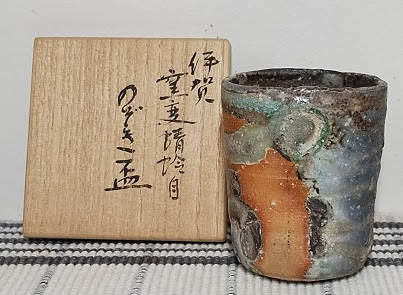
242. MATSUO Takaaki (1938- ), Iga-ware cylindrical sake cup, with natural ash-glazing, kiln effects, and dragonfly eyes

242. MATSUO Takaaki 松尾髙明  (1938- ),  伊賀自然釉窯変蜻蛉目のぞき盃  Iga shizenyū yōhen tombo no me nozoki-hai (Iga-ware cylindrical sake cup, with natural ash-glazing, kiln effects, and dragonfly eyes)


For Matsuo, see item 241. 

Light gray clay. Natural ash glazing over the exterior and upper portion of the interior, with kiln effects in the red range on the exterior and interior; some vitrification. Weight: 80 g (2.9 oz).  Width: of rim: 5.5 x 4.8 cm (2-1/4 x 1-7/8 in); of base, 3.5 cm (1-1/2 in). Height: 6.5 cm (2-5/8). 

This is similar to the preceding item, but slightly smaller. The inscription on the box explicity labels it a natural ash-glazed piece. It was also fired with the mouth facing the direction of the heat and ash flow. 

This sits on a very shallow, concave circular base. Above the base the walls flare out at a shallow angle to a diameter of 4.2 cm (1-3/4 in). From there the walls rise in more or less a straight line to the rim. The top of the cup is an oval. The movement from the round base to the oval rim creates a piece with two slightly flatter sides. The surface varies from smooth over the vitrified portions to rough over the areas with more ash deposits. Nozoki is one of the terms for labeling a cylindrical piece. 

Unglazed. This was apparently fired lying on one side with the mouth facing the direction of the heat and ash flow. The ash deposits are not as heavy as they are on the preceding item; they are heaviest on the side that faced upwards. The vitrification occurred at the edges of these ash deposits and ran down the sides in several long drips. The side facing downwards shows kiln effects in the red range. The interior shows some ash deposits at the rim; the rest of the interior shows kiln effects. The base was colored a dull red from the kiln effects. 

This came in a box, inscribed by Matsuo. The top surface of the lid reads, in four lines, 伊賀 / 自然釉窯変 / 蜻蛉目 / のぞき盃  (Iga / shizenyū yōhen / tombo no me / nozoki-hai;  Iga[-ware] / natural ash-glazing, kiln effects / dragonfly eyes / cylindrical cup). The underside of the lid is inscribed with the potter’s given name 髙明 (Takaaki) followed by an impression of his seal stamped in red. Included with the box were a short printed biography and an orange wrapping cloth. 

Purchased from Kura Monzen Gallery, in Kyoto, Japan, (Shipping label, invoices, customs documents)


241. MATSUO Takaaki (1938- ), Iga-ware cylindrical sake cup, with kiln effects and dragonfly eyes

241.  MATSUO Takaaki 松尾髙明  (1938- ),  伊賀窯変蜻蛉目のぞき盃  Iga yōhen tombo no me nozoki-hai (Iga-ware cylindrical sake cup, with kiln effects and dragonfly eyes)


Matsuo was born in Yokohama. In 1960 he began studying ceramics under Tsuji Seimei 辻清明 at Renkōji in Tama City and trained for over fifteen years. He constructed an ascending kiln at Renkōji in Tama in 1975 and became independent. He was selected for the Issuikai Exhibitions in 1967 and 1968. Since then he has mainly exhibited in private exhibitions. His work focuses on Shigaraki-ware, Karatsu-ware, and Hagi-yu glaze. 

Light gray clay. Natural ash glazing over the exterior and upper portion of the interior, with kiln effects in the red range on the exterior and interior; some vitrification. Weight: 96 g (3.5 oz).  Width: of rim: 5.6 x 4.8 cm (2-1/4 x 1-7/8 in); of base, 3.5 cm (1-1/2 in). Height: 7.2 cm (2-3/4). 

This sits on a very shallow, concave circular base. Above the base the walls flare out at a shallow angle to a diameter of 5 cm (2 in). From there the walls rise in more or less a straight line to the rim. The top of the cup is an oval. The movement from the round base to the oval rim creates a piece with two slightly flatter sides. The surface varies from smooth over the vitrified portions to rough over the areas with more ash deposits. Nozoki is one of the terms for labeling a cylindrical piece.

Unglazed. This was apparently fired lying on one side with the base facing the direction of the heat and ash flow. The ash deposits are heaviest on the base and the side that faced upwards. The vitrification occurred at the edges of these heavier ash deposits and ran down the sides in several long drips. The side facing downwards shows kiln effects in the red range. The interior shows some ash deposits near the rim and an area of kiln effects beneath this layer. The bottom area of the interior shows only the clay. 

This came in a box, inscribed by Matsuo. The top surface of the lid reads, in three lines, 伊賀 / 窯変蜻蛉目 / のぞき盃  (Iga / yōhen tombo no me / nozoki-hai;  Iga[-ware] / kiln effects dragonfly eyes/ cylindrical cup). The underside of the lid is inscribed with the potter’s given name 髙明 (Takaaki) followed by an impression of his seal stamped in red. Included with the box were a short printed biography and a blue wrapping cloth.

Purchased from Kura Monzen Gallery, in Kyoto, Japan, (Shipping label, invoices, customs documents)


Monday, October 16, 2023

233. FURUTANI Kazuya, 1976- , faceted Iga-ware vase

233. FURUTANI Kazuya  古谷和也, 1976- ,  伊賀面取花入 Iga mentoru hanaire (faceted Iga-ware vase)


Furutani Kazuya is the eldest son of the late Shigaraki and Iga master Furutani Michio 古谷道生 (1946-2000). After completing his education at the Yamaguchi College of Art in 1997, he dedicated a year to ceramics research in Kyoto. Upon his return, he immersed himself in his father's workshop in Shigaraki. After his father’s death, Furutani Kazuya became head of the family. Since then, he has constructed three anagama kilns. He has been invited to exhibit at prestigious events like the National Ceramics Exhibitions and had solo shows at places like the Tōen Gallery in Tokyo. He works in both the Shigaraki and the Iga traditions. 

Light gray clay, with some feldspar pebble inclusions; unglazed, with kiln-effect colors in the black, gray, and red ranges and some vitrified natural ash glazing. Weight: 2.9 kg (6.5 lb). Height: 30.5 cm (12 in). Width: of mouth, 3.2 cm (1-1/4 in); of lip, 6.7 cm (2-5/8 in); maximum, 10.2 cm (4-1/8 in). 

This was shaped using the mentoru technique (see item no. 232). It sits on a flat circular area inside the base; the center of this area was slightly and irregularly hollowed out. This is not quite a foot ring, since there are no exterior walls. Outside the ring, the base has been beveled slightly upward and the clay pushed out to protrude in an irregular line on all sides beyond the walls above it. The protrusion varies in width but is no more than a centimeter (3/8 in) wide at most. Measurement of the interior of the vase shows that the base is about two centimeters (3/4 in) thick. The walls have been roughly shaped into six vertical facets, with varying widths, and some horizontal shelves on the front side (arbitrarily, the side with the heaviest ash deposits). The artist’s mark was incised across two of the facets on the back side near the base; the mark is larger than is common for such marks. The walls are thick—about 1.2 cm (1/2 in). The widest part of the vase is 12.5 cm (5 in) above the base; the walls narrow both above and below this. The lip of the vase is lower toward the front of the vase.  The surface is rough and pitted. 

This was made from Iga clay, with some addition of feldspar pebbles, as is typical of Iga-ware. It was unglazed but acquired some natural ash glazing across the upper half of the front side and the top couple centimeters of the interior. The firing created kiln-effect colors in the black and gray range across the front and in the gray and red ranges on the back. The interior shows some red coloration. 

This came in a box with a stamped orange wrapping cloth and a potted biography. Unfortunately the box was damaged in shipping. I have glued it back together and reinforced it. The top of the box was inscribed by Furutani in three lines, from right to left: 伊賀 Iga /  面取花入 mentoru hanaire (Iga-ware faceted vase) / 和也  Kazuya; followed by the artist’s seal in red, an irregular blob with the character 和 Kazu. 

Purchased from Treasures of Old Times, Bangkok, Thailand, October 2023.

Tuesday, September 12, 2023

230. KISHIMOTO Kennin, 1934- , Iga-ware vase with paired ear lugs

230. KISHIMOTO Kennin 岸本謙仁, 1934- , Iga sō-mimi hanaire 伊賀双耳花入 (Iga-ware vase with paired ear lugs)


Born in Nagoya, Kishimoto now lives in Toki, Gifu Prefecture. After working in a production kiln, in 1960 he began a serious pursuit of pottery in Mino. He produces wares in the Shino, Oribe, Iga, ki-Seto, and celadon traditions. He has made unique contributions to each of these very different approaches to pottery. Apparently he likes to work in one tradition, mastering it and making it his own, and then moves on to new challenges. He is best known for his Iga-ware and has pieces in the collections of the Yale University Art Gallery, the Metropolitan Museum of Art, the Brooklyn Museum, the Peabody Essex Museum, the Cincinnati Art Museum, and the Minneapolis Institute of Art. 

Gray clay, unglazed, colors due to kiln effects and natural ash glazing; some green glass-like vitrification. Weight: 2.7 kg (6.1 lb). Height: 29 cm (11-1/2 in). Width of rim: 13 cm (5-1/4 in); maximum: 16.4 (6-1/2 in); of base: 13 cm (5-1/4 in). 

This sits on the flat base. The remains of the wads used to separate the piece from the kiln shelves during firing are visible on the bottom.  The lower end of the piece is a bulbous convex arc extending to a height of 10.5 cm (4-1/4 in), with the maximum diameter just below the midpoint of the bulge. On opposite sides, on the upper half of the bulge, the walls were crushed inward. At the lower edge, just above the base, is what may be the artist’s mark incised into the clay (they could also just be random marks). Above the bulge, the walls are roughly cylindrical, tilting slightly forward toward the front. At the rim, the walls were rolled outward to form a prominent lip. The lip was bent downward on one side, almost like a pouring spout. Two handles, or “ear” lugs—a feature of Iga-ware vases--were attached just under the rim, on opposite sides of the long neck. The exterior of the vase is encircled by shallow horizontal lines. They may be remnants of a coil-building process or perhaps were gouged into the clay after the piece was shaped. They appear to predate the attachment of the handles and the creation of the indentations in the bulge. A ledge was shaped around the interior of the mouth. The interior of the piece follows the contours of the exterior. The surface of the piece is slightly rough and irregular. 

This was unglazed. Much of the exterior is covered with a natural ash glaze, in the gray and black color ranges. The ledge just inside the mouth and many of the horizontal lines on the exterior have green glass-like deposits of vitrified ash (bidoro). Beads of vitrified ash run down the interior. One side of the piece shows kiln effects in the reddish-brown color range, as does part of the base. The interior, particularly the upper portions, similarly shows kiln effects and natural ash glazing. 

This came in a box, inscribed by the artist on one side in two lines: on the right, Iga sō-mimi hanaire 伊賀双耳花入 (Iga-ware vase with paired ear lugs); and on the left, the artist’s given name, Kennin 謙仁, with the artist’s seal stamped in red bearing the seal script versions of the same characters. 

This is a monumental piece. It is insistently clay. 

Purchased from the Kura Monzen Gallery in Kyoto, Japan, September 2023 (invoice, shipping and customs documents). 

Pottery

Looking for suggestions

I need to dispose of my collection. I've tried to donate it to several local museums or schools with ceramics programs, but no one wants...