Showing posts with label stoneware. Show all posts

Tuesday, July 4, 2023

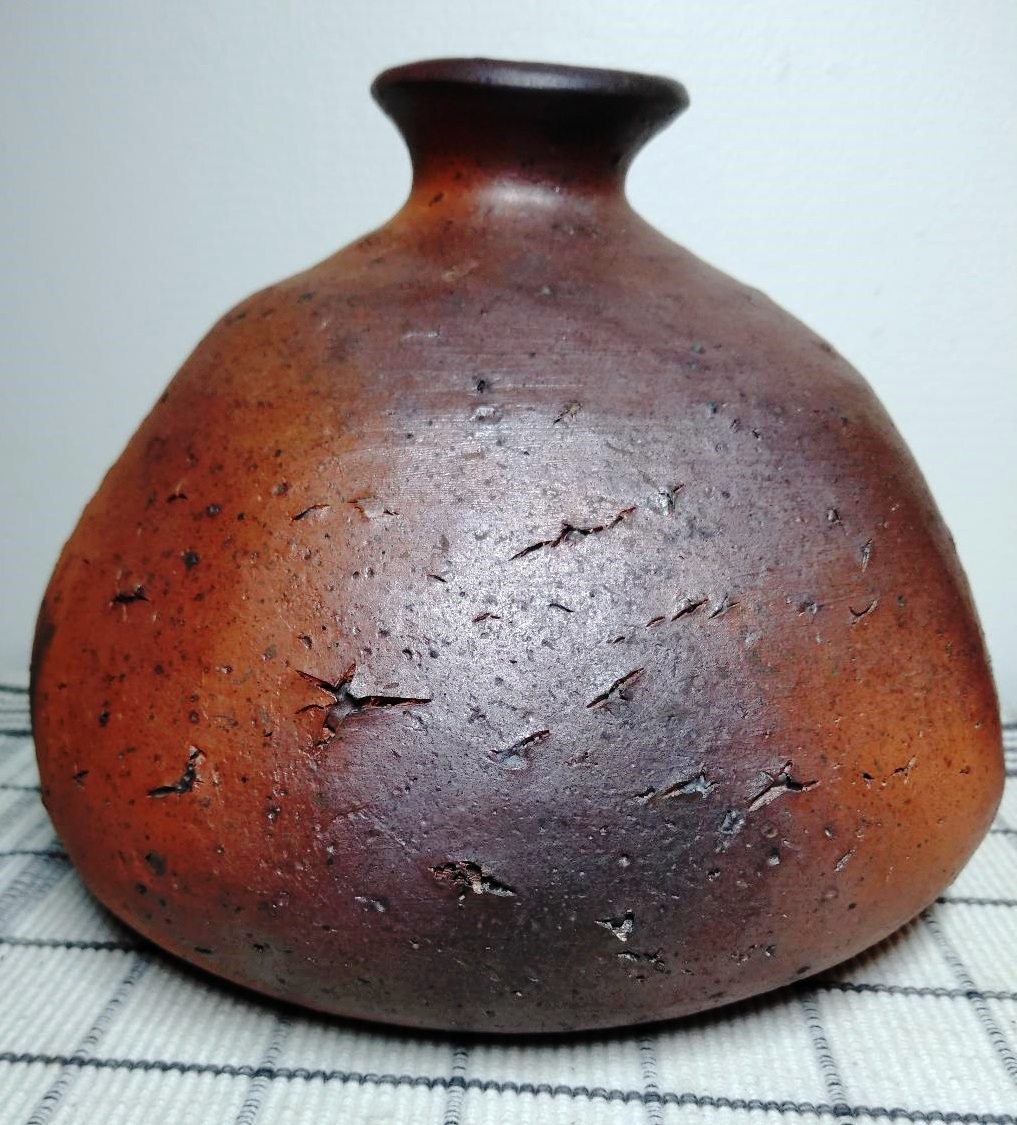
221. KAWABUCHI Naoki, 1946- , Nanban-style unglazed flask vase

221. KAWABUCHI Naoki 川淵直樹, 1946- , Nanban-style unglazed flask vase


Kawabuchi graduated from Wako University in 1971 and studied crafts history from renowned researcher and ceramicist Koyama Fujio. He trained in Akahada-ware in Nara and started the Warabe kiln in 1976, focusing mainly on Nanban yakishime (unglazed stoneware) and kohiki glaze (a dripped or swabbed white slip glaze). Kawabuchi is one of the authors of Building Your Own Kiln: Three Japanese Potters Give Advice and Instructions, published in 2003. 

Dark clay, unglazed with blackened ash deposits and kiln colors ranging from dark red to dark brown. Weight: 2286 g (5.1 lb). Height: 17.1 cm (7 in). Width: mouth 2.8 cm (1-1/8 in); rim 6.8 cm (2-5/8 in); neck 4.4 cm (1-3/4 in); widest 23.3 cm (9-1/4 in); base 15.8 cm (6-1/4 in). 

This sits on a circular base, a fairly even ring; the area within the base has been hollowed out in a concave arc with a roughly circular bulge in the middle. Above this the walls of the pot form a long convex arc to the neck, with the widest portion being 5.3 cm (2-1/8 in) above the base. There is a break at the shoulders ca. 12.5 cm (5 in) above the base. There is a line at this point where the walls slope inward more rapidly as they rise toward the neck, which is 14.4 cm (5-3/4 in) above the base. Above the neck the walls rise outward and upward at a sharp angle to the rim. The mouth of the piece is recessed below the rim.  The four sides of the pot have been flattened somewhat, more so toward the shoulders, so that the piece is roughly squared off, but with rounded edges. The surface of the pot is blistered and cracked from the high-temperature (yakishime) firing. It is generally smooth in the parts that are not blistered. 

The Nanban (“southern barbarian”) style uses no glaze and depends on kiln effects for the surface color and effects. The bottom of this has many rough, blackened ash deposits. There are two places on the walls that have ash deposits as well. One side of the pot is a dark brown; the remainder is a dark reddish brown. 

This came with a wrapping cloth and a box inscribed in three lines: 南蛮  四方 (Nanban four-sided); 花X (can’t read the second character, but undoubtedly something that means “flower vase”); and 直 (the first character of the artist’s name), with his seal stamped in red. 

This is a solid, substantial piece, giving the impression of almost sagging under its own weight. With rich colors and great surface effects from the firing. 

Purchased from Treasures of Old Times, Bangkok, Thailand, June 2023.


Tuesday, April 11, 2023

209. Andrew Sartorius, Caldera Series, no 2

209. Andrew Sartorius, Caldera Series, no 2, 2023


For Sartorius, see item 143.

From the artist’s statement: “This new series of sculptural vessels explores shape and form allowing each sculpture to emerge through my coiling and carving process of hand building. Each form culminates with a caldera to catch pooling ash from the firing. This flow of ash to pool around the base of the caldera cradles a world of glaze crystalline effects that I found thrilling and wanted to explore further. The sculptures reveal themselves to me in shifting from and merging and meeting lines that lend themselves to focusing on kiln placement and the interaction between clay choice and kiln effect.” 

North Carolina stoneware clay with small chips of feldspar “to create the dramatic white inclusions in the warm dark clay body.” Fly ash glazing resulting in colors in the black, gray, russet, and brown range. The vitrified ash in the caldera is a dark green-black color. The front, base, back, and right side have a luster glazing from the melted ash.  Weight: 818 g (1.8 lb). Length: 13 cm (5-1/8 in). Width: 10.1 cm (4 in). Height: 10.3 cm (4-1/4 in). 

This is ovate in shape. This sits on the oval base, which is 7 x 5.3 cm (2-3/4 x 2-1/8 in) at the widest points. The base is a shallow concavity. The sides are one continuous piece; they are shaped in a convex arc, with the widest point roughly in the middle of the piece. The front (shown in the first two pictures) has a vertical groove sloping from left to right, about a third in from the left-hand side. The artist’s mark is impressed into the body at the left-hand side of the front face, just above the base.  The top is highest on the right side. It is shaped into a concavity with a flat bottom (the “caldera”). The opening is toward the left side and measures 2 cm (3/4 in) in diameter. The edge where the sides and top meet is quite sharp. The texture is smooth under the vitrified ash deposit and rougher on the parts less impacted by ash deposits. 

This was fired in an anagama over a two-day period. The front and the back have streams of ash glaze. The heavier deposits of the glaze vitrified nicely in the areas noted above.  The pooling in the caldera is especially impressive and results from the shaping of the piece at this point and its placement in the kiln.

An exciting development of this artist’s skills. 

Purchased from the artist in April 2023.

Friday, January 27, 2023

197. Jeff Abney, mug

197. Jeff Abney (Red Gate Pottery Studio), mug “with tractor-tire texture”


For Abney, see item 138.

Stoneware, coarse gray clay. “Hamada” glaze showing dark red with black streaks; bottom unglazed. Weight 490 g (17.5 oz). Height: 9.2 cm (3-5/8 in). Diameter at mouth: 9.7 cm (3-7/8 in); Width with handle: 13.2 cm (5-1/4 in). Capacity: 428 ml (15 fl oz).

This sits on the flat base, which has been scored with concentric circles. The walls slope outward from the base, reaching the widest diameter 9.2 cm (3.5/8 in) about 2.5 cm (1 in) above the base and then move gradually inward to the narrowest diameter 8.8 cm (3-1/2 in) about 2 cm (3/4 in) below the rim. The walls then flare outward at a slight angle to the rim. The walls would be very irregular in cross-sections. The artist’s marks (2) have been impressed into the walls just above the base. Two horizontal rows of chevrons (the “tractor-tire texture") were impressed into the walls just above the widest diameter and at the narrowest diameter. They appear to have been made with a roller device. The top of the handle is attached over the top row of chevrons; the bottom is even with the base.  The texture is smooth except over the chevrons.

This was glazed in what Abney calls the Hamada glaze, a dark reddish brown glaze with black streaks from the wood-firing reminiscent of those used by Hamada Shōji. The base and a narrow portion of the walls just above the base were left unglazed.

The mug is heavy but easy to hold.  Simple yet effective decoration.

Purchased from the artist in September 2022.


Sunday, September 12, 2021

149. Joseph Bounds, lidded stoneware box

149. Joseph Bounds, lidded stoneware box


Bounds is a young potter in Faison, North Carolina. For other examples of his work, see his Instagram account, @jgbounds.

Brown clay, yellowish-brown, white, and clear glazes. Weight: 336 g (12 oz).  Bottom section; dimensions at top: 6.3 x 7.2 cm (2-1/2 x 2-7/8 in); dimensions of base: 5.7 x 6.5 cm (2-1/4 x 2-5/8 in); size of opening: 4.4 x 5.3 cm (1-3/4 x 2-1/8 in) by 2.5 cm (1 in) deep. Height: 3.2-3.4 cm (1-1/4–1-5/16 in). Top section: dimensions at bottom and top: 6.3 x 7.2 cm (2-1/2 x 2-7/8 in); dimensions of opening: 4.3 x 5.7 cm (1-7/8 x 2-5/16 in) by 2.5 cm (1 in) deep. Height: 3.8 cm (1-1/2 in). Height (overall): 7 cm (2-3/4 in).

This was shaped “upside down” as a hollowed-out shape with straight sides and a domed top. It was then set open side down upon a rolled slab; the slab was trimmed to fit the bottom and then attached to the body. The slab is about 0.6 cm (1/4 in) thick. “BOUNDS” was incised into the bottom of the base. The seam is not visible to the eye but can be felt by the fingertips. The shape of the body is roughly rectangular. The sides have been smoothed down, but vertical grooves were cut into the long sides at two points. The top is rough and unfinished. The box was cut at a slight diagonal to form the lid and base. A narrow flange was built around the opening on the base section, roughly 0.3 cm (1/8 in) high; a slightly taller groove was hollowed out along the inside margins of the lid section to accommodate the flange. The lid fits securely on the base. The texture of the base section is sandy; the top of the lid is quite bumpy.

The interiors of both sections appear to have been coated with a clear glaze. The exterior was coated with a brown slip and a white (ash?) glaze was splashed over the top and dripped down the sides.

Purchased from the artist in September 2021.


Tuesday, July 20, 2021

141. Monte Young, large wood-fired stoneware vase, with altered shape

141. Monte Young, large wood-fired stoneware vase, with altered shape


Young is a potter in Jasper, Indiana. For more on him and other examples of his work, see monteyoungpottery.com or his Instagram account @monte.young1961.

Gray clay, covered with a Shino slip; other colors from wood-firing. Weight: 1938 g (4.3 lb). Rim dimensions: 10.2 x 9.7 cm (4 x 3-7/8 in); maximum dimensions: 15.7 x 13.8 cm (6-1/4 x 5-1/2 in); base diameter: 9.7 (3-7/8 in). Height: 24.7 cm (9-3/4 in).

This sits on the outside edges of the base, which is very slightly concave. The base has been scored in an expanding series of arcs. The remains of the three posts used to separate the pot from other surfaces during the firing are visible on the base. After throwing, the shape of the pot was altered into an oval. The artist’s mark, a raised circle with a design inside, was pressed into one side of the pot just above the base. Above the base, the walls rise in a continuous convex arc to the bottom of the neck, which is about 0.6 cm (1/4 in) below the rim. The wood-firing left a somewhat bumpy surface, especially where the ash deposits are thickest. The white lines visible on the front of the pot are grooves, filled in with the Shino slip. The firing gave the pot a smooth, slick finish.

A Shino slip was applied to the interior and parts of the exterior of the pot, with the exception of the base. The wood-firing created colors ranging from dark reddish brown to black through to a bluish gray in the areas where the ash deposit and carbon capture was greatest. According to the explanation provided by Young, this was fired for 36 hours in a small wood-firing cross-draft kiln. The interior is largely the creamy red of the Shino glaze.

Purchased from the artist, July 2021.

Pottery

Looking for suggestions

I need to dispose of my collection. I've tried to donate it to several local museums or schools with ceramics programs, but no one wants...