Showing posts with label tenmoku glaze. Show all posts

Thursday, January 23, 2025

269. KIMURA Moriyasu , 1935- , Teabowl with Tenmoku glaze

 269. KIMURA Moriyasu 木村盛康, 1935- , Tenmokuyū chawan 天目釉茶盌  (Teabowl with Tenmoku glaze)


Kimura was born into the Kimura family of potters in Kyoto, the youngest of four children. After learning the basics of ceramics at the Kyoto Municipal Industrial High School, he studied under his eldest brother, Morikazu (1921-2015), and learned decorating techniques from his father, Shigeji (1895-1971) . Soon after graduating high school, he saw the National Treasure “yuteki 油滴 (oilspot)  tenmoku teabowl” (see below) in the Atake collection of the Museum of Oriental Ceramics in Osaka and decided to devote himself to Tenmoku glazes, for which he is now famous. 


In 1959, at the age of 24, Moriyasu gained national attention when he was selected as a participant in the Modern Ceramics of Japan exhibition at the National Museum of Art. In the 1960s he began exhibiting at the Nihon Dentō Kōgeiten (National Traditional Crafts Exhibition). His works are held in several important public collections, including the Boston Museum of Fine Arts, Dallas and Houston museums, Peabody Essex Museum, National Palace Museum in Taiwan, and the collection of the Ise Shrine. In 2019-2020, his works were featured in the Iridescent Sparkles of Tenmoku – Works by Kimura Moriyasu exhibition at the Museum of Oriental Ceramics in Osaka. 

Light tan clay. “Oilspot Tenmoku” glaze; oilspots black; area between oilspots, ranging from cream through coral to a dark chocolate colors; foot ring and surrounding area unglazed. Weight: 325 g (11.6 oz). Height: 7.5 cm (3 in). Widths: rim (the widest point), 12 cm (4-3/4 in); of foot ring, 3.3 cm (1-1/4in). 

This sits on the base of the foot ring, which is quite bumpy and irregular and roughly a centimeter wide (3/8 in). On the outside the foot ring measures about one centimeter high; the interior of the ring, which is 3.3 cm (1-1/4 in) in diameter, was only slightly hollowed out. In the unglazed area of the wall beside the foot ring, the artist impressed a rectangular seal into the clay, leaving the seal character version of his given name stamped into the clay (see the third photo from the end). The body of the bowl is a rough circle in cross-section. Above the foot ring, the walls proper extend outward and upward in a very shallow convex arc to a height of around 3.3 cm (1-1/4 in). At this point, the bowl is about 10 cm (4 in) in diameter. Above this the walls extend upward vertically. There is a shallow horizontal groove extending around the bowl about halfway up. Above the groove the walls move outward gradually to the rim, the widest point of the piece. As can be seen in the unglazed portion, the clay body is rather pitted. The surface of the glazed portion is bumpy from the indentations of the oilspots but otherwise smooth to the touch. 

The Tenmoku glaze combines feldspar, limestone, and iron oxide.  The more quickly a piece is cooled, the blacker the glaze becomes. A long firing process and a clay body heavily colored with iron increase the opportunity for iron from the clay to be drawn into the glaze. While the glaze is molten, iron can migrate within the glaze to form surface crystals, as in the “oilspot” glaze, or remain in solution deeper within the glaze for a rich glossy color. Oilspots are more common in an oxidation firing. A longer cooling time allows for maximum surface crystals. For more on this glaze, see Wikipedia, s.v. “Tenmoku.” 

Covered with a Tenmoku glaze except for the foot ring and the area surrounding it.  The surface is densely covered with black “oilspots.” These form circular dimples within the glaze (see the fourth photo). The center of each oilspot reflects light, making the surface appear spotted with glowing dots. The glaze between the oilspots is raised, forming elevated rivulets variously colored cream, coral, and shades of brown. 

This came in a wooden box inscribed by the artist on the topside of the lid in two lines: 天目釉 / 茶盌 tenmokuyū / chawan (Tenmoku glaze / teabowl); the underside of the lid is inscribed 盛康作  Moriyasu saku (made by Moriyasu). The third character is written over the artist’s seal in red ink. showing his given name in seal script.  The same seal was stamped in red on a blue wrapping cloth included in the box. 

Purchased from the Kura Monzen Gallery, Kyoto, Japan, in January 2025 (invoice, shipping and customs documents, jointly with item 270)

Thursday, January 26, 2023

196. Anne Maraviglia, mug

196. Anne Maraviglia (Flying Plumtree Studio), wood-fired Tenmoku-glazed mug


For Maraviglia, see item 126.

Brown clay. Tenmoku glaze showing reddish brown colors; grays and blacks due to ash deposits from wood-firing; melted ash glaze on some surfaces showing as a golden sheen. The bottom was left unglazed and unexposed to the ash flow. Weight: 440 g (1 lb). Height: 10.7 cm (4-1/14 in); Diameter: 8.4 cm (3-5/16 in). Width with handle: 11.3 cm (4-1/2 in). Capacity: 426 ml (15 fl oz).

This sits on the flat base; the sides of the base are beveled at about a 45 degree angle up toward the walls of the cup. There is a slight groove just above this bevel. The glazing extends down to the groove. There are two horizontal bulges roughly 40 and 60 percent of the way up the cup. The handle is attached just above the bottom rim and just above the uppermost bulge. The artist’s mark was impressed into the clay just above the groove and next to the handle.

This was wood-fired. One side of the cup shows a large patch of black and gray ash deposits. The opposite side shows less impact from the wood-firing. Melted ash glazing left a gold-hued sheen over much of the exterior surface. The rim is black and gray on the exterior. The interior is a dark reddish brown. The surface of this is smooth.

The mug is well balanced. The lower placement of the handle makes it easier to hold even when the mug is full despite the depth of the cup.

Purchased from the artist in September 2022.


Thursday, March 24, 2022

178. Andrew Mazzaschi, eight wall hangings, cont.

178. Andrew Mazzaschi, eight wall hangings, cont. (see previous entry).


E. Red clay. Glazed in a dark Tenmoku with white highlights. Weight: 76 g (2.7 oz). Dimensions: 9.7 x 6.6 x 2 cm (3-7/8 x 2.5/8 x 3/4 in).


F. Red clay. Glazed in white, with the red clay showing through, with blue and gold highlights. Weight: 72 g (2.6 oz). Dimensions: 9.7 x 6.8 x 2.5 cm (3-7/8 x 2-3/4 x 1 in).


G. Red clay. Glazed in white, with the red clay showing through, with blue highlights. Weight: 78 g (2.7 oz). Dimensions: 11.7  x 7.6 x 2.3 cm (4-5/8 x 3 x 7/8 in).


H. Black clay. Glazed in a dark Tenmoku with white and blue highlights. Weight: 86 g (3 oz). Dimensions: 10.2 x 6.8 x 2.3 cm (4 x 2-3/4 x 7/8 in).


Friday, November 12, 2021

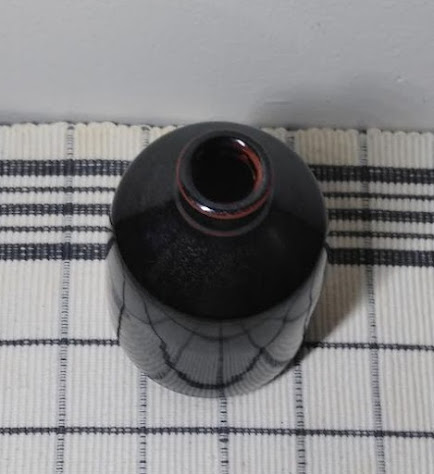
156. John Charles Karrasch, 1934-2010, weedpot vase with Tenmoku glaze, ca. 1972

156. John Charles Karrasch, 1934-2010, weedpot vase with Tenmoku glaze, ca. 1972


From the seller: “This lethal vase form was created in Reno, Nevada when John and Susan Karrasch worked together creating world class ceramics. John Karrasch is historically one of Nevada's most significant potters. From Vasefinder: John Charles Karrasch (1934-2010) was born in Missouri. He received the first technical B.F.A. in Ceramics from the University of Southern California in 1956, where he was a student of Susan Peterson and Vivika Heino. He received his M.F.A. from the Rhode Island School of Design in 1963, where he was a student of Lyle and Dorothy Perkins. John was a scholarship student at the Haystack Mountain School of Crafts. For a brief period, John studied glass technology with Harvey Littleton, when he was a student at the Toledo Museum of Art. He received a Georg Jensen Grant to study glass technology in Finland. John also worked as a marketing assistant for the League of New Hampshire. He was a designer for the Metlox Pottery. He has taught at Chouinard, as well the University of Nevada Reno to just mention a couple locations. John worked in several clay mediums, such as porcelain, stoneware and earthenware. He founded the Nevada Clay Arts Guild in the mid-1970s. Prior to 1961, we show John exhibiting at the Missouri State Fair in 1955 and 1956. In 1956, he had a one-man show at the Fisher Gallery of USC, Los Angeles, California. He also exhibited in one-man shows in Reno and Las Vegas in 1959 and exhibited at the Nevada State Silver Centennial, Virginia City, Nevada. John exhibited at the Syracuse Ceramic Nationals in 1962, 1964 and 1966.”

Light tan clay, brown Tenmoku glaze; base left unglazed. Weight: 396 g (14 oz). Width of rim: 3 cm (1-1/16 in); maximum width: 8.2 cm (3-1/4 in); width of foot ring: 5.7 cm (2-1/4 in). Height: 13.4 cm (5-1/4 in).

This sits on the foot ring, which is about 0.7 cm (1/8 in) high on the outside and about half that depth on the inside. The initials “JK” and “SK” and something resembling the Greek letter pi are written in black on the inside of the ring foot. Above the foot ring, the walls flare out in a straight line at about a 30-degree angle for about 1.7 cm (5/8 in). The maximum width is at the top of this section, about 1 cm (3/8 in) above the base. From there the walls slant inward in more or less a straight line to the shoulders, which are 9.4 cm (3-3/4 in) above the base. At the shoulders, the vase is 7 cm (2-3/4 in) in diameter. The walls then slant inward at a 45-degree angle to the base of the neck, which is 11.3 cm (4-1/2 in) above the vase. The diameter at the base of the neck is 3.3 cm (1-1/4 in). The neck is 1.7 cm (5/8 in) high. It slants inward to just under the rim, reaching a diameter of 2.5 cm (1 in) at the narrowest point. The rim is rolled outward.  There is a paper sticker near the bottom on one side with “John Karrasch” and a logo matching his initials on the bottom of the vase. printed in black. This is very symmetrically shaped and very smooth to the touch.

With the exception of the ring foot and its interior, this was evenly glazed in a dark brown Tenmoku glaze. At the rim, the base of the neck, and around the bottom edge of walls, the glaze has pulled away from the clay and appears as lighter reddish-brown bands. In most lights, the vase looks almost black in color. Under a strong light, innumerable pinpricks of the lighter reddish-brown color show through in the characteristic “oil spots” of this glaze.

A beautiful example of very formal studio pottery with a flawless glaze, more typical of the output of studio potters in the 1970s than it is now.

Purchased from Charlie B. Studio of Carson City, Nevada, in October 2021.  Charlie B. purchased the vase directly from the artist around 2005.


Monday, May 24, 2021

105. Andrew H.S. Mazzaschi, vase with tenmoku glaze

105. Andrew H.S. Mazzaschi, vase with tenmoku glaze


For Mazzaschi, see item 103.

Reddish-brown stoneware clay, tenmoku glaze in browns, tans, and grays; base left unglazed. Weight: 584 g (1.3 lb). Rim diameter: 4.4 cm (1-3/4 in); maximum diameter: 9.5 cm (3-3/4 in); base diameter: 7 cm (2-3/4 in). Height: 12.5 cm (5 in).

This sits on the base. The interior of the base was hollowed out to slightly more than an eighth of an inch. The artist’s mark, his initials, AHSM, inside a square, was stamped inside this area. The walls rise in a continuous convex arc from the base to the neck. The arc moves outward to the maximum diameter 5.7 cm (2-1/4 in) above the base. Above this the walls curve inward in a shallow arc toward the shoulder 10.7 cm (4-1/4 in) above the base. The diameter of the shoulder is only slightly less than the maximum diameter. Above the shoulder the walls move quickly inward to the neck, which is 3.7 cm (1.1/2 in) in diameter and 11.7 cm (4-5/8 in) above the base. From the neck, the walls angle outward to the rim. The finish on the pot is very smooth.

Both the interior and the exterior, with the exception of the base, were glazed in dark brown (almost black) tenmoku, with lighter areas in cream, tans, and gray.

Purchased from the artist, May 2021.


Pottery

Looking for suggestions

I need to dispose of my collection. I've tried to donate it to several local museums or schools with ceramics programs, but no one wants...