231. WATANABE
Takuma 渡邊琢磨, 1968- , Bizen-ware kōro 備前香炉 (incense
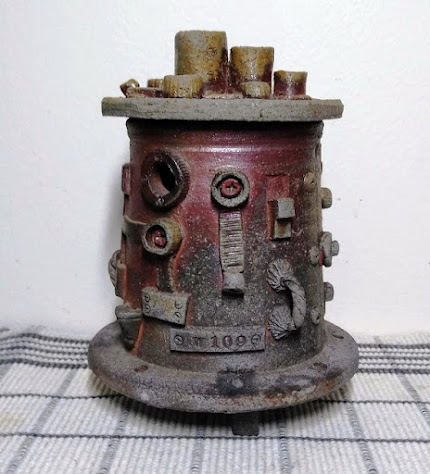
burner), “Mirai no kaseki” ミライノカセキ (Future fossils) series, no. 109



Watanabe
was born in Hyogo Prefecture in 1968. After graduating from Kansai University,
Watanabe apprenticed himself to Bizen-ware artist Yamauchi Atsuyoshi in 1991.
In 1996, he joined the Bizen Tōen Kiln. Shortly thereafter, he began exhibiting
and received awards at the Okayama Prefectural Exhibition, the National
Traditional Crafts Exhibition, and the Issui Kai Exhibition (the Issui Kai is a
modern artists' association). He was also selected for the influential Tanabe
Museum Modern Forms in Tea Exhibition. In 2006, he became independent and
established his own kiln. He has also built a small kiln for reduction firing. After
shaping a piece on the pottery wheel, he often hand-finishes it by carving,
inlaying, and hand-building. The Future Fossils Series now contains over 400
pieces. For more of his work, see his Instagram account #takuma.watanabe.clayworks He is also on Facebook:
facebook.com/bizen.watanabe.
His
statement of purpose (my translation): “By blending Japanese tradition and
modern sensibilities. I create ‘objects with ideas’ to satisfy the heart. In
this way, my slight products are meant to be ‘tools for stimulating the
imagination’ that provoke feelings in the user.”
Dark
brown clay, unglazed Bizen-ware, with kiln effects in reddish-brown and grays hades; some slight vitrification of the ash deposits on the
underside of the lid. Weight: overall, 860 g (1.9 lb); bottom section, 638 g (22.8 oz;
1.4 lb); lid, 222 g (7.9 oz). Height: overall: 16.7 cm (6-5/8 in);
bottom section, 13.2 cm (5-1/4 in); lid, 5 cm (1-15/16 in). Width: of base of
bottom section (also, the maximum width), 12.6 cm (5 in).
This
sits on the bases of three truncated, trapezoidal legs attached about 2 cm (3/4
in) from the circumference of the underside of the base section of the bottom
part. Each leg is 2 cm (3/4 in) high. The underside of the base is flat. The artist’s mark, |+<, was incised into the
center of the underside. The proper orientation of the mark isn’t clear, but it
appears from the similar mark on item 252 that it was incised with downward strokes
in the orientation shown here. The edges of the
base are 1 cm (3/8 in) wide. The top side of the base is a gentle convex arc up
to the walls of the bottom section. Eight small round holes are spaced evenly
around this section of the piece. The base ends 3.2 cm (1-1/4 in) up. The walls
proper begin at this point. The walls are 10 cm (4 in) tall. At the lower end
the diameter of the walls is 8.8 cm (3-1/2 in); at the top it is 8.5 cm (3-3/8
in). So the walls slope inward very gradually. On the outside of the walls,
Watanabe attached a variety of molded forms resembling electrical switches and
conduits, Phillips-head screws, dials, and plates. One horizontal plate is
incised with a stamped “W 109”—perhaps “W” for “Watanabe” and 109 for this
piece’s place in the Future Fossils series. There are also two short, braided
handles on the lower part of the walls. A curved arrow around one of the dials
indicates the direction in which it would turn. Another short vertical arrow
indicates which direction is up. There is a circular opening into the interior
near the top of this section. The interior of this section is unadorned but
shows the finger marks from the throwing process.
The circular
lid consists of a straight-sided flange 1.1 cm (7/16 in) high and 7 cm (2-3/4
in) wide that fits inside the bottom section of the piece. The underside of the
base of the lid proper is flat. It is 10 cm (4 in) wide and extends beyond the
top of the bottom section. The top of the base of the lid is also flat. To this
have been attached several molded forms. Three of these are circular
“smokestacks”; with holes opening into the interior of the bottom section to
allow the incense smoke to rise and escape. The other attachments are more
mechanical in shape and attached with “screws.” There is another braided handle
on the top.
The surface decorations are very precise and
even and attached to the body in such a way that the joins are crisp and exact.
Given the colors, from a distance, this could be mistaken for an old metallic
object, perhaps part of some machine, which has become encrusted with dirt and
rusted over time. The surface has the roughness of medium-grade sandpaper. In
contrast to the Kishimoto vase (item 230), which defiantly foregrounds its
origins in clay, this piece belies its origins.
Unglazed, colors from kiln effects and gray ash
deposits on the exterior. The mouth and the interior of the bottom section show
little evidence of exposure to the ash flow, in contrast to the legs and the
underside of the base, which are a dull gray. So the bottom section may have been
turned upside down during the firing process, thus shielding the interior from
the ash flow.
This
came in a wooden box, inscribed in three lines (from right to left); 備前香爐
(Bizen kōro [using the older form of
the character for ro], “Bizen-ware
incense burner”); ミライノカセキ
(mirai no kaseki, “future fossil”): 琢磨 (Takuma), followed by the
artist’s seal with his given name in the seal script forms of characters,
stamped in red. Included in the box were
a blue cloth and a short printed biography of the artist.
Purchased from the Kura Monzen Gallery, Kyoto,
Japan, September 2023 (invoice, shipping and customs documents)


