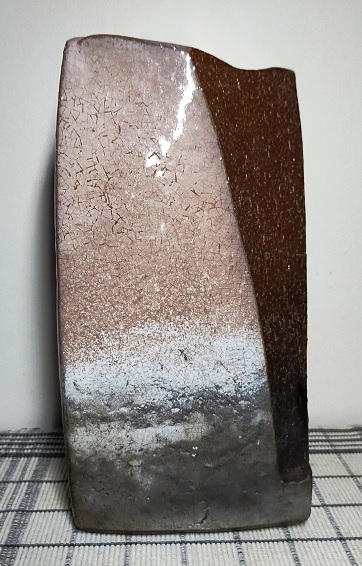
257. SAKATA Keizō 坂田慶造 (十五代 坂田泥華 Sakata Deika XV), 1949-2004. Hagi XXha take hanaire 萩XX破竹花入 (Hagi-ware broken bamboo-shaped vase)


The Sakata family is one of the ancient lineages of Hagi-ware potters. Keizō was the son of Sakata Deika XIV (1915-2010). After graduating from university, he studied sculpture and spent some time traveling in the United States before beginning work at the family kiln. This exposure outside the traditional world of Hagi-ware pottery is sometimes cited as setting him apart from other local potters. In 1978, he received an award at the First Exhibition of New Traditional Crafts (Dentō Kōgei Shinsaku Ten). In 1989, he became a member of the Japan Kōgei Association and exhibited with that organization, garnering a number of prizes as well as receiving awards at the Japan Traditional Crafts Exhibition (Dentō Kōgei Ten) and the Grand Prize at the Tanabe Museum Ceramics of Tea Exhibition. He was expected to make great advances as the next Sakata Deika but died in 2004 at the age of 54. He was posthumously named the 15th generation Sakata Deika. A brother is now Sakata Deika XVI.
Gray clay, visible only on the bottom half of the interior. The color of the glaze is hard to pin down. In sunlight the exterior is a milky coffee color; in artificial light, it acquires a greenish hue. The glaze on the interior is whiter, with a bluish cast in some lights. Only the upper half or so of the interior was glazed. The base and a small patch at the bottom of the back side were left unglazed and show kiln-effect colors in a reddish tan and a dark red. Weight: 4.4 kg (9.7 lb). Height: 33.3 cm (13 in). Width: top. 12 cm (4-3/4 in); widest: 13.5 cm (5-1/4 in); base: 11.5 x 10.5 cm (4-1/2 x 4-1/8 in).
The vase is shaped to resemble one of the dilapidated bamboo vases that often hang on the walls or pillars of a tea ceremony hut. It sits on a flat, eight-sided base, a rough rectangle with angled corners. The artist’s mark, the character 慶, was incised into the base with shallow lines (on the lower left in the next to last picture). Comparison of the interior depth with the exterior walls shows that the base is about 1.3 cm (1/2 in) thick. The walls rise in irregular vertical slabs from each side of the base. The front (the side with the torn away section and the bamboo leaves) is more rounded than the back. The piece as a whole tilts backward slightly. A deep, rough gouge encircles the piece about 7 cm (2-3/4 in) above the vase. The widest point of the vase occurs at this point. The gouge is meant to mimic the joint between two sections of bamboo. On the front side, just above this horizontal gouge, Sakata made two bamboo-leaf shaped gouges. The clay surrounding these gouges was forced to the side to create jagged lines defining them. No apparent attempt was made to trim away the excess. Another notable feature of the piece is the rough, almost violent tearing away of a section of the front of the pot to suggest a portion of the bamboo wall that was ripped off. The margins of this opening are very rough and irregular. The walls themselves are quite thick, measuring from 2.5 to 3.0 cm (1 to 1-3/16 in) at the top. The clay is so thick that several shallow, vertical fissures opened up on the interior walls while the piece was drying/ The interior is roughly circular in cross-section. The surface is smoothest over the most heavily glazed sections. Elsewhere it is quite bumpy and rough.
Glazed in a milky coffee color over most of the exterior surfaces. The glaze covers the surface unevenly. Most sections received only a light coating, allowing the clay beneath to show through as darker patches. The glaze is thickest and most uniform over the smoother panels, in the areas with a more textured surface, it is more broken, exposing the clay beneath. On the interior, the glaze is a bluish white, again with many darker streaks showing through.
This came in a wooden box, inscribed by the artist in two lines: 萩XX破竹花入 / 坂田慶造 Hagi XX ha take hanaire / Sakata Keizō (Hagi-ware broken bamboo-[shaped] vase / Sakata Keizō), followed by Sakata’s seal stamped in red. There are two characters in the line on the right that I cannot read, but from their position, they must modify “bamboo” and probably characterize the design of the vase. Included in the box was a leaflet with a potted biography of the artist.
Purchased from Kura Monzen Gallery in Kyoto, Japan, July
2024 (invoice, shipping and customs documents).