Showing posts with label Narumi Oribe. Show all posts

Saturday, September 9, 2023

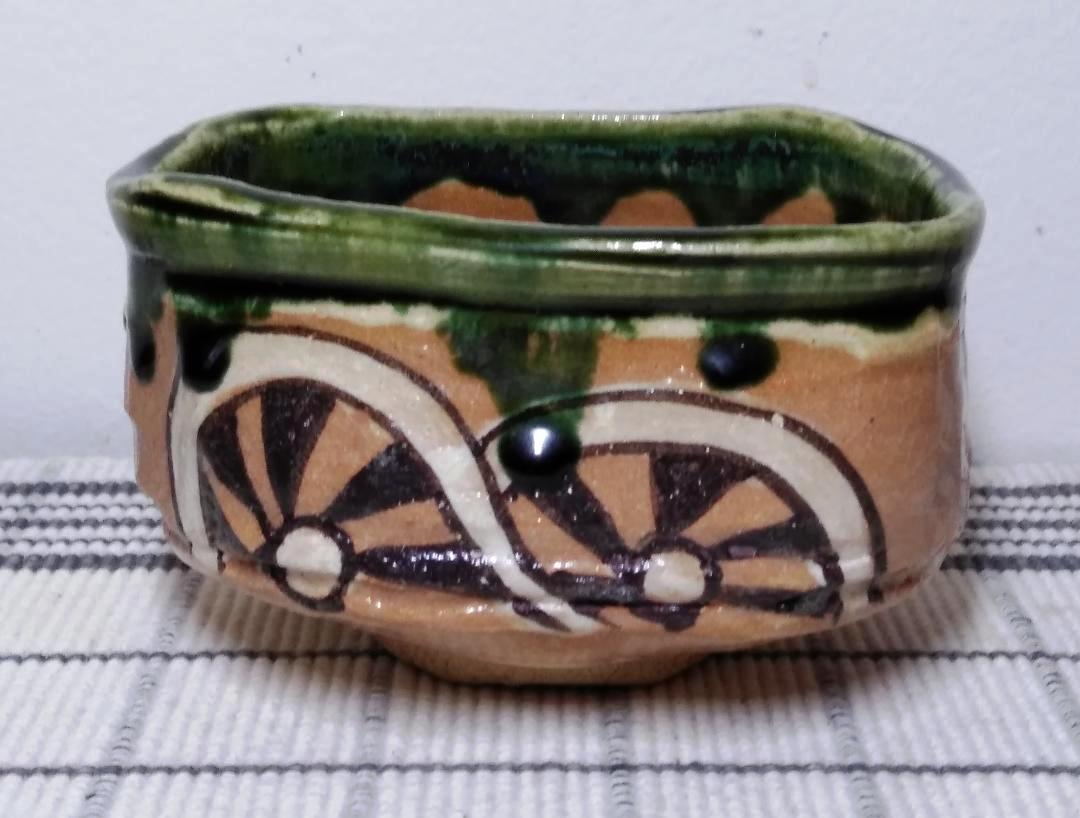
228. TAKIGUCHI Kiheiji, 1937- , aka Oribe chawan (red Oribe teabowl)

228. TAKIGUCHI Kiheiji  瀧口喜兵爾,  1937- ,  赤織部茶盌 aka Oribe chawan (red Oribe teabowl)


Takiguchi was born in the Asakusa district of Tokyo and graduated from the Faculty of Agriculture at Tamagawa University. He studied under the renowned Mino-ware master KATŌ Jūemon (see items 184 and 227), before venturing out on his own in 1965. His artistic pursuits took him to Kyoto's Shinroku Tsuji pottery studio and later led him to establish his kiln in Ogaya, Mino. A move to the U.S. in 1971 led him to Malborough, Vermont, where he set up an anagama kiln in 1973 and followed with a climbing kiln in 1975. He is a specialist in red and black Oribe-ware.  His works are in the collections of the Brooklyn Museum and the Minneapolis Museum of Art. 

Light reddish-tan and white clays, with a slip glaze and added decoration in green, cream, and brown glazes; foot ring and surrounding areas left unglazed. Weight: 334 g (12 oz). Width of rim: 13 x 10 cm (5 x 4 in); of foot ring: 5.6 x 5.3 cm (2-3/8 x 2 in). Height: 6.6 cm (2-5/8 in). 

This is a kutsugata , or “clog-shaped” teabowl. It sits on the foot ring, which is an irregular oval, about 0.4 cm (3/16 in) high on the exterior; the interior of the foot ring was hollowed out to about the same depth. Above the foot ring, the walls rise in a straight line at about a 30-deegree angle to a height of 1.2 cm (1/2 in) and approximately the width and shape of the rim. The potter’s mark was incised into the clay of the base. There is a sharp break in direction at this point. Above this, the walls rise vertically to about 1.2 cm (1/2 in) below the rim in a straightish line. Just above the base, there is a circular groove around the exterior of the piece. Then the walls bulge outward slightly in a convex arc ending in a shallow concave groove, about a finger’s width wide, encircling the piece. This area of the walls contains many short vertical and horizontal grooves and bulges. Above this, the walls angle outward slightly to the rim, which is curved. The interior of the piece mirrors the exterior, but the walls are much smoother. The clay is finely grained, and even the unglazed portions are smooth. 

Another piece using the Narumi technique. The lower section of this was formed with a light reddish-tan clay; the rim with a whitish clay. With the exceptions of the foot ring and an area of the base surrounding it, the piece was covered in a slip, which became glossy during firing. The front side was decorated in two cartwheels using cream and brown glazes. On the back side are two squares—the outline and an interior area are marked off with borders drawn with the brown glaze. The area between the borders was filled in the cream glaze. The rim and the upper section of both the interior and the exterior was covered with the heavy green Oribe copper glaze, which was allowed to run down the sides in several beads, partially covering the other decorations. A narrow line of white clay is occasionally visible at the base of the green glaze. 

This came in a wooden box, with a short printed biography and an orange wrapping cloth. One side of the box is inscribed, in two columns:  on the right--赤織部茶盌 (aka Oribe chawan, “red Oribe teabowl”; a variant character for wan is used); and on the left--喜兵爾 (Kiheiji), followed by the artist’s seal in red ink. 

The seller labeled this a “Momoyama-style” teabowl. It is strikingly similar to item 227 both in construction and decoration. This piece is much more lively, however. In  the Hayashi version, the triangles within the cartwheels were drawn with straight lines; here the sides of the triangles are curved, which imparts a sense of motion to the wheels. The greater abandon with which the green glaze was applied here also makes this a more free-wheeling piece. Item 227 is static in comparison. 

Purchased from Shogun Pottery (a new branch of Treasures of Old Times), in Hobarth, Australia, September 2023. (Joint receipt with item 227).

Friday, September 8, 2023

227. HAYASHI Eiji, 1931- , aka Oribe chawan (red Oribe teabowl)

 227. HAYASHI Eiji 林英仁, 1931- , 赤織部茶碗 aka Oribe chawan (red Oribe teabowl)


From Tajimi City, Gifu Prefecture, Hayashi is the grandson of the esteemed Katō Juemon (see item 184), a designated Gifu prefectural intangible cultural property. Under the guidance of his grandfather, he underwent rigorous training in the traditional art of pottery. He specializes in old-style Mino-, Shino-, and Kiseto-wares. He graduated from Tamagawa University, where he subsequently was an assistant professor. In 1968, Hayashi returned to his hometown and dedicated himself primarily to tea pottery. 

White and reddish-tan clays using the Narumi technique (see item 217); slip glazed with added decorations in Oribe green, cream, and brown; foot ring and surrounding areas left unglazed. Weight: 392 g (14 oz).Width of rim: 14 x 10 cm (5-1/2 x 4 in); of foot ring: 5.7 x 5.5 cm (2-3/8 x 2-1/8 in). Height: 7.5 cm (2-7/8 in). 

This is a kutsugata , or “clog-shaped” teabowl. It sits on the foot ring, which is an irregular oval, about 0.6 cm (1/4 in) high on the exterior; the interior of the foot ring was hollowed out to about a third of that on the interior. Above the foot ring, the walls rise in a straight line at a shallow angle to a height of 1.8 cm (5/8  in). The potter’s mark was incised into the clay at this point. There is a sharp break in direction at this point. Above this, the wall rise vertically to the rim in a straightish line. Just above the base, there is a circular groove around the exterior of the piece. Then the walls tilt slightly outward as they rise to around 1.8 cm below the rim. This area of the walls is flatter but still retains the shallow grooves and ridges created by the potter’s fingers as he shaped the piece. Above this, there is another groove encircling the piece before the walls flare outward at a sharper angle to meet the rim.  This area has several shallow grooves running around the circumference. The interior of the piece mirrors the exterior, but the walls are much smoother. The clay is finely grained, and even the unglazed portions are smooth. 

With the exception of the foot ring and the area of the base surrounding it, the piece was covered with a slip, which, when the piece was fired, created a glossy surface. The upper portion of the piece (roughly the first 2 cm [3/4 in]) was formed from a white clay. The top part of this section were covered with a thin layer of the green copper Oribe glaze. The white clay is visible elsewhere beneath the slip. Beneath this, the piece was made from a reddish-tan clay. This section was decorated in cream and brown. The front has two cartwheels. The back side has two square and three circular elements. Each is outlined in brown, with the interior filled in with cream, with added lines in brown. 

This came in a wooden box with an inscription in three lines, reading from right to left: 赤織部 (aka Oribe, “red Oribe); 茶碗 (chawan, “teabowl”); 英仁 (Eiji), followed by the artist’s seal stamped in red with the characters for his “studio name,” or sobriquet. The characters in the seal are 桃山, which can be read tōsan or tōzan or momoyama. They translate literally as “peach mountain.” The second reading might be a pun on 登山, “climbing the mountain,” an important ritual in some sects of Japanese Buddhism. “Momoyama” is the name given to a period of Japanese history; item 228, which has a similar decorative scheme, was identified by the seller as a Momoyama-style piece  If the latter is the correct interpretation, it may be Hayashi’s claim to be making old-style pieces. Of course, all these meanings could be invoked simultaneously. The wooden box was further enclosed in a cardboard box with a label identifying the contents. 

Purchased from Shogun Pottery (a new branch of Treasures of Old Times), in Hobarth, Australia, September 2023 (receipt).

Friday, June 23, 2023

217. Narumi Oribe kutsugata chawan

217. Narumi Oribe 鳴海織部 kutsugata chawan (clog-shaped teabowl)


Narumi (aka red Oribe) is a technique in which two clays are used to make a piece. Here a white clay was used to form the upper edge of the walls; most of this was subsequently covered with the dark green Oribe glaze. In some places on the exterior lower edge of the green glaze, a narrow band of the white clay is visible, revealing how irregular this area is. The rest of the piece was formed from a reddish brown clay. A thin white slip was applied to most of this area, resulting in a pinkish color when the pot was fired. Additional decoration was applied in dark brown and white. The foot ring and the area around it were left unglazed. Weight: 304 g (11 oz). Height: 7.3 cm (2-7/8 in). Width: 13.6 x 10.4 cm (5-3/8 x 4-1//8 in). 

This sits on the foot ring, which mirrors the shape of the piece as a whole. It is 6.3 x 5.7 cm (2-12 x 2-1/4 in) and roughly 0.6 cm (1/4 in) high inside and out. Above the foot ring, the walls move outward at about a 15-degree angle to a height of 1.2 cm (1/2 in) and the approximate dimensions of the piece. From there the walls rise in more or less a straight line to a height of 5 cm (2 in). Above this the rim bulges outward and then upward to meet the rim of the cup, with several horizontal ridges running around the cup. This is smooth to the touch. The unglazed portion around the ring foot is also quite smooth—the red clay used here is very fine textured. 

The green band encircles the rim and the upper walls. It was allowed to drip down in several places. The interior and most of the exterior walls were coated with a thin white slip. This area is dimpled with small dots and thin lines where the clay shows through. Brown and white glazes were used to add decoration to the piece. The front has a stylized branch with leaves. This was done very carefully and deliberately. An attempt was made to make the branch appear three-dimensional. Unusually, the design spreads across the front and onto the right side. On the back of the piece are three crudely drawn circles. 

This came in a box with “Naru(mi) Oribe” 鳴織部 inscribed in the center. The characters on the left are too cursive for me to decipher. 

The seller claimed that this dates to the Meiji era. 

A nice example of red Oribe and the kutsugata shape. The formal, careful decoration on the front of the piece contrasts nicely with the slapdash circles on the back. The piece has good balance. 

Purchased from Treasures of Old Times in Bangkok, June 2023.


Pottery

Looking for suggestions

I need to dispose of my collection. I've tried to donate it to several local museums or schools with ceramics programs, but no one wants...