Showing posts with label Andrew Sartorius. Show all posts

Wednesday, July 5, 2023

223. Andrew Sartorius, Sculpture series no. 25, “Mt. Meru”
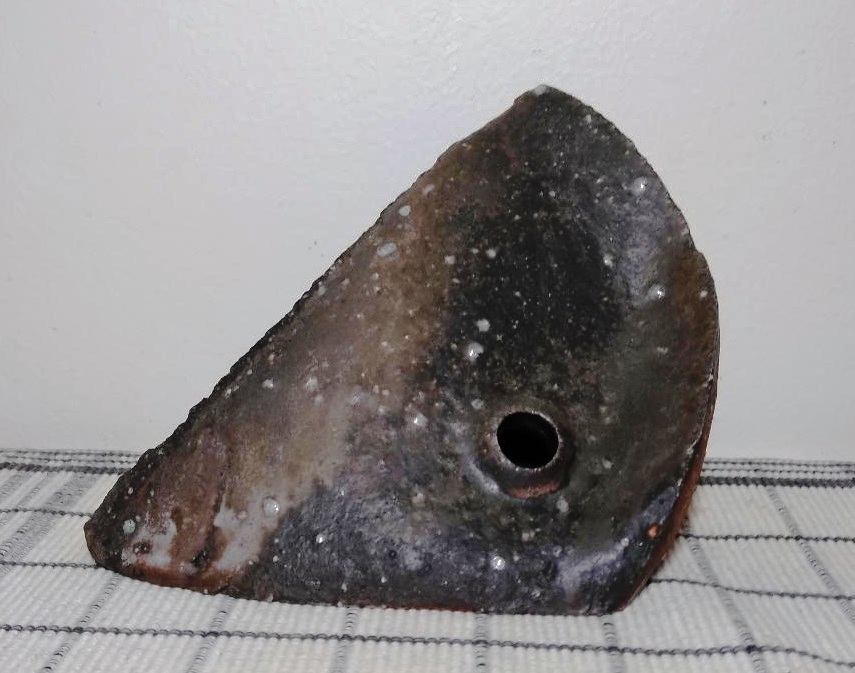
 223. Andrew Sartorius, Sculpture series no. 25, “Mt. Meru”


For the artist, see no. 143.

“This series of sculptural vessels explores shape and form allowing each sculpture to emerge through my coiling and carving process of hand building. The sculptures reveal themselves to me in shifting from and merging and meeting lines that lend themselves to focusing on kiln placement and the interaction between clay choice and kiln effect.” (Author's statement.)

West Virginia wild clay with add feldspar and granite chips, tan in color, unglazed, with kiln effects coloring the surface shades of gray to black, with dark reddish brown areas on the sides and terra cotta color on the base. The molten ash pooled inside the piece and vitrified to form a glassy blue-colored layer on the bottom of the opening. Weight: 1208 g (2.7 lb). Height: 14 cm (5-1/2 in). Width: 18.7 x 13.4 (7-3/8 x 5-1/4). 

The body has three sides. This sits on the flat base, a triangle with curved sides. There are five circles marking the locations of the wads separating the piece from the shelf during firing. Each of the three sides is a triangle with curved sides. The edges where the sides meet are sharp, bumpy ridges. The front side contains the opening, roughly 2 cm (3/4 in) in diameter and located beneath the peak of the piece, about a quarter of the way up from the base. The right-hand side has the artist’s mark in the lower left-hand corner just above the base. The surface of this is pitted and scratched. 

This was wood-fired in the lower front of a train kiln for two days. The exterior colors are kiln effects; as noted above, the ash pooled inside the piece and vitrified. The feldspar and granite chips largely retained their white color, speckling the surface. 

Purchased from the artist, June 2023.

Sunday, May 21, 2023

214. Andrew Sartorius, Sculptural Vessel 2, “Ala Ancha”

214. Andrew Sartorius, Sculptural Vessel 2, “Ala Ancha,” 2023


For Sartorius, see item no. 143. 

Wild clay from West Virginia, colors in the reddish brown, black and gray ranges, with some ash glazing on the back side. Weight: 3.25 kg (7.1 lb). Height (overall): 24.5 cm (9-3/4 in). Length (overall): 29.2 cm (11-1/2 in). 

This consists of three parts: the main body; the neck, and the bell (rim, mouth).  The piece sits on a flat base, oval in shape, 12 x 17 cm (4-3/4 x 6-3/4 in), located under the center of the main body of the piece. The wadding used during the firing process is visible is three grayer areas on the base. The front side of the main body (that shown in the first two pictures) has two globular bodies with a seam between them; the back side is a continuous arc. The artist’s mark was impressed into the clay at the lower edge of the right-hand side. The main body is 20 cm (8 in) long and 15.8 cm (6-1/4 in) high. The neck juts off to the right side of the main body, rising at about a 60-degree angle. The walls of the neck bow outward slightly toward the center. There is a pronounced seam where the neck joins the main body and again at the bell. The rim of the bell flares outward from the neck in a straightish line. It is roughly football shaped and is 10.7 x 22.7 cm (5-1/2 x 9 in). The bell angles upward; the lower end jutting out to the right of the piece is 14.4 cm (5-7/8 in) above the base; the upper end is 24.5 cm (9-3/4 in) above the base. The mouth mirrors the shape of the rim. It is offset slightly toward the rear of the bell and is 5 x 9.5 cm (2 x 3-3/4 in) in dimension. The surface of this is smooth over the redder surfaces and slightly rough over the ash-glazed areas. The weight and balance of the piece are very much toward the base. 

This was wood-fired over four days in the center of an anagama kiln. The front and base of this are a rich reddish brown. The back side and the interior of the bell have melted ash deposits..Some of the ash glaze ran down in streaks. 

The name “Ala Ancha” is a Spanish idiom for a wide-brimmed hat. 

An astonishing piece. The Sculptural Vessel series continues to explore Sartorius’s interest in the interactions of clay, shape, and firing process. The piece feels much more open and outgoing than the other pieces by Sartorius that I have. The two other pieces in the series are similar in having globular, swollen shapes.

 Purchased from the artist in May 2023.


Tuesday, April 11, 2023

209. Andrew Sartorius, Caldera Series, no 2

209. Andrew Sartorius, Caldera Series, no 2, 2023


For Sartorius, see item 143.

From the artist’s statement: “This new series of sculptural vessels explores shape and form allowing each sculpture to emerge through my coiling and carving process of hand building. Each form culminates with a caldera to catch pooling ash from the firing. This flow of ash to pool around the base of the caldera cradles a world of glaze crystalline effects that I found thrilling and wanted to explore further. The sculptures reveal themselves to me in shifting from and merging and meeting lines that lend themselves to focusing on kiln placement and the interaction between clay choice and kiln effect.” 

North Carolina stoneware clay with small chips of feldspar “to create the dramatic white inclusions in the warm dark clay body.” Fly ash glazing resulting in colors in the black, gray, russet, and brown range. The vitrified ash in the caldera is a dark green-black color. The front, base, back, and right side have a luster glazing from the melted ash.  Weight: 818 g (1.8 lb). Length: 13 cm (5-1/8 in). Width: 10.1 cm (4 in). Height: 10.3 cm (4-1/4 in). 

This is ovate in shape. This sits on the oval base, which is 7 x 5.3 cm (2-3/4 x 2-1/8 in) at the widest points. The base is a shallow concavity. The sides are one continuous piece; they are shaped in a convex arc, with the widest point roughly in the middle of the piece. The front (shown in the first two pictures) has a vertical groove sloping from left to right, about a third in from the left-hand side. The artist’s mark is impressed into the body at the left-hand side of the front face, just above the base.  The top is highest on the right side. It is shaped into a concavity with a flat bottom (the “caldera”). The opening is toward the left side and measures 2 cm (3/4 in) in diameter. The edge where the sides and top meet is quite sharp. The texture is smooth under the vitrified ash deposit and rougher on the parts less impacted by ash deposits. 

This was fired in an anagama over a two-day period. The front and the back have streams of ash glaze. The heavier deposits of the glaze vitrified nicely in the areas noted above.  The pooling in the caldera is especially impressive and results from the shaping of the piece at this point and its placement in the kiln.

An exciting development of this artist’s skills. 

Purchased from the artist in April 2023.

Monday, April 10, 2023

208. Andrew Sartorius, Sculpture Series 24, “Burnt Bone”

 208. Andrew Sartorius, Sculpture Series 24, “Burnt Bone,” 2023


For Sartorius, see item 143.

West Virginia wild clay with small imbedded white pebbles, fired at the front of a train kiln during a reduction-cooled firing. Ash glazed, with colors in the black, gray, and reddish brown ranges. (Note: the blurb on Sartorius’s website described this as a four-day firing in an anagama kiln rather than a train kiln—that description comes from a handwritten note on a postcard that came with the piece.) Weight: 1.8 kg (4 lb). Length: 17.7 cm (7 in). Width: 12.6 cm (5 in). Height: 12.6 cm (5 in).

This sits on a narrow flat base, roughly oval in shape, running the length of the piece and 5 cm (2 in) wide at the maximum. The base shows remnants of the wads used to hold this in place during the firing. The front side and top (the part with the opening) are one continuous piece with a curved edge. The front wall bulges outward, and the top slopes downward to the right and is a shallow concavity. The opening is at the right end of the curved edge, about 2 cm (3/4 in) in diameter. The right side is an inverse comma in shape; a sharp, sloping ridge bisects this shape above the mid-point. Both halves are shallow concavities.

The back side is a rough rectangle, with another shallow concavity toward the right-hand side. The artist’s mark was impressed into the clay on the lower left, just above the base. The left-hand side is a rough circle, narrower at the bottom and wider at the top, a slightly flatter concavity that those found on the other faces. Except for the rolling edge at the front top, the edges where the faces meet are sharp and defined. The surface is very rough. 

The ash glaze pooled on the top in the concavity. There are streams of ash glaze down the front. The back and sides have less ash glazing.

Another splendid piece from this artist. The base is quite narrow in comparison with the top of the piece, but it sits solidly. 

Purchased from the artist in April 2023.

Sunday, February 5, 2023

206. Andrew Sartorius, Firebox Sculpture 21, “Triumvirate 2”

206. Andrew Sartorius, Firebox Sculpture 21, “Triumvirate 2”


For Sartorius, see item 143.

This was the first in a series of three small sculptures.

West Virginia wild clay, wood-fired, then reglazed with a Shino glaze and refired in a cone 11 soda firing. Colors range from a grayish blue through mahoganies. Weight: 282 g (10 oz). Height: 6.3 cm (2-1/2 in). Dimensions: base 5.3 x 6 x 7 x 5.7 cm (2-1/8 x 2-3/8 x 2-3/4 x 2-1/4 in); top 3.8 x 5.7 x 5.1 x 4.4 cm (1-1/2 x 2-1/4 x 2 x 1-3/4 in).

This sits on a flat base. Remnants of the four posts used to keep this from fusing to the kiln surface are visible on the bottom. Each side is a quadrilateral; except at the base, where the walls meet the base in sharp line, the edges are slightly rounded. The line where the edges meet also bow outward slightly. The top slopes downward slightly viewed from the front (arbitrarily the view shown in the first picture). The opening is located in the upper portion of the top. The surface of this is smooth and glossy. The artist’s mark was impressed into the clay in the lower left-hand corner of one side. The subsequent firings and glazing obscured it somewhat (see the fourth picture).

This was wood-fired in the back of anagama kiln and naturally glazed over a four-day period with fine ash particles. It was then reglazed with a “very thin” coating of a Shino glaze and refired in a cone 11 soda firing, leaving the surface with a smooth shiny glaze and imparting a variety of colors in the blue and cream range.  The colors are quite mottled and dynamic.

Multo in parvo

Purchased from the artist in January 2023.


Saturday, February 4, 2023

205. Andrew Sartorius, Firebox Sculpture no. 16, “Calico"

205. Andrew Sartorius, Firebox Sculpture no. 16, “Calico,” 2022


For Sartorius, see item 143.

West Virginia wild clay, with a slip made from North Carolina wild clay; with a Shino glaze on the upper portions with enough carbon capture to turn some areas a light gray-blue; the wood-firing created colors in the gray to black range and red to mahogany range. The interior was glazed with Shino. Weight: 1010 g (2.3 lb), Height: 17 cm (6-3/4 in). Width: 10.2 cm (4 in). Length 13.3 cm (5-1/4 in).  

This sits on a flat base, roughly triangular in shape, 12.5 x 11.3 x 10.1 cm (5 x 4-1/2 x 4 in). There are remnants of four posts used to keep the pot from fusing to the shelf on which it said during firing, which were roughly filled in later with a bit of clay. The pot is a truncated pyramid. Besides the base, the pot has three sides and a top. The front side (the one with the opening) rises in a convex arc to about three-quarters of the height before bending forward. The opening is 3.7 cm (1.5 in) wide and sits in the center of the convex arc. The right side (looking from the front) of the pot begins as a circular concave depression on the bottom half and then squares off into a long rectangle with a slight convex arc. On the bottom left of this side is a small triangular area. The artist’s mark is stamped next to the base within this area. The left side is a quadrilateral, slightly convex in shape that first bend to the left and then back to the right. The top is an inclined triangle with curved sides tilting forward, 8.2 x 5.7 x 8.8 cm (3-1/4 x 2-1/4 x 3-1/2 in). The areas coated with the Shino glaze and with the melted ash glaze are smooth to the touch. The unglazed areas are rougher.

This was wood-fired in the upper front of an anagama kiln for four days. A Shino glaze was applied to the upper parts of the pot and to the interior. The glaze on the exterior absorbed enough carbon to turn a gray-blue color; in some areas the Shino glaze turned red. The interior glaze shows the red and white colors associated with Shina. The fire was also hot enough that the glaze exhibits crackling. The wood-firing also was hot enough that there was some ash melt, along with coloring in the gray-black and red-mahogany-brown ranges.

A superior piece, showing Sartorius’ control over the interactions between shape and firing. The Shino glaze adds a new depth to this series of pieces.

Purchased from the artist in January 2023.

Wednesday, February 1, 2023

202. Andrew Sartorius, Firebox Sculpture no. 13, “Skin Changer”

202. Andrew Sartorius, Firebox Sculpture no. 13, “Skin Changer”


For Sartorius, see item 143. 

Wild West Virginia clay, wood-fired, with colors in the gray to black range and a dark reddish brown. Weight: 874 g (1.9 lb). Height: 8.8 cm (3-1/2 in). Length: 18 cm (7-1/8 in). Width: 9.5 cm (3-3/4 in).

This sits on a flat oval-shaped base 7.6 x 4.8 cm (3 x 1-7/8 in), roughly in the center of the bottom. The bottom sides curves upwards to the two end sides. The artist’s mark was impressed into the clay to one side of the flat base. Each side of the sculpture is contoured in many different directions. Some of the sides meet at sharp edges; other move smoothly into each other. The opening is roughly triangular and sits on a separate, small, four-sided plane of the sculpture.  The surface of this is rough and pitted from the ash deposits during the wood-firing.

This was fired toward the back of an anagama kiln for four days. According to a note from Sartorius: “I thought the quieter presence of ash and larger surface area of West Virginia clay color would really suit the piece and I am thrilled with the finished product.”

This is a spectacular piece. The contours are amazing, as are the effects wrought by the contrasts in how the various surfaces meet. The firing added subtle gradations of color and impact from the heat and ash flows.

Purchased from the artist in November 2022.

Tuesday, January 24, 2023

194. Andrew Sartorius, Firebox Sculpture 15, “Little Bird”

 194. Andrew Sartorius, Firebox Sculpture 15, “Little Bird”


For Sartorius, see item 143.

Elsewhere Sartorius refers to this as “Little Wing.”

Wild clay from North Carolina; mostly gray colors from the wood firing, with some dark reds and rust colors; some glazing from the ash melt. Weight 150 g (5 oz). Height: 5.4 cm (2-1/8 in). Length: 10.4 cm (4 in). Width: 5 cm (2 in).

This sits on a flat, round base about 4.2 cm (1-7/8 in) in diameter. The base was relatively untouched by the ash flow. The sides flow upward from the base in a complex series of contours. There are three sides. The smallest is a rough triangle; the artist’s mark was impressed into this area. The other two, longer sides are rough teardrops in shape. The top is another teardrop shape, with the opening toward one end. The opening is about 2.2 cm (7.8 in) in diameter and has a raised vertical lip about 0.7 cm (7/8 in) high.

This was fired in the lower front of an anagama kiln for four days. According to Sartorius, “it was dangerously close to the embers for such a small piece. It really developed the cooler ash surface of something insulated by the embers surrounding it.”

Purchased from the artist, July 2022.

Pottery

Looking for suggestions

I need to dispose of my collection. I've tried to donate it to several local museums or schools with ceramics programs, but no one wants...