Showing posts with label wood-fired. Show all posts

Friday, July 21, 2023

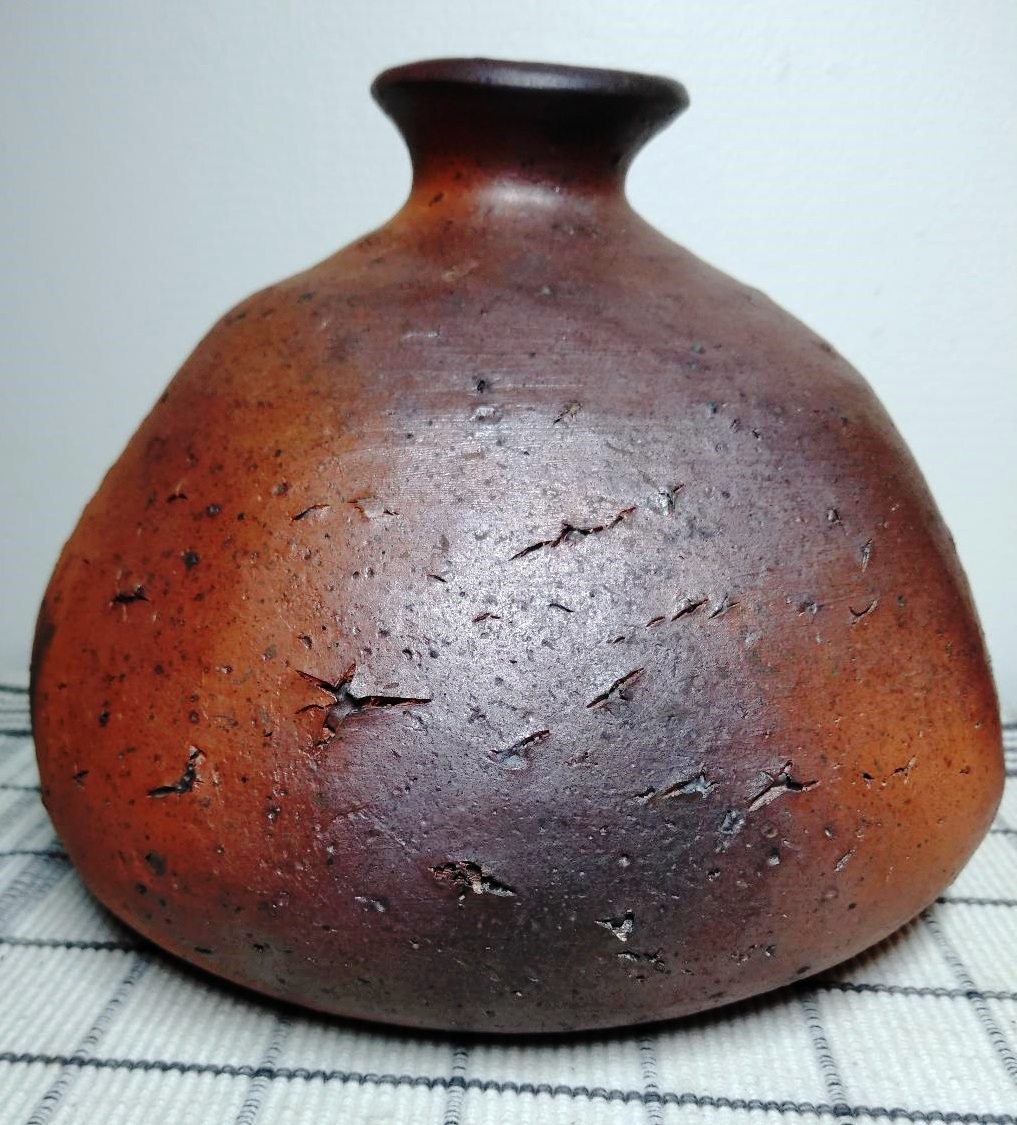
224. FURUTANI Taketoshi, 1974­- , small flat-sided Shigaraki vase

224. FURUTANI Taketoshi 古谷剛敏,  1974­- , Shigaraki shizenyū  hen hanaire  信楽自然釉扁花入 (flat-sided Shigaraki vase with natural ash glazing)


For the artist, see item no. 218.

Gray clay, with natural ash glazing, with colors in the reddish brown, gray and black range, with vitrified green glass-like glaze in one spot on the right side. Weight: 518 g (1.2 lb). Height: 8.8 cm (3-1/2 in). Width: 8.8 cm (3-1/2 in). 

This consists of two rough squares forming the front and back of the piece. The edges of each square are irregular and much pitted and grooved. The sides and top and bottom are rectangular; each is inset from the edges of the front and back by around 0.4 cm (1/8 in plus). The corners where the sides meet the top and bottom are rounded. The piece sits on the lower edges of the front and back squares. The inset bottom is inscribed with the potter’s mark; the small sticker with the number 23 is from the exhibition of the Furutani family's works at the Kura Monzen Gallery in Kyoto in 2023. The surface of the front was gouged and slashed; The part that is reddish brown is more deeply incised than the gray parts. The right-hand side between the front and back walls is smoother and more level than the rest of the piece. The back is marked by three diagonal passes of a spatula-like tool and is much pitted and rough. The left-hand side between the front and back sides is, like the right-hand side, relatively smooth. The rim around the mouth is 3.2 x 2.3 cm (1-1/4 x 7/8 in) and 0.3 cm (1/8 in) high; the mouth is 1.9 x 1.6 cm (3/4 x 5/8 in). 

The wood-firing resulted in colors in the reddish-brown, gray, and black ranges, with natural ash glazing in patches on all sides. There is a small green-colored bidoro tear on the right-hand side. The portions of the front that are red in color are deeper than the gray areas; the edges of this area are sharp and distinct. 

The piece came in a wooden box, with an inscription by the artist. Included in the box was an orange wrapping cloth and a printed sheet containing the artist’s biography. The inscription on the box reads from right to left: 信楽  Shigaraki 自然釉 shizenyū (natural ash glaze) 扁花入 hen hanaire (small vase) 剛敏 Taketoshi, followed by the artist’s seal stamped in red. 

Purchased from the Kura Monzen Gallery, Kyoto, Japan, July 2023 (invoice, shipping and customs documents)

Wednesday, July 5, 2023

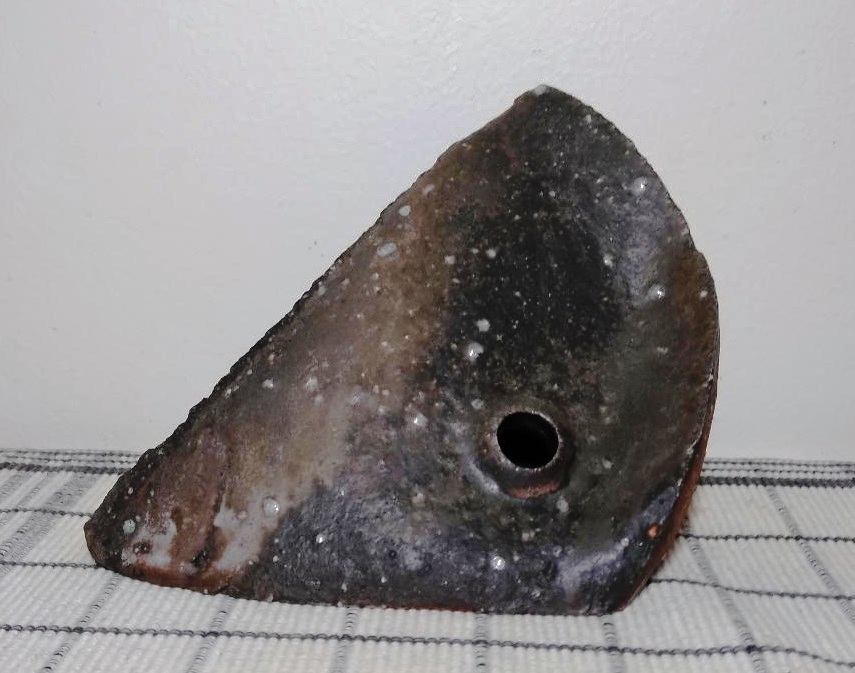
223. Andrew Sartorius, Sculpture series no. 25, “Mt. Meru”

 223. Andrew Sartorius, Sculpture series no. 25, “Mt. Meru”


For the artist, see no. 143.

“This series of sculptural vessels explores shape and form allowing each sculpture to emerge through my coiling and carving process of hand building. The sculptures reveal themselves to me in shifting from and merging and meeting lines that lend themselves to focusing on kiln placement and the interaction between clay choice and kiln effect.” (Author's statement.)

West Virginia wild clay with add feldspar and granite chips, tan in color, unglazed, with kiln effects coloring the surface shades of gray to black, with dark reddish brown areas on the sides and terra cotta color on the base. The molten ash pooled inside the piece and vitrified to form a glassy blue-colored layer on the bottom of the opening. Weight: 1208 g (2.7 lb). Height: 14 cm (5-1/2 in). Width: 18.7 x 13.4 (7-3/8 x 5-1/4). 

The body has three sides. This sits on the flat base, a triangle with curved sides. There are five circles marking the locations of the wads separating the piece from the shelf during firing. Each of the three sides is a triangle with curved sides. The edges where the sides meet are sharp, bumpy ridges. The front side contains the opening, roughly 2 cm (3/4 in) in diameter and located beneath the peak of the piece, about a quarter of the way up from the base. The right-hand side has the artist’s mark in the lower left-hand corner just above the base. The surface of this is pitted and scratched. 

This was wood-fired in the lower front of a train kiln for two days. The exterior colors are kiln effects; as noted above, the ash pooled inside the piece and vitrified. The feldspar and granite chips largely retained their white color, speckling the surface. 

Purchased from the artist, June 2023.

Tuesday, July 4, 2023

221. KAWABUCHI Naoki, 1946- , Nanban-style unglazed flask vase

221. KAWABUCHI Naoki 川淵直樹, 1946- , Nanban-style unglazed flask vase


Kawabuchi graduated from Wako University in 1971 and studied crafts history from renowned researcher and ceramicist Koyama Fujio. He trained in Akahada-ware in Nara and started the Warabe kiln in 1976, focusing mainly on Nanban yakishime (unglazed stoneware) and kohiki glaze (a dripped or swabbed white slip glaze). Kawabuchi is one of the authors of Building Your Own Kiln: Three Japanese Potters Give Advice and Instructions, published in 2003. 

Dark clay, unglazed with blackened ash deposits and kiln colors ranging from dark red to dark brown. Weight: 2286 g (5.1 lb). Height: 17.1 cm (7 in). Width: mouth 2.8 cm (1-1/8 in); rim 6.8 cm (2-5/8 in); neck 4.4 cm (1-3/4 in); widest 23.3 cm (9-1/4 in); base 15.8 cm (6-1/4 in). 

This sits on a circular base, a fairly even ring; the area within the base has been hollowed out in a concave arc with a roughly circular bulge in the middle. Above this the walls of the pot form a long convex arc to the neck, with the widest portion being 5.3 cm (2-1/8 in) above the base. There is a break at the shoulders ca. 12.5 cm (5 in) above the base. There is a line at this point where the walls slope inward more rapidly as they rise toward the neck, which is 14.4 cm (5-3/4 in) above the base. Above the neck the walls rise outward and upward at a sharp angle to the rim. The mouth of the piece is recessed below the rim.  The four sides of the pot have been flattened somewhat, more so toward the shoulders, so that the piece is roughly squared off, but with rounded edges. The surface of the pot is blistered and cracked from the high-temperature (yakishime) firing. It is generally smooth in the parts that are not blistered. 

The Nanban (“southern barbarian”) style uses no glaze and depends on kiln effects for the surface color and effects. The bottom of this has many rough, blackened ash deposits. There are two places on the walls that have ash deposits as well. One side of the pot is a dark brown; the remainder is a dark reddish brown. 

This came with a wrapping cloth and a box inscribed in three lines: 南蛮  四方 (Nanban four-sided); 花X (can’t read the second character, but undoubtedly something that means “flower vase”); and 直 (the first character of the artist’s name), with his seal stamped in red. 

This is a solid, substantial piece, giving the impression of almost sagging under its own weight. With rich colors and great surface effects from the firing. 

Purchased from Treasures of Old Times, Bangkok, Thailand, June 2023.


Sunday, July 2, 2023

220. TAKAHASHI Rakusai, Shigaraki yunomi (teacup)

220. TAKAHASHI Rakusai IV 高橋楽斎, 1925- , Shigaraki yunomi 信楽湯のみ (Shigaraki-ware teacup)


The Takahashi family has been a major producer of Shigaraki-wares since the early nineteenth century. Tozaemon, the founder of the lineage, was active from the 1820s and founded the Rakusai kiln around 1835. The third-generation Rakusai (1898-1976) was an important figure in the post-WWII preservation of traditional wood-fired unglazed potting in Shigaraki and a holder of a Shiga prefectural Living National Treasure title. The seller attributes this to Takahashi Rakusai IV. The fourth-generation holder of the title was named Mitsuo at birth, ascended to the Rakusai title in 1976 on the death of his predecessor, and held it until 2010, when he surrendered it to his son, the current and fifth-generation Rakusai. He was still an active potter at the age of 97 in 2022. The leaflet enclosed in the box is devoted to Takahashi Rakusai III.  From the pictures of pots and boxes available online, the piece and the calligraphy and the seal stamped on the box resemble those of Takahashi Rakusai IV. The box in which this came does not appear to be over fifty years old. Rakusai IV is probably the correct attribution.

Light tan clay, wood-fired with kiln effects in the pinkish brown range, fly ash deposits, and vitrified natural ash glazing, with one bidoro tear. The base and the interior of the foot ring largely escaped the kiln effects, showing the natural color of the baked clay..Weight: 164 g (5.8 oz). Height: 7.6 cm (3 in). Width (at the widest point at the rim): 7.9 cm (3-1/8 in). 

This sits on the flat foot ring, which is 4.4 cm (1-3/4 in) in diameter and roughly 0.8 cm (5/16 in) high on the exterior wall of the foot; the base of the foot ring is 0.3 cm (1/8 in) wide; and the area within the ring foot was hollowed out to roughly two-thirds of the depth of the foot. The interior is level and flat. The foot ring appears to have been trimmed on a wheel—the dimensions are very even. Above the foot, the walls move outward and upward in a straight line at about a 45-degree angle to a height of 1.3 cm (1/2 in). The artist’s seal, a small oval cartouche with characters inside (too tiny to read) was pressed into this area of the piece. The walls proper extend upward and outward at a steep angle in roughly a straight line. The exterior walls and the interior base of the cup show circular finger marks. A groove encircles the exterior, rising slowly up the cup in a continuous line as it moves around the exterior, to just below the rim. The surface of the piece is rough, like fine-grain sandpaper. 

This was unglazed. On the front of the cup near the rim and extending downward about a third of the height of the cup is an area of vitrified natural ash glaze, dark greenish brown in color; at the right end of this area, a tear of molten glass (bidoro) formed and slid downward. The front of the cup and the area of the interior opposite the front are covered with the blackened remnants of some fly ash deposits. The back and the interior of the cup were largely unaffected by ash and are a pinkish brown color. Where the cup was exposed to more heat and flames, the color tends toward a darker, reddish brown. 

This came with a box. The lid is inscribed in three lines:  信楽 (Shigaraki), 湯のみ (yunomi), and 楽斎 (Rakusai), with the artist’s seal stamped in red on the lower left. A potted biography of Takahashi Rakusai III was enclosed with the piece.

A nice example of how a skilled hand and a knowledgeable kiln operator can enhance an ordinary, everyday object. 

Purchased from Treasures of Old Times, Bangkok, Thailand, June 2023 (invoice).


Sunday, June 25, 2023

218. TANI Seiuemon IV, 1913-?, Shigaraki uzukumaru vase

218. TANI Seiuemon IV 四代 谷清右衛門 , 1913-?, Shigaraki uzukumaru vase


Born in Shigaraki in 1913, Tani Seiuemon IV was a key person in the revival of Ko-Shigaraki and Ko-Iga styles with natural ash glaze effects. His works are exhibited in the British Museum and Cleveland Museum of Art. His son Tani Q currently operates the family kiln in Shigarakicho. To judge from pictures of other works by him available online, this piece is typical of his work. 

Reddish brown clay with embedded feldspar pebbles, wood-fired with natural ash deposits, colors ranging from reds through browns to pinks; Weight: 1192 g (2.7 lb). Height: 14.5 cm (5-3/4 in). Widths: mouth 4.8 cm (1-7/8 in); lip 7 cm (2-3/4 in); neck 4.8 cm (1-7/8 in); shoulders (widest) 12.6 cm (5 in); base 10.2 cm (4 in). 

This shape is known as the uzukumaru (蹲る) or “crouching” style of vase, apparently a reference to its squat shape. This sits on the flat base, which is a circular with pitted edges. The surface of the base was scored with a flat blade to create ridges and grooves. The artist’s mark, a cursive form of the character 清 was etched into the middle of the base. The walls immediately above the base bulge outward slightly as if the weight of the clay pressed the body outward before the clay dried. Above this the walls rise in a shallow convex arc to the neck. The widest point is at the shoulders 8.7 cm (3-1/2 in) above the base. From there the walls curve inward more rapidly to the neck, which lies 11.7 cm (4-5/8 in) above the vase. Above the neck the walls curve inward slightly and then outward in in a concave arc to meet the lip, which is a horizontal ring topped by a short vertical slanting slightly inward. The interior of the pot roughly mirrors the exterior. The surface of this is rough and pitted. Tani added the small feldspar pebbles common in Iga ware to portions of the exterior. 

This was unglazed and wood-fired. Natural ash deposits cover much of the surface. Some of these vitrified, leaving a glassy surface. 

The pot is heavily weighted toward the base, which is about 1.2 cm (1/2 in) thick. 

Purchased from Treasures of Old Times in Bangkok, June 2023.


Monday, June 5, 2023

216. Iga-ware mizusashi

216. Iga-ware mizusashi 伊賀焼水指, a lidded fresh water container for the tea ceremony


Dark brown clay, with natural ash glazing in a blue-green color on the exterior and a whitish lining glaze over much of the interior. Weight: 1354 g (3 lbs). Height: 15.1 cm (6 in). Diameter: of mouth, 8.8 cm (3-1/2 in); of lid, 10.4 cm (4-1/8 in), of rim, 12.5 cm (5 in); maximum of body, 13.9 cm (5-1/2 in); of base, 11.6 cm (4-5/8 in). 

This sits on the flat base, which has several gouges from the bamboo shaping spatula. Above the base the walls move outward and upward in a straight line at about a 45-degree angle to a height of 1.7 cm (5/8 in) to the meet the walls proper of the body. The widest point of the piece occurs at this junction. The body looks almost as if it had sagged downward at this point. Above the junction the walls move inward in more or less a straight line to a height of about 3 cm (1-1/4 in). From there the walls rise roughly in a straight line to the shoulders of the piece 10 cm (4 in) above the base, where they curve outward and then inward in a convex arc to the neck, which is 10.4 cm (4-1/8 in) in diameter and located 11.4 cm (4-1/2 in) above the base. They then rise in a straight line to the rounded edge of the rim of the piece. The body of the piece is much dented, pitted, grooved. The two ear lugs are affixed at the shoulder; they are crudely fashioned, roughly circular knobs with a hole in the center. 

The lid sits on an interior gallery. The bottom of the lid is a rounded convex shape. The edge of the top surface is a flat circle; the interior of this area was hollowed out. A rectangular piece of clay was pressed into the center of the lid and folded upward to create a curved grasping point.  The lid sits securely, and all but the top of the grasping point is below the rim of the body proper. 

The surface is much pitted and rough to the touch. There are a few small pebbles embedded in the surface of the exterior walls. 

The lining glaze covers the bottom of the interior and some of the sides. It is whitish in color. The colors on the exterior range from black through dark browns to a lighter yellowish brown.  The yellowish brown color appears to have been brushed on and may result from interaction between the wood-firing and a slip or some sort of flashing glaze.  The exterior also has drips and spots of the blue-green ash glaze for which Iga-ware is known. In a few places, this glaze has vitrified and formed the turquoise spots known in Japanese as bidoro (from the Portuguese vitro ‘glass’). The underside of the lid is a sooty black. 

This came in an old wooden box. Included in the box was a white wrapping cloth. The top is inscribed 水指古伊賀焼, or “Mizusashi, Old Iga-ware.” The wood has grown so dark over time that the characters are barely visible. At a later point, someone wrote these characters on a small slip of paper and taped it to the lid.  The side of the box has an intriguing inscription.  The line on the right reads 明治三十一年十一月 (Meiji sanjūichi nen jūichi gatsu). The inscription uses a variant character for the first 十. This translates as “Thirty-first year of the Meiji era, eleventh month,” or November 1896. Japan officially adopted the Gregorian calendar in the 1870s, and I’m assuming this date reflects that.  

The middle line of the inscription was written in much larger characters and reads 吉春日.  This could have several possible translations. Literally it is “auspicious spring day,” or just “auspicious day.” The first two characters are also used as a given name read “Yoshiharu.”  The larger size relative to the other characters indicates its importance. It might be the name of the piece. Interestingly, beneath the second and third characters are the remnants of other characters, impossible to read now. 

The third line, on  the left, reads 古伊賀水指, or “old Iga mizusashi,’ The inclusion of “old” is intriguing—was  the piece already “old” when the box was made? Does the date indicate when the piece was made, or was this a gift on an auspicious occasion with the date of the gifting inscribed on the box? 

A great piece of pottery. 

Purchased from Treasures of Old Times in Bangkok, Thailand, May 2023.


Pottery

Looking for suggestions

I need to dispose of my collection. I've tried to donate it to several local museums or schools with ceramics programs, but no one wants...