Showing posts with label Oribeyaki. Show all posts

Friday, August 9, 2024

258. SUZUKI Gorō, 1941- . Painted Oribe-ware ceramic winter melon sculpture

258. SUZUKI Gorō 鈴木五郎 , 1941-  . E-Oribe Tō Tōgan  絵織部陶冬瓜   (Painted Oribe-ware ceramic winter melon), sculpture, 2003.


“Oribe keeps developing. It never stayed in one place. So I create whatever comes to my mind, one after another. I never stop. I feel like I’m playing with clay. The playfulness makes one’s life interesting.”                                                                                                                                                          --Suzuki Goro

Born in Toyota City, Aichi Prefecture, in 1941, the prolific Suzuki Gorō is known particularly for his Oribe-ware, as well as for Shino and ki-Seto pieces. Stylistically playful, Suzuki’s experiments with color and form result in works both sculptural and functional. His art is experimental and showcases a youthful and quirky approach to Mino and Seto ceramics. He has brought a fresh and innovative perspective to Oribe-ware. His works are held by, among others, the Los Angeles County Museum of Art, Metropolitan Museum in New York City, Minneapolis Institute of Art, Museum of Fine Arts in Boston, and Peabody Essex Museum in Salem, Massachusetts. 

A visit to a daughter living in Los Angeles inspired this piece and its drawings of buildings and a car. 

White clay. Glazed in Oribe green, cream, and dark brown; one unglazed spot near the base. Weight: 2.3 kg (5.1 lb). Height: 27 cm (10-5/8 in). Width: 18.5 cm (7-1/4 in). 

This is a rough cylinder with a rounded and flattened top and bottom. It sits on a flat base, with a central depression. The character 五 go (the first character’s in Suzuki’s given name) was incised into the base. The body is roughly circular in cross-section, though with many bumps and dents. The widest point is about 7.5 cm (3 in) up from the base. The diameter gradually narrows to the shoulders to about 14 cm (5-1/2 in) some 25 cm (10 in) above the base. The top has a central depression, filled with a “stem” about 5 cm (2 in) long. The surface is smooth to the touch. 

For a piece of this size, it is remarkably light in weight. Suzuki must have trimmed it when it had partially dried until the walls were quite thin. There is no obvious escape hole for the air inside the pot, a necessity for the kiln. The stem has a central hole, but it extends only a short distance inward. Perhaps the vent was filled in after the firing. 

Except for the three oval picture areas, the pot is covered in the Oribe green glaze. This glaze is of varying thicknesses. The direction of the drips implies the piece lay on its side as this glaze was applied, although there is one long prominent vertical drip. The picture areas were covered with the Oribe cream glaze. The oval shapes are reminiscent of the picture areas on highly painted Ming and Qing vases. The pictures are drawn in the Oribe brown glaze. The first shows a boxy car with jagged shapes above it (mountains?).The second has a light bulb beneath a metal shade, with a rotating off-on switch, hanging from an electrical cord. Diagonal lines suggest rays of light. A brown line outlines the edges of this oval. The image is reminiscent of the motif of persimmons suspended by cords from the eaves of a house, a common image on classical Oribe pieces (see item no. 7 for an example). The third oval contains drawings of two skyscrapers with a helicopter. Similar images can be found on other pieces by Suzuki. 

This piece has all the playfulness and whimsy of classical Oribe-ware, with the updated images containing nods to classical styles of decoration. 

This came in a wooden box inscribed by Suzuki in two lines:  絵織部陶冬瓜   E-Oribe Tō Tōgan /  X五 (painted Oribe-ware ceramic winter melon / sigil Go). The sigil is indecipherable. Interestingly, Suzuki did not stamp the box with his seal. The same signature and the lack of a seal are found on online examples of boxes inscribed by Suzuki. 

Purchased in August 2024 from Dai Ichi Arts in New York City, which had it directly from the artist (invoice, shipping documents, postcard from seller, small brochure/catalogue of Suzuki’s works).


Tuesday, May 21, 2024

248. WAKAO Toshisada, 1933- , Oribe-ware incense container

248. WAKAO Toshisada 若尾利貞, 1933- , Oribe kōgō 織部香合 (Oribe-ware incense box)


Wakao was born in Tajimi. After graduating from junior high school, he worked at a ceramics factory while studying Shino-ware on his own. He went independent in 1970. He is a recipient of the Katō Kōbei Award, the Mino Newcomer’s Award, and the New Craft Award, among other honors. He has been a participant and award-winner at the Chūbu Art Exhibition, Gifu Prefectural General Design Exhibition, Asahi Ceramics Exhibition, Japanese Traditional Crafts Exhibition, and the Chūnichi International Ceramics Exhibition. He has had solo exhibitions held at the Nihonbashi Takashimaya, Nagoya Matsuzakaya, and Tokyo Tsubogen, among other venues. He is a member of the Japan Kōgei Association.

Cream-colored clay, with Oribe green, brown, and cream glazes; the edges where the two halves meet are unglazed. Weight: 102 g (3.6 oz). Height: overall, 4.3 cm (1-3/4 in). Width: 6 cm (2-3/8 in).                

Bottom part: This sits on a foot ring 3.7 cm (1-1/2 in) in diameter and about 0.3 cm (1/8 in) high on both sides. Within the ring is the artist’s sigil written with a brush in brown glaze. Above the foot ring, the walls flare outward at about a 45-degree angle to meet the sides 0.5 cm (3/16 in) above the base. The walls rise in more or less a straight line to the top of the bottom part 1.8 cm (3/4 in) above the base; at this point the piece has a diameter of 3.2 cm (1-1/4 in). There is a horizontal shelf about 0.5 cm (3/16 in) wide on which the top part rests. At the inside edge of this shelf is a vertical flange 0.8 cm (5/16 in) high. The interior of this part mirrors the shape of the exterior walls. 

Top part. Overall, this part is 3.2 cm (1-1/8 in) high. The bottom edge is flush with the top edge of the bottom part; The walls are 0.5 cm (3/16 in) thick. Above this, the walls curve inward in a high convex arc to a flat circular area at the top 3.4 cm (1-1/4 in) in diameter. In the center of this is a roughly circular small button less than a centimeter (3/8 in) in diameter. The interior of this part mirrors the shape of the exterior. 

There are eight vertical grooves extending from the circle at the top of the upper part across the body of the piece to the lower edge of the walls. The texture of the exterior is bumpy; the interior is smooth. 

The circle at the top and the upper half of the top part were covered with the green Oribe glaze. Below this each groove was filled in with the brown Oribe glaze; between each of these lines Wakao used the brown glaze to draw an irregular vertical shape. Wakao also used this glaze to draw his sigil on the base. Other than the edges where the halves meet, the rest of the piece has a cream glaze. 

This came in a small wooden box inscribed by the artist in two lines: 織部香合 / 利貞 Oribe kōgō / Toshisada (Oribe incense container / Toshisada), followed by the artist’s seal stamped in red. Included in the box were a blue wrapping cloth, also stamped with the artist’s seal in red, and a short biography.

Purchased from Dai Ichi Arts in New York City in May 2024. (invoice, shipping label)

Sunday, September 10, 2023

229. Kutsugata kuro Oribe chawan (clog-shaped black Oribe teabowl)

229.  Kutsugata  kuro Oribe chawan  沓形黒織部茶碗  (clog-shaped black Oribe teabowl)


Gray clay; glazed in black and cream with added decorations in brown; foot ring and base left unglazed. Weight: 398 g (14 oz). Width of rim: 14 x 11 cm (5-1/2 x 4-3/8 in); of foot ring: 5.4 x 5.2 cm (2-3/16 x 2 in). Height. 6.6 cm (2-5/8 in). 

This is a kutsugata, or “clog-shaped” teabowl. It sits on the foot ring, which is an irregular oval, about 0.5 cm (1/4 in) high on the exterior; the interior of the foot ring was hollowed out to slightly less than this depth. Above the foot ring, the bottom rises at a shallow angle to the junction with the vertical walls, which begin 1.7 cm (5/8 in) above the base. An artist’s mark was inscribed on the bottom. There could be characters inscribed within the foot ring, but that may just be my eye trying to find patterns in the scratches. The bottom dimensions of the sides are slightly narrower than the rim but generally mirror the shape of the rim. There is a horizontal groove a finger’s width wide running around the piece, centered just below the midpoint of the walls. Below this the walls are shaped in a shallow convex arc; above it, the walls swell gently outward to the rim in a straightish line. The walls have many horizontal lines running around the piece. The rim is rounded. The interior follows the contours of the exterior but is much smoother. Overall the surface is quite smooth, including the unglazed sections. The clay looks coarse, but it is actually fine-grained. The base is pitted but otherwise smooth to the touch. 

The foot ring and most of the base were left unglazed. The outer edges of the base have some spillover black glaze on one side. The interior and most of the exterior were coated in a thick black glaze. Two sections of the walls were covered in a cream glaze (probably put on before the black glaze was applied). Portions of the cream glaze have a rosy orange tint, somewhat like the effects found with the Shino glaze. A brown glaze was used to draw patterns in the cream areas. 

This came in an old wooden box, inscribed in two lines. The line on the right reads: 沓形 (kutsugata, or “clog-shaped”; the line on the left:  黒織部茶碗  (kuro Oribe chawan, or “black Oribe teabowl”). 

The seller dated this piece to the Meiji era. 

Purchased from Treasures of Old Times), Bangcock, Thailand, September 2023. 

Friday, September 8, 2023

227. HAYASHI Eiji, 1931- , aka Oribe chawan (red Oribe teabowl)

 227. HAYASHI Eiji 林英仁, 1931- , 赤織部茶碗 aka Oribe chawan (red Oribe teabowl)


From Tajimi City, Gifu Prefecture, Hayashi is the grandson of the esteemed Katō Juemon (see item 184), a designated Gifu prefectural intangible cultural property. Under the guidance of his grandfather, he underwent rigorous training in the traditional art of pottery. He specializes in old-style Mino-, Shino-, and Kiseto-wares. He graduated from Tamagawa University, where he subsequently was an assistant professor. In 1968, Hayashi returned to his hometown and dedicated himself primarily to tea pottery. 

White and reddish-tan clays using the Narumi technique (see item 217); slip glazed with added decorations in Oribe green, cream, and brown; foot ring and surrounding areas left unglazed. Weight: 392 g (14 oz).Width of rim: 14 x 10 cm (5-1/2 x 4 in); of foot ring: 5.7 x 5.5 cm (2-3/8 x 2-1/8 in). Height: 7.5 cm (2-7/8 in). 

This is a kutsugata , or “clog-shaped” teabowl. It sits on the foot ring, which is an irregular oval, about 0.6 cm (1/4 in) high on the exterior; the interior of the foot ring was hollowed out to about a third of that on the interior. Above the foot ring, the walls rise in a straight line at a shallow angle to a height of 1.8 cm (5/8  in). The potter’s mark was incised into the clay at this point. There is a sharp break in direction at this point. Above this, the wall rise vertically to the rim in a straightish line. Just above the base, there is a circular groove around the exterior of the piece. Then the walls tilt slightly outward as they rise to around 1.8 cm below the rim. This area of the walls is flatter but still retains the shallow grooves and ridges created by the potter’s fingers as he shaped the piece. Above this, there is another groove encircling the piece before the walls flare outward at a sharper angle to meet the rim.  This area has several shallow grooves running around the circumference. The interior of the piece mirrors the exterior, but the walls are much smoother. The clay is finely grained, and even the unglazed portions are smooth. 

With the exception of the foot ring and the area of the base surrounding it, the piece was covered with a slip, which, when the piece was fired, created a glossy surface. The upper portion of the piece (roughly the first 2 cm [3/4 in]) was formed from a white clay. The top part of this section were covered with a thin layer of the green copper Oribe glaze. The white clay is visible elsewhere beneath the slip. Beneath this, the piece was made from a reddish-tan clay. This section was decorated in cream and brown. The front has two cartwheels. The back side has two square and three circular elements. Each is outlined in brown, with the interior filled in with cream, with added lines in brown. 

This came in a wooden box with an inscription in three lines, reading from right to left: 赤織部 (aka Oribe, “red Oribe); 茶碗 (chawan, “teabowl”); 英仁 (Eiji), followed by the artist’s seal stamped in red with the characters for his “studio name,” or sobriquet. The characters in the seal are 桃山, which can be read tōsan or tōzan or momoyama. They translate literally as “peach mountain.” The second reading might be a pun on 登山, “climbing the mountain,” an important ritual in some sects of Japanese Buddhism. “Momoyama” is the name given to a period of Japanese history; item 228, which has a similar decorative scheme, was identified by the seller as a Momoyama-style piece  If the latter is the correct interpretation, it may be Hayashi’s claim to be making old-style pieces. Of course, all these meanings could be invoked simultaneously. The wooden box was further enclosed in a cardboard box with a label identifying the contents. 

Purchased from Shogun Pottery (a new branch of Treasures of Old Times), in Hobarth, Australia, September 2023 (receipt).

Friday, June 23, 2023

217. Narumi Oribe kutsugata chawan

217. Narumi Oribe 鳴海織部 kutsugata chawan (clog-shaped teabowl)


Narumi (aka red Oribe) is a technique in which two clays are used to make a piece. Here a white clay was used to form the upper edge of the walls; most of this was subsequently covered with the dark green Oribe glaze. In some places on the exterior lower edge of the green glaze, a narrow band of the white clay is visible, revealing how irregular this area is. The rest of the piece was formed from a reddish brown clay. A thin white slip was applied to most of this area, resulting in a pinkish color when the pot was fired. Additional decoration was applied in dark brown and white. The foot ring and the area around it were left unglazed. Weight: 304 g (11 oz). Height: 7.3 cm (2-7/8 in). Width: 13.6 x 10.4 cm (5-3/8 x 4-1//8 in). 

This sits on the foot ring, which mirrors the shape of the piece as a whole. It is 6.3 x 5.7 cm (2-12 x 2-1/4 in) and roughly 0.6 cm (1/4 in) high inside and out. Above the foot ring, the walls move outward at about a 15-degree angle to a height of 1.2 cm (1/2 in) and the approximate dimensions of the piece. From there the walls rise in more or less a straight line to a height of 5 cm (2 in). Above this the rim bulges outward and then upward to meet the rim of the cup, with several horizontal ridges running around the cup. This is smooth to the touch. The unglazed portion around the ring foot is also quite smooth—the red clay used here is very fine textured. 

The green band encircles the rim and the upper walls. It was allowed to drip down in several places. The interior and most of the exterior walls were coated with a thin white slip. This area is dimpled with small dots and thin lines where the clay shows through. Brown and white glazes were used to add decoration to the piece. The front has a stylized branch with leaves. This was done very carefully and deliberately. An attempt was made to make the branch appear three-dimensional. Unusually, the design spreads across the front and onto the right side. On the back of the piece are three crudely drawn circles. 

This came in a box with “Naru(mi) Oribe” 鳴織部 inscribed in the center. The characters on the left are too cursive for me to decipher. 

The seller claimed that this dates to the Meiji era. 

A nice example of red Oribe and the kutsugata shape. The formal, careful decoration on the front of the piece contrasts nicely with the slapdash circles on the back. The piece has good balance. 

Purchased from Treasures of Old Times in Bangkok, June 2023.


Wednesday, April 26, 2023

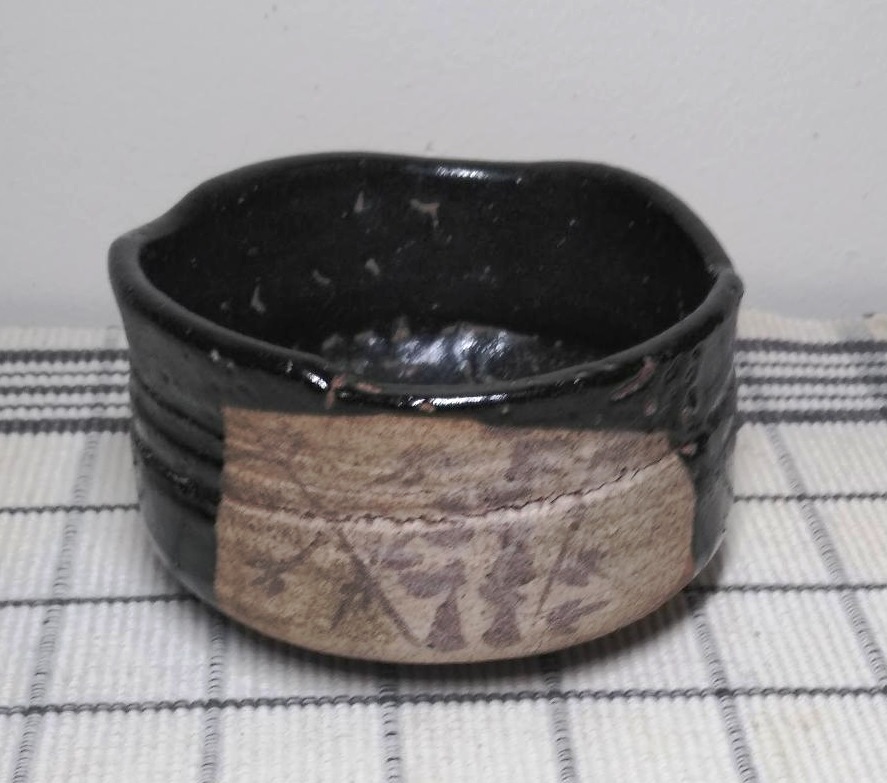
213. Black Oribe chawan

213. Black Oribe chawan  (Kuro Oribe chawan   黒織部茶碗)


Light gray clay, with a lighter color slip and a thick black glaze over the interior and most of the exterior walls; base unglazed except around the outer edges. Weight: 368 g (13 oz). Height: 7.5 cm (3 in). Width 12.5 cm (5 in). Width of foot ring: 5.4 cm (2-1/8 in). 

This sits on the foot ring , which is an irregular circle, about 0.3 cm (1/8 in) high on the outer side and 0.1 cm (1/16 in) on the inside.  Above the foot ring , the walls of the base rise at a shallow angle to meet the perpendicular walls of the bowl, beginning about 2 cm (3/4 in) above the base. The walls are much grooved and bumpy, but with a pronounced groove near the center. The rim is quite irregular. The surface is relatively smooth to the touch. 

The interior and about three-quarters of the exterior walls are covered with a thick black glaze, much pitted. The remainder of the exterior wall appears to have been coated with a light-colored slip. Within this are darker “ghost” figures—perhaps created with a resist technique or perhaps a glaze that fell off during the firing.  It’s impossible to tell what they represent. 

The seller says this dates to the mid-Edo period, eighteenth to nineteenth centuries. The ghost figures add an intriguing element to this piece. This came with a box and a wrapping cloth; the top of the box has the characters 黒織部茶碗 (kuro Oribe chawan, black Oribe teabowl).

Purchased from Treasures of Old Times in Bangkok in April 2023.

Pottery

Looking for suggestions

I need to dispose of my collection. I've tried to donate it to several local museums or schools with ceramics programs, but no one wants...