Showing posts with label Maine potters. Show all posts

Thursday, May 13, 2021

53. Ned Roche, vase

53. Ned Roche, vase


Roche is a potter in York, Maine. He is director of Chase’s Garage, a former garage coverted into studio spaces for ceramic and print artists and a sales showroom for their output.

Light gray clay, colors in the glazed areas are greens, blues, blacks, and reds; base left unglazed. Weight: 498 g (1.1 lb). Rim diameter: 2.8 cm (1-1/4 in); maximum diameter: 8.3 cm (3-1/4 in); base diameter: 6.8 cm (2-5/8 in). Height: 16.5 cm (6-1/2 in).

This sits directly on the base. Above the base, for a space of 0.8 cm (5/8 in), the sides of the pot have been gouged out in vertical scallops all around the circumference of the pot. The maximum diameter of the pot is just above this area. The walls of the pots bend inward slightly before rising to the shoulder, which is 7.8 cm (3-1/8 in) in diameter and some 10 cm (4 in) from the base. Above this the walls move inward to the neck, which is 2.5 cm (1 in) in diameter at the narrowest point and about 14.5 cm (5-3/4 in) above the base. The walls then flare outward and upward to the rim. The lip of the pot slants, one side being about 0.3 cm (1/8 in) lower than the opposite part. The pot is very irregularly shaped, with a few dents and bumps, but the finish is quite smooth.

A reddish slip is visible at the bottom edges of the glazing and shows through on the sides of the pot in some places. The base and the gouges on the bottom were left unglazed. The colors in the glazed area range from light greens and blues to blacks. From the direction of the drips, the pot was held upside down while the being glazed. The interior of the mouth of the pot is glazed, but, because of the narrowness of the opening, it’s impossible to see if the interior is glazed.

Purchased at Chase’s Garage in York, Maine, October 2019.


52. Brian Buckland, container

52. Brian Buckland, container


Buckland is a potter in Portland, Maine. For more on him and other examples of his work, visit his website: www.bucklandceramics.com.

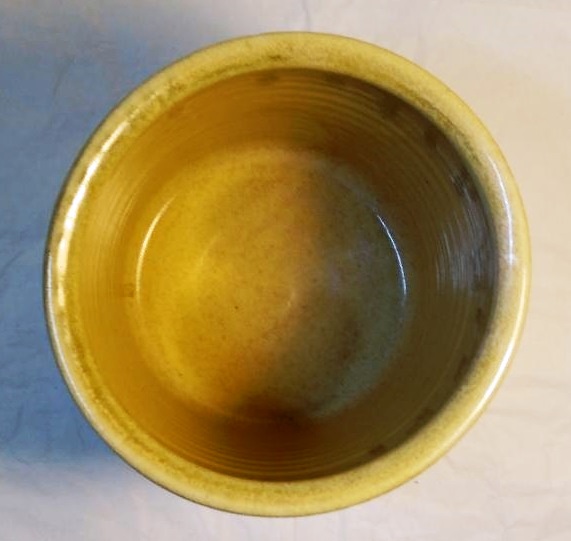
White clay, glazed in green, bottom left unglazed.  Weight: 866 g (1.9 lb). Rim and maximum diameter: 12.5 cm (5 in); base diameter: 12.5 cm (5 in). Height: 12.2 cm (4-13/16 in).

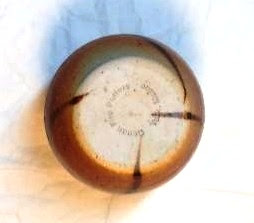
This sits directly on the base. The rim and the base are the same diameter. The walls of the pot are inset slightly from the top and the bottom. The remains of the posts used to separate pots in the kiln are visible on the base. The artist’s mark, “bb” in a square, was stamped just above the base on one side of the pot. The rim has three parallel grooves around the circumference of the pot at the top.

Both the interior and the exterior are glazed. The coverage is uneven, giving the piece a mottled appearance. The glaze has pooled in the grooves at the top and around the artist’s mark, making those areas darker. About three-fourths of the exterior has a good crackling; the fourth side is free of any fractures. A luster may have been applied to this—there are areas of the base that have a sheen to them.

This resembles the ceramic containers used to hold calligraphy brushes in China and Japan.

Purchased at Chase’s Garage in York, Maine, October 2019.

51. Amy Clark, large wood-fired vase

 51. Amy Clark, large wood-fired vase 


For Clark, see item 48.

Light gray clay, interior and lip have a gray glaze; exterior slip decorated in brown, with colors from wood-firing. Weight: 1378 g (3 lb). Rim diameter: 5.3 cm (2-1/8 in); maximum diameter: 13.2 cm (5-1/4 in); base diameter: 8 cm (3-1/4 in). Height: 23.3 cm (9-1/4 in).

The pot sits directly on the base, which is only very slightly concave. The pot rises outward and upward from the base in a shallow arc to the maximum width, which is 11.3 cm (4-1/2 in) above the base. The walls then curve inward to the neck, which is about 5.2 cm (2-1/8 in) wide at the narrowest point and about 18.8 cm (7-1/2 in) above the base. The pot then bows outward slightly to the rim. The artist’s mark, “Ocean Fire Pottery York Maine” is stamped in a circle at the bottom of one side, just above the base. The pot sits very solidly on the base.

The interior and the lip are covered with a gray glaze. The exterior walls and base were decorated in curving lines with a brown slip. The colors on the exterior are light browns and reds and come from the wood-firing. One side of the vase has a glossy sheen from natural ash glazing.  The surface of the exterior is much speckled with ash. The surface is alightly rough to the touch.

A satisfying combination of long lines, warm, randomly generated colors from the wood-firing, and a freely executed design. 

Purchased at the artist’s studio, Ocean Fire Pottery, York, Maine, September 2019.


50. Amy Clark, begging bowl

 50. Amy Clark, begging bowl 


For Clark, see item 48.

Dark brown clay, glazed in brown and cream colors; bottom left unglazed. Weight: 362 g (13 oz). Rim (and maximum) diameter 12 cm (4-3/4 in); base diameter: 7.5 cm (3 in). Height: 7.3 cm (2-7/8 in).

Clark herself labeled this a "begging bowl." In Japan monks in neighborhood temples stand in front of parishioners’ houses and chant, holding a bowl much like this one. The housewife emerges and places food—rice or vegetables—in the bowl.

Hand-thrown. This sits directly on the base. The artist’s mark, “Ocean Fire Pottery York Maine” is stamped into the base. The walls rise outward and upward from the base in a gentle arc to a height of around 4 cm (1-1/2 in) from the base; from that point they rise in more or less a straight line to the rim.

The glazing is reminiscent of the Tenmoku glaze often seen on Japanese pottery. The colors range from a rich brown through tans to cream. The surface of the glazed area is randomly speckled with many “oil drops.”

Purchased at the artist’s studio, Ocean Fire Pottery, York, Maine, September 2019.


49. Amy Clark, small vase

49. Amy Clark, small vase


For Clark, see item 48.

Light gray clay, decorated with a reddish-brown slip and green celadon glaze; base left unglazed. Weight: 262 g (9 oz). Rim diameter: 4 cm (1-1/2 in); maximum diameter: 6.5 cm (2-5/8 in); base diameter: 5.3 cm (2-1/4 in). Height: 13.2 cm (5-1/4 in).

Hand-thrown. This sits directly on the base. The edges of the base are slightly beveled upward; this created a slight ridge on the exterior of the pot. The artist’s mark, “Ocean Fire Pottery York Maine” was stamped into the base. The pot rises outward in more or less a straight line to the maximum width 8.7 cm (3-/12 in) above the base. It then curves inward to the neck, which is 3.2 cm (1-5/16 in) wide at the narrowest point and 11.7 cm (4-5/8 in) above the base. The walls then flare outward to the rim. The lip slants a bit.

The pot was covered with a reddish-brown slip. The interior and most of the exterior were then covered with a green celadon glaze. The bottom of the pot up to height of about 2.8 cm (1-1/8 in) was left unglazed allowing the slip color to appear.

The contrast between the glazed and unglazed surfaces on the exterior set the pot apart.  Had the exterior been completely glazed, the pot would have been just another example of a glazed vase, well done but lacking interest. A simple design choice by Clark created something special.

Purchased at the artist’s studio, Ocean Fire Pottery, York, Maine, September 2019.


48. Amy Clark, miniature wood-fired vase

48. Amy Clark, miniature wood-fired vase


Amy Clark is a potter in York, Maine. Her studio, Ocean Fire Pottery, is next to her house. “The pottery I make,” she states, “is earthy and created to be used and enjoyed. . . . I create simple forms with natural colors in hopes of evoking serene, effortless emotions from the user.” For more on her and pictures of her work, visit her website: www.oceanfirepottery.com.

Light gray clay, the interior and the upper part of the exterior were glazed in a gray color; exterior decorated with brown slip, with colors from wood-firing. Weight: 72 g (2.5 oz). Rim diameter: 3.4 cm (1-1/4 in); maximum diameter: 4.7 cm (1-7/8 in); base diameter: 3.5 cm (1-3/8 in). Height: 5.5 cm (2-1/4 in).

This sits directly on the base. The artist’s mark, “Ocean Fire Pottery York Maine” has been stamped into the base. The walls rise outward in more or less a straight line to the maximum diameter, which is 2 cm (3/4 in) above the base. After a brief arc around the maximum diameter, the walls then move inward, again in more or less a straight line, to the neck, which is 2.7 cm (1-1/16 in) wide and 4.7 cm (1-7/8 in) above the base. From the neck the walls flare outward slightly to the rim. The walls are comparatively thick for the size of the piece.

This follows much the same glazing and decorating program as item 51. The interior and the upper part of the exterior down to about the maximum diameter have a gray glaze. The exterior was decorated in curving lines using a brown slip. The ends of these lines extend over the base of the pot; I infer from this that Clark held the pot upside down when drawing these lines. During the wood-firing, the pot acquired additional colors. The lower part of the exterior (the part not covered by glaze) is largely a dark red in color. The upper part is mottled creams and tans. A portion of the pot just above the base has no coloring, allowing the clay color to show. The pot is much speckled on the outside with ash. The interior of the pot is colored red. The upper part of the exterior has a sheen from the natural ash glazing.

For such a small pot, a lot is in play here. The curving brown lines impart motion and freedom to the piece. The colors laid down by the wood-firing and the ash specks are entirely random. 

Purchased at the artist’s studio, Ocean Fire Pottery, York, Maine, September 2019.


Wednesday, May 12, 2021

47. Elaine Xenelis Fuller, small pit-fired vase

47. Elaine Xenelis Fuller, small pit-fired vase


Fuller has been potting since 1978. She pots and teaches at her workshop, The Red Door Pottery Studio, in Kittery, Maine. For more on her and pictures of her work, visit her website: www.reddoorpottery.com.

Light gray clay, no glaze, colors from pit-firing. Weight: 138 g (5 oz).  Rim diameter: 5.7 cm (2-1/4 in); maximum diameter: 7.5 cm (3 in); base diameter: 4.5 cm (1-3/4 in). Height: 8.2 cm (3-1/4 in).

This pot sit directly on the base. “Elaine” was incised into the base. From the base the walls rise in an even arc to the widest point, which is about 4.5 cm (1-5/8 in) above the base. The pot then curves inward to the neck, which is 5 cm (2 in) wide and 6.7 cm (2-11/16 inches) above the base. The neck rises in almost a straight line to the rim.

The colors come entirely from the pit-firing, which used seaweed (item 46 was part of the same firing). The color of the clay shows through on one side; elsewhere the pot is colored a deep black, shades of gray, a deep reddish brown, and orange. The interior is mostly gray.

A richly colored, classically shaped piece. A fine example of the possibilities and rewards of pit-firing.

Purchased at The Red Door Pottery Studio, Kittery, Maine, September 2019.


Pottery

Looking for suggestions

I need to dispose of my collection. I've tried to donate it to several local museums or schools with ceramics programs, but no one wants...