Friday, January 19, 2024

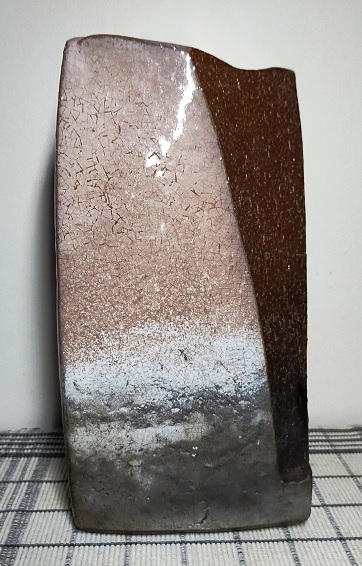
239. MIWA Eizō, 1946‒99, Hagi-ware vase

239. MIWA Eizō 三輪栄造, 1946‒99, Hagi hanaire  萩花入 (Hagi-ware vase)


Miwa Eizō was the second son of Living National Treasure Miwa Kyūsetsu XI 十一代 三輪休雪. He graduated from the private Musashino Art University and was a member of the Japanese Traditional Crafts Society and often displayed his works at their national exhibitions (Nihon Dentō Tōgeiten). He was the recipient of the top prize at the Tanabe Museum’s prestigious Modern Tea Forms Exhibition (Gendai Cha no Yu Zōkeiten). ). Unfortunately, he died in 1999 at the early age of fifty-two. His brother Ryōsaku 龍作 succeeded to the family name as Miwa Kyūsetsu XII 十二代休雪. His works are held in the collections of, among others, the British Museum and the National Museum of Modern Art in Tokyo. For more on this artist, see The Ceramic Works of Eizo Miwa (2001), published posthumously by the Kuroda Tōen art gallery of Tokyo. 

Dark gray clay, glazed on four sides with the white Hagi glaze, with two of these sides tinged pink from the flames (hi-iro); two of the sides and the bottom are a reddish brown; the lower parts of three of the sides were blackened by a build-up of ash deposits. Weight: 3.9 kg (8.7 lb). Height: 29.2 cm (11-1/2 in). Dimensions: of base, 13.8 cm (5-1/2 in) square; of top, 20 x 10 cm (8 x 4 in). 

This is a six-sided figure, sitting on a square base. The remnants of the four posts used to separate the piece from the shelf during firing are visible on the bottom. The base is slightly less than a centimeter (3/8 in) high. The edges are beveled outwards to form a square 15.7 cm (6-1/4 in) on a side. Four of the walls rest on the base. The vase began as a square; two of the corners were then sliced away to form long triangles, 11 cm (4-3/8 in) wide at the top and tapering down to a narrow ledge 3.2 cm (1-1/4 in) wide at the bottom, sited about 3.2 cm above the base. This left the remaining four sides with three 90-degree angles and one long sloping side; these are about 7 cm (2-3/4 in) wide at the top and 15.7 cm at the bottom. The top is a six-sided figure, a lozenge with two pointed ends, forming equilateral triangles joined to a longer rectangle. The hole, 4.7 cm (2-7/8 in) wide is a circular opening to a vertical shaft about 2.5 cm (1 in) long. The top slopes inward from all sides toward the opening. It’s impossible to get accurate measurements, but the walls appear to be about a centimeter thick. The surface of this varies from very smooth in the glazed areas to rough and pitted in the sections with ash buildup. 

The four-sided walls were glazed with the white Hagi glaze (Wikipedia has good information on this glaze; see under “Hagi ware”). On the front side (arbitrarily designated as the side with the most kiln effects), the glaze turned pink because of the kiln effects. On the back side and the top, the glaze remained white and exhibits much crackling. The two triangular sides are rich reddish brown. The bottoms of the two front four-sided panels were blackened by ash deposits during the firing and are mottled black, bluish gray, and white; the base of one of the back panels was lightly blackened during the firing. The interior was unglazed. 

This came in a wooden box inscribed in two lines, 萩花入 (Hagi hanairei, Hagi-ware vase) and 栄造 (Eizō), followed by the artist’s seal stamped in red. 

The appearance of this varies considerably depending on the side from which it is viewed. From the sides it appears to be a tall, rectangular vase, with dramatic contrasts of light and dark. Viewed from the front or back, with the triangular portions centered, the shape becomes much more complex. From the back side, it appears to be a highly glazed, mostly white piece; from the front, a richly colored vase dominated by a blush pink hue. A very substantial work. 

Purchased from the Kura Monzen Gallery in Kyoto, Japan, in January 2024 (invoice, shipping and customs documents).

Wednesday, January 3, 2024

238. SAKATA Jinnai, 1943­- , white clay colored, wave-patterned, flattened vase)

238.  SAKATA Jinnai 坂田甚内 , 1943­- , Hakudeisai hajō henko  白泥彩波状扁壺  (white clay colored, wave-patterned, flat-sided vase)


Sakata Jinnai was born in Tokyo in 1943 and apprenticed under Kamoda Shōji in 1964, establishing his first kiln in 1966. His work was selected for display at the Nihon Dentō Kōgei Shinsakuten (National Traditional New Crafts Exhibition) in 1969, and the following year at the Nihon Dentō Kōgeiten (National Traditional Crafts Exhibition). In 1971 his work was exhibited at the first Nihon Tōgeiten National Ceramics Exhibition. This event toured the United States and Canada as well. Two years later he was seen there again, and this time the show toured South America. In 1977 he moved away from the competitive world of mass exhibitions and focused more on private galleries. He was the first artist selected for display at the newly opened Takashimaya Gallery in New York in 1993. Work by him is held in the collections of the British Museum, Rockefeller Foundation, Sakuma Museum, and Waseda University Museum, as well as some of Japan's holiest sites such as the Ise Shrine, Izumo Shrine, Takachiho Shrine, Yakushiji in Nara, and both Kodaiji and Enryakuji in Kyoto. Not limited to clay, he also works in painting, washi handmade paper (from 1995), and glass (from 2000). 

White clay, with kiln effects in coral and brown on the sides and top; the base is largely free of color; the interior is blackened with soot. Weight: 4 kg (8.9 lbs). Height: 31 cm (12-1/4 in). Length: 22.7 cm (8-7/8 in). Width: 9.8 cm (3-7/8 in). 

This is a rectangular box, with longer front and back wall panels, and narrower side wall panels. The wall panels are about a centimeter (3/8 in) thick. The piece sits on the bottom edges of the walls. The bottom of the piece is recessed 2 cm (3/4 in) from the lower edges of the exterior walls. The joins where the bottom meets the side panels have been filled in with clay rounded in concave arcs. The artist’s seal, a square cartouche with the seal-script form of the character 甚, was impressed into the center of the bottom panel. The front and back panels have the same shape. At the bottom of each of these panels are three irregularly shaped indents. The sides of the panels rise in roughly straight lines to a height of 23 cm (9 in) and then curve inward. A rectangular piece was cut out of the tops of both panels, centered across the width, 13.4 cm (5-1/4 in) wide and 2.7 cm (1-1/16 in) deep. This creates four “horns” at the top. The two end sides are recessed about 1.3 cm (1/2 in) from the outer edges of the front and back panels. As with the bottom, the joins between the panels were filled in with clay rounded in concave arcs. At the top, the side panels curve inward, ending just before the peaks of the “horns.”  The top opening has two panels bordering the exterior walls, recessed 1.3 cm (1/2 in) below the lower edge of the rectangular cutout on the front and back panels. The two recessed panels measure roughly 9.2 x 3.8 cm (3-5/8 x 1-1/2 in), leaving an opening into the interior 8.8 x 7.3 cm (3-5/8 x 2-3/8 in). On the interior of the vase is a rectangular panel, running between the front and the back walls and from the center of the bottom to roughly two-thirds of the way up the piece, perhaps serving as a brace to strengthen the exterior walls. 

The exterior of the piece, including the bottom and the recessed panels at the top were scored with a metal comb-like tool to create wave patterns. These patterns are irregular and random. The surface of this piece is coarse and unfinished.

Kiln effects randomly colored the clay coral, with many patches of the white clay body showing through, creating a mottled effect. There are a few darker brown blotches. 

This came in a wooden box inscribed by Sakata, along with an orange covering cloth and a printed biography. The upper side of the lid is inscribed, in two lines, 白泥彩 hakudeisai (white clay, colored)  波状扁壺 hajō henko  (wave-patterned, flat-sided vase)/ The bottom side of the lid is inscribed 甚内  Jinnai, with Sakata’s seal in red.

 Purchased from the Kara Monzen Gallery in Kyoto, Japan, in December 2023. (Invoice, shipping and customs documents)

Saturday, December 30, 2023

237. HASHIMOTO Tomonari , 1990- , “untitled,” sphere with artist-applied kintsugi, 2023

 237. HASHIMOTO Tomonari  橋本知成, 1990- , “untitled,” sphere with artist-applied kintsugi  金継ぎ  (gold welding), 2023


For Hashimoto and his methods, see item no. 236. 

Clay color unknown. Surface colors are mostly in the blue ranges, with some browns, blacks, grays, and areas of metallic sheen. Weight: 4.6 kg (10.2 lb). Diameter: 26 cm (10-1/4 in). 

This is a fairly even, hollow sphere. The base is slightly flattened and has a hole in the middle to allow heated air to escape during the firings. The surface on the top hemisphere is relatively smooth; that on the bottom hemisphere is much rougher due to ash deposits during the second firing. 

Either during or after the second firing, the piece broke in two about a third of the way down. Hashimoto repaired it using the kintsugi  金継ぎ  (gold welding) technique, creating a golden line meandering around the sphere. 

The colors of this depend on the lighting. The predominant color is blue, in various shades, but these can appear black in some light. 

Hashimoto’s spheres are tremendous technical feats. The randomness of the kintsugi line, however, adds further dimensions to this piece.   

This came in a wooden box, inscribed by the artist, "Untitled" and "Tomonari," followed by his seal stamped in red.

Purchased from the Kara Monzen Gallery in Kyoto, Japan, in November 2023. The Gallery hosted a solo exhibition of Hashimoto’s works in November-December 2023. The Gallery included a copy of the exhibition booklet with the work and a plastic ring to serve as a base supporting the sphere when displayed.

Saturday, November 25, 2023

236. HASHIMOTO Tomonari, 1990- , “untitled,” truncated cone sculpture, 2023

236. HASHIMOTO Tomonari  橋本知成, 1990- , “untitled,” truncated cone sculpture, 2023


Hashimoto Tomonari was born in Wakayama Prefecture, the son of a sculptor. In 2012, he graduated from the Kyoto University of Education, where he majored in Fine Arts. He began studying ceramics in his junior year. He received a master’s degree from the Kanazawa University of Art in 2014, and a Ph.D, in 2017. After graduation he became an artist-in-residence at the Shigaraki Ceramic Cultural Park, which allowed him to pursue his goal of creating larger works. He now lives in Shigaraki. He has participated in and been selected to be a part of numerous group exhibitions and competitions and has had several solo exhibitions. His works are part of the collections of the Victoria and Albert Museum in London, Los Angeles County Museum of Art, LOEWE Foundation in Madrid, Korea Ceramics Foundation, and Shigaraki Ceramic Cultural Park, as well as several hotels in Japan. 

He forms each piece through hand-building, shaping, and paddling. The piece is then bisque-fired and glazed. Using fire bricks, he builds a kiln around each object (or collection of smaller objects) and heats the kiln to around 1000-1100 degrees Celsius. He then dumps in millet or rice husks, which carbonize on the surface and in combination with the metals in the glaze create iridescent colors in random patterns. 

A statement from Hashimoto: "Everything is simple in essence. Humans, or the society we create, can complicate or obstruct our ability to see these essences. The process of creation is a time for me to discipline myself, to face my inner self. I believe it is paramount to allow oneself time to behold the essence of things and through that observation to face oneself."

White clay, with kiln-effect colors in the red, brown, and black ranges. Weight: 2.7 kg (6 lb). Height: 24.7 cm (9-3/4 in). Width: top, 18 cm (9-3/4 in); maximum, 26 cm (10-1/4 in), base, 4.8 cm (1-7/8 in). 

This is very symmetrical; any given cross-section would be a near-perfect circle. It is a truncated cone in shape, much like a traditional gemstone. It sits on a flat base. The base has a small hole in the center to allow air to escape during the firing process. From the base, the walls rise upward and outward in a straight line to the maximum width, which is 16.7 cm (6-5/8 in) above the base. From there the walls move upward and inward, again in a straight line, to the circular top. The exterior surface is covered with many small, irregular, shallow grooves and pits. They look almost as if bits of the surface had flaked off. 

The interaction of the glaze and the carbonization of plant materials left this colored black and a deep russet color. The base was left unglazed and was largely unaffected by the final firing process. 

This came in a box, inscribed in roman letters “UNTITLED” and “Tomonari,” followed by the artist’s seal stamped in red. Hashimoto does not give his works titles, and all the boxes I have seen are inscribed “untitled.”  Included in the box was a white wrapping cloth. 

Unfortunately, because of the narrowness of the base in contrast to the size and weight of the structure above it, this does not sit firmly on the base. It would be unwise to leave it where the even a slight jostling would tip it onto its side. 

Purchased from the Kara Monzen Gallery in Kyoto, Japan, in November 2023. The Gallery hosted a solo exhibition of Hashimoto’s works in November-December 2023. The Gallery included a copy of the exhibition booklet with the work. 

235. MURAKOSHI Takuma, 1954- , natural ash-glazed water container

235. MURAKOSHI Takuma  村越琢磨, 1954- ,  shizenyū mizusashi 自然釉水指 (natural ash-glazed water container for the tea ceremony)


For Murakoshi, see item 234. 

Light gray clay. Kiln effect colors in reds; natural ash glazing, with white, gray, and black colors. Weight 2.3 kg (5.2 lb). Height: overall, 16.4 cm (6-1/2 in); lid, 3.2 cm (1-1/4 in); bottom part, 15.7 cm (6-1/4 in). Width: lid, 9.2 cm (3-7/8 in); rim, 11 cm (4-3/8 in); neck, 11.3 cm (4-1/2 in); widest, 18.2 cm (7-1/4 in), base, 13.3 cm (5-1/4 in). 

This sits on the edges of the base, which is slightly concave. The artist’s sigil, a long line surmounted by a short stroke (rather like a "T" with a short bar and a long tail), with two shorter lines beside the other end of the long line, has been incised into the base. The base is otherwise randomly pitted. The sides of this appear to have been formed from long strips of clay wound around the circumference. (In a description of another piece, the seller explains that this was the process used to form a large vase.) On the exterior, the seams between the strips have been shaped to form prominent ridges. On the interior the seams have for the most part been smoothed over. The body of the bottom part is a highly irregular convex curve from the rim of the base to the neck. There are many bumps and bulges in this section, and the surface is very rough and pitted. The widest part of the body occurs about 5 cm (2 in) above the base. The neck is about 12.5 cm (5 in) above the base. Above the neck, the walls flare outward at about a 70-degree angle to the rim. The outer edge of the rim is roughly 1 cm (3/8 in) wide; it is a shallow concavity and rises upward at about a 30-degree angle. The mouth drops to a narrow gallery about 1.3 cm (1/2 inch) below the upper edge of the rim. The lid is a rough circle. The upper surface is concave, with a central pillar serving as a lifting point. The surface is grooved and bumpy. The underside of the lid is convex, mirroring the general shape of the top surface. There are remnants on the underside of the three posts used to separate the lid from the shelf during firing. When properly aligned, the lid fits within the mouth. 

This was fired unglazed. The colors derive from kiln effects and natural ash glazing. The base was largely unaffected by the firing and exhibits the natural color of the clay, with some reddish coloring and vitrification on one side. The side of the pot nearest the flames has a coating of vitrified natural ash glazing, mostly in gray, with some black spots. The opposite side shows red kiln effects, but less of the natural ash glazing. On this side, toward the base, the natural clay color shows through. The exterior surface is studded with the melted white dots from the ash glazing known as shiseki 歯石 in Japanese (it translates as “tartar”). The upper side of the lid has a thick coating of gray ash glazing; the underside shows the red kiln effect colors. With the exception of the lip of the mouth and the bottom, the interior exhibits mostly the natural clay color. The mouth has some reddening and vitrification; the bottom has some blackening from soot deposits.  

This came with a wooden box inscribed by Murakoshi. The calligraphy begins on the lid and continues down one side. The column on the right reads 自然釉  (shizenyū, “natural ash glazed”); the middle column, 水指し (mizusashi, “water container”); and on the left on the front panel たくま (Takuma). Included in the box were a brown wrapping cloth and small printed biography. The artist's seals (see item no 234 for description) were stamped on the top and side of the box.

Like all of Murakoshi’s pieces, this is highly irregular and individual. 

Purchased from the Kura Monzen Gallery in Kyoto, October 2023. The Gallery hosted an exhibition of Murakoshi’s works in October-November 2023. (Invoice, customs and shipping documents)


Monday, October 23, 2023

234. MURAKOSHI Takuma , 1954- , “Ganbaruman,” ash-glazed Shigaraki-ware vase

234. MURAKOSHI Takuma  村越琢磨, 1954- , “Ganbaruman がんばるまん” (Stick-with-it-Man) ash-glazed Shigaraki-ware vase 


To quote Robert Mangold of the Kura Monzen Gallery: “Murakoshi Takuma is one of those enigmas who simply lives to work with clay. He does not seek to make a living through pottery, but through his primal approach has earned a following which keeps his work in high demand. He was born in Shinshiro-shi in Aichi Prefecture in 1954 and began his stroll down the pottery path in 1980 under the tutelage of Kyoto potter Umehara Takehira. Favoring very rough Shigaraki clay, he established his own kiln in 1997 in the Kiyomizu pottery district of Kyoto, then moved to Nagaoka in 2002. Although eschewing the world of competitive exhibitions, he has been picked up by many of Japan’s preeminent galleries, including private exhibitions at the prestigious Kuroda Toen of Tokyo’s Ginza District.  

In a printed leaflet accompanying this piece, Murakoshi characterizes his approach to pottery as “First, the clay; second, the fire; third, the technique.” He uses clay from Shigaraki mixed with natural ash and fires his pieces in high heat. 

The piece is part of a series of similarly shaped pots all entitled “Ganbaruman.” The “man” here is the English word, as in Superman. Ganbaru means “to persevere,” but it is often used colloquially to encourage others and is equivalent to “Keep at it,”or “Stick with it,” or “Don’t give up.” So, “Stick-with- it-Man.” I don’t know the number of this particular iteration; a posting to Murakoshi’s Instagram account (@takuma.murakoshi) dated September 3, 2020 pictures no. 10 in the series. A posting dated to December 2019 shows nos 5 and 6. So he has been making these for a few years. The 2020 posting also refers to that pot as being part of the Jidai ni gyakkō shirizu 時代に逆行シリズ, or “Running counter to the times series.” This means something similar to Huysman’s À rebours and gets at the mindset behind the shaping of the pot. 

Gray clay, with natural ash glazing and kiln colors in the reddish-pink, brown, gray, and black ranges, with natural ash glazing across most of the surface. The only unaffected sections are the bases of the feet on which this sits. The ash melt and glazing are heavy, even on the interior. There is a pool of vitrified, dark green, glass-like glaze on the bottom of the interior. On the exterior similar accretions of bidoro glazing are found in the many grooves on the piece. Beads of this glaze are present on the underside of the body. 

Weight: 4.2 kg (9.4 lb). Height: 22.8 cm (9 in). Width (maximum): 24 x 16.5 cm (9-1/2 x 6-1/4 in). 

Any attempt to pin this piece down to exact measurements will fail. This sits on four flat tires positioned near the ends of an oval base. The base sags downward toward the center of the piece, as if the feet and base were being crushed by the weight of the body. The body is a rough oval in cross-section, moving inward to the narrowest point at the neck. Above the neck the walls flare outward toward the rim, again a rough oval 10.2 x 9 cm (4 x 3/12 in). The two handles, or Ganbaruman’s arms bow outward in a convex arc from the shoulders to the base (Ganbaruman’s hips). This is a caricature of the human body. Mangold describes it as “A frumpy vase in ash glaze, settled down on its haunches like some tough guy, hands on hips.” The surface is rough and pitted. 

Unglazed before firing, with kiln colors and natural ash glazing. 

This came in a wooden box inscribed by Murakoshi in his distinctive calligraphy. As is his wont, the inscription begins on top of the box and continues down one side. The inscription is written in hiragana and reads: がんばるまん (ganbaruman) and たくま (Takuma). The top is stamped in red with a seal with Murakoshi’s studio name: へうげも屋  (Hyōgemono-ya, “Jocular Fellow Studio”; interestingly he uses the kyūkanazukai, or old kana usage, to write hyō. Hyōgemono is also the name of a popular nanga character. On the side of the box is another seal stamped in red, giving Takuma in characters, 琢磨. Included in the box were a brown wrapping cloth and a printed leaflet from Murakoshi. 

Purchased from the Kura Monzen Gallery in Kyoto, October 2023. The Gallery hosted an exhibition of Murakoshi’s works in October 2023. 

Pottery

Looking for suggestions

I need to dispose of my collection. I've tried to donate it to several local museums or schools with ceramics programs, but no one wants...