Sunday, September 12, 2021

150. Joseph Bounds, guinomi

150. Joseph Bounds,  guinomi


For Bounds, see item 149.

Light tan clay. Dark blue, tan, and white glazes; base left unglazed. Weight: 124 g (4.5 oz). Rim and maximum diameter: 5.4–5.7 cm (2-1/8–2-1/4 in). foot ring diameter: 3.2–3.6 cm (1-1/4–1-3/8 in). Height: 5.4 cm (2-1/8 in).

This appears to be a pinch pot. It sits on the base of the foot ring, which is a rough oval, about 0.3 cm (1/8 in) high on the outside wall and about half that distance on the inside. Above the foot ring, the walls slant outward at about a 45-degree angle to a height of 1.3 cm (1/2 in) and then continue upward in more or less a straight line to the rim. The exterior walls are very bumpy and gouged. The interior is quite smooth.

It appears that, with the exception of the foot ring and base, the cup was coated with a yellowish-brown slip or glaze; then a white (ash?) glaze was brushed over the exterior. A dark blue glaze was then applied to the interior and a narrow band at the top of the exterior and allowed to run down the exterior on one side.

Purchased from the artist in September 2021.

149. Joseph Bounds, lidded stoneware box

149. Joseph Bounds, lidded stoneware box


Bounds is a young potter in Faison, North Carolina. For other examples of his work, see his Instagram account, @jgbounds.

Brown clay, yellowish-brown, white, and clear glazes. Weight: 336 g (12 oz).  Bottom section; dimensions at top: 6.3 x 7.2 cm (2-1/2 x 2-7/8 in); dimensions of base: 5.7 x 6.5 cm (2-1/4 x 2-5/8 in); size of opening: 4.4 x 5.3 cm (1-3/4 x 2-1/8 in) by 2.5 cm (1 in) deep. Height: 3.2-3.4 cm (1-1/4–1-5/16 in). Top section: dimensions at bottom and top: 6.3 x 7.2 cm (2-1/2 x 2-7/8 in); dimensions of opening: 4.3 x 5.7 cm (1-7/8 x 2-5/16 in) by 2.5 cm (1 in) deep. Height: 3.8 cm (1-1/2 in). Height (overall): 7 cm (2-3/4 in).

This was shaped “upside down” as a hollowed-out shape with straight sides and a domed top. It was then set open side down upon a rolled slab; the slab was trimmed to fit the bottom and then attached to the body. The slab is about 0.6 cm (1/4 in) thick. “BOUNDS” was incised into the bottom of the base. The seam is not visible to the eye but can be felt by the fingertips. The shape of the body is roughly rectangular. The sides have been smoothed down, but vertical grooves were cut into the long sides at two points. The top is rough and unfinished. The box was cut at a slight diagonal to form the lid and base. A narrow flange was built around the opening on the base section, roughly 0.3 cm (1/8 in) high; a slightly taller groove was hollowed out along the inside margins of the lid section to accommodate the flange. The lid fits securely on the base. The texture of the base section is sandy; the top of the lid is quite bumpy.

The interiors of both sections appear to have been coated with a clear glaze. The exterior was coated with a brown slip and a white (ash?) glaze was splashed over the top and dripped down the sides.

Purchased from the artist in September 2021.


Friday, September 10, 2021

148. Anonymous, splashed glazed vase


148. Anonymous, splashed glazed vase


Red clay, a blue underglaze, a khaki green overglaze, and splashed darker green glaze; base left unglazed. Weight: 1774 g (4 lb). Rim diameter: 12.7 cm (5 in), maximum diameter: 14.7 cm (5-3/4 in); foot ring diameter: 8.7 cm (3-3/8 in). Height: 22.7 cm (9 in).

This sits on the base of the foot ring, which is a scant 1/16 inch high on the exterior; the interior of the base was hollowed out to a similar depth. Above the foot ring, the walls have been carved out in a concave shape to a height of about 0.6 cm (1/4 in). There is a slight groove at the edge of this. Above this, the walls rise in a shallow convex arc to the shoulders, which are about 14.7 cm (5-3/4 in) above the base. From there the walls turn inward in more or less a straight line to the base of the neck, which is 17.8 cm (7 in) above the vase. At this point the diameter is 9 cm (3-1/2 in). The walls then curve outward in a deep concave arc to the rim. The rim is slightly rolled. The shape is symmetrical, and the texture is smooth over the glazed portions. Just above the unglazed base at the bottom of the glazed area, a potter’s mark was impressed into the wall of the vase. It is circular, with a design of petals inside, 1.2 cm (1/2 in) in diameter.

Except for foot ring and the area immediately above it, the pot is glazed. The blue underglaze is visible on the interior of the vase, along a narrow band at the bottom of the glazed area on the exterior, and peeking through at random places on the exterior. The khaki green color dominates the exterior. The darker green glaze was splashed over the neck and shoulders of the vase, running down into the main body, in two arcs on opposite sides of the piece.

According to the seller, the “clay body is similar to that used at the Pacific Stoneware Pottery of Bennett Welsh” in Oregon. Pacific Stoneware Pottery was a large operation that produced both hand-thrown one-of-a kind pots and mechanized, mass-produced pottery. The seller dates the pot to the mid-1960s.

The shape used to be more common than it is nowadays. The design is typical of the classical shape and restrained decoration of the period.

Purchased from Charlie B. Gallery in Carson City, Nevada, September 2021.


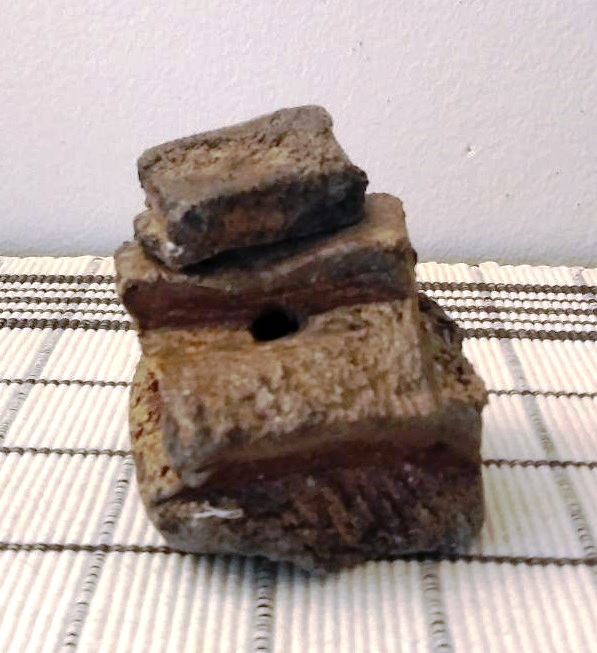
147. Lauryn Axelrod, lidded incense burner

147. Lauryn Axelrod, lidded incense burner, wood-fired, made of wild clay


Axelrod lives in West Pawlet, Vermont. For more on her and pictures of other work, see threetreespottery.com or her Instagram account, @threetreepottery.

Light brown clay, unglazed, colors from wood-firing. Weight: 516 g (18 oz). Maximum width: 8.2 cm (3-1/4 in). Height (overall): 7.7 cm (3 in).

This sits directly on the base. It is highly irregular in shape. The bottom section consists of two roughly rectangular lumps of clay. The lower section is a trapezoid about 7.7 cm (3 in) on a side and 4.5 cm (1-3/4 in) high; one corner of the bottom has been rounded and another has been cut back to slant upward. The upper section is a smaller rectangle, about 7 cm (2-3/4 in) by 4.5 cm (1-3/4 in) and 1.2 cm (1/2 in) high. It sits toward the back side of the lower section. The exposed area at the top of the lower section is scored and pitted. At the front, where the two sections meet, a hole about 0.6 cm (1/4 in) wide has been punched through to the interior (visible in the first picture above; "front" is an arbitrary designation with this piece). An irregular rectangle about 2.9 cm (1-1/8 in) by 1.6 cm (5/8 in) has been hollowed out through both sections of the base; it is about 4.5 cm (1-3/4 in) deep. The lid is a rough rectangle about 5.1 cm (2 in) by 3.3 cm (1-1/4 in) and 2 cm (3/4 in) high. There is a rectangular flange on the bottom to anchor the lid inside the base. The lid fits loosely on the base. The texture of this is very rough and unfinished.

This was unglazed. The colors derive from three days of wood-firing in an anagama-style kiln. The colors range from dark russet through brown into dark gray and black. There is some ash melt, particularly in the russet-colored areas.

A rough-hewn, brutalist statement of solidity and mass, unmistakably clay.

Purchased from the artist in September 2021.


Thursday, September 2, 2021

146. Jason Edmonds, wood-fired tokkuri with two guinomi

146. Jason Edmonds, wood-fired tokkuri with two guinomi


Edmonds is a potter and ceramics teacher in Davis, California. His studio is called “of the dirt pottery.”  More of his work can be seen on his Instagram account @of­_the_dirt.

Dark chocolate clay, interior of tokkuri glazed; exterior colors from wood firing and clay. Tokkuri. Weight: 526 g (1.2 lb). Rim diameter: 3.5 cm (1-3/8 in); maximum diameter: 10 cm (4 in); base diameter: 6.3–7.0 cm (2-1/2 – 2-3/4 in). Height: 13.5 cm (5-3/8 in). Guinomi (each). Weight: 130 g (4.6 oz). Rim diameter: 4.7–5.3 cm (1-7/8 – 2-1/8 in); foot ring diameter: 3.3 cm (1-1/4 in). Height: 6 cm (2-3/8 in).

The tokkuri sits directly on the flat base, which has an irregular shape. The walls rise in a convex arc to the neck which begins 10 cm (4 in) above the base and is 3.3 cm (1-1/4 in) in diameter at that point. The walls reach the maximum diameter 5.7 cm (2-1/4 in) above the base. The neck is a shallow concave arc to the lip. This appears to have been thrown on a wheel.  There are four slightly irregular and angled vertical columns spaced more or less equally around the exterior, each about 0.6 cm (1/4 in) wide, creating four spaces. The clay in these spaces was cut out to varying depths, leaving ridges and flat areas of different sizes. The exterior is rough and unfinished. The guinomi appear to be thumb pots. Each has an irregular foot ring, 0.6–1.0 cm high on the exterior; the interiors have been hollowed out to a similar depth. The interiors are relatively smooth; the exteriors have been cut and gouged in the same way as the tokkuri.

The interior of the tokkkuri is glazed, presumably to make it waterproof. The colors come from the clay and the wood-firing. One area on the exterior of the tokkuri is a dark reddish-brown from the wood-firing; the rest is a dark brown color. One of guinomi has a shiny ash deposit on part of the foot ring.

This is brutalism in action; these very much illustrate the nature of the clay. When I unwrapped these, there was even a strong smell of mud. Although the inside of the tokkuri was glazed to make it waterproof, the surface of the guinomi is so rough that drinking from them would endanger the lips.

Purchased from the artist in August 2021.


Tuesday, August 31, 2021

145. KATŌ Bakutai, 1861–1943, Seto-ware teabowl

145. KATŌ Bakutai  加藤麦袋,1861–1943, Seto-ware teabowl, with picture of horse and characters hatsugama 初窯, Shino glaze


Katō Bakutai was a prominent potter who initially worked under Katō Shuntai (1802-77). He was partially responsible for the revival of Seto-ware techniques in the nineteenth century. He worked with a variety of traditional pottery styles including Shino, Tenmoku, and Mishima.

Light brown clay, Shino glaze in pink and white, with characters and decoration in black; foot ring and surrounding area left unglazed. Weight: 238 g (8.5 oz). Rim and maximum diameter: 12.8 cm (5-1/16 in); foot ring diameter: 4.6 cm (1-13/16 in). Height: 6.3 cm (2-1/2 in).

This sits on the base of the foot ring, which is 0.6 cm (1/4 in) high on the outside. The interior of the foot ring has been excavated out to slightly less than this height. The exterior walls extend outward at a slight upward angle (5­–10-degree slope) for 1 cm (3/8 in); The artist’s mark, a small oval with the incised characters for “Bakutai” 麦袋, was pressed into this area.  The walls then rise up and outward in a shallow convex curve to just about 1.3 cm (1/2 in) below the rim. Above this a concave groove encircles the bowl just below the rim. The lip of the rim has been forced outward slightly. The surface of the glazed portion of this is dotted with small pits, giving it a slightly rough texture.

The bowl was glazed in Shino. The interior and the central band of the exterior have a slight pinkish blush from the wood-firing. The exterior decoration was applied with a calligraphy brush. The characters, 初窯, indicate that the bowl was produced in the potter’s first firing of the year. A compound with the same pronunciation but with a different second character is used for the first tea ceremony of the year; so the characters may be doing double duty here. Since the horse is one of the animals in the Asian zodiacal cycle, I’m guessing this may have been made during a horse year. Given the artist’s life dates, the possibilities are 1894, 1906, 1918, 1930, and 1942.

The brushwork on the horse is impressively economical and resulted in a sprightly figure. The bowl is slightly smaller than most “summer” teabowls. The color range and placement show good control of the kiln during firing.

Purchased in August 2021 from Treasures of Old Times in Bangkok.


Monday, August 23, 2021

144. Andrew Sartorius, ash-glazed, twice-fired teabowl


144. Andrew Sartorius, ash-glazed, twice-fired teabowl made using wild clay


For Sartorius, see item 143.

Dark brown wild clay from West Virginia, colors from wood- and soda-firings. Weight: 546 g (1.2 lb). Rim diameter: 12 cm (4-3/4 in); maximum diameter: 12.6 cm (5 in); foot ring diameter: 6.3-7.0 cm (2-1/2 to 2-3/4 in). Height: 7.6 cm (3 in).

This was hand-built using coils of clay. It sits on the foot ring, which is an irregular oval in shape. The outside wall of the foot ring is 0.3 cm tall (1/8 in). The interior of the foot ring has been scooped out to a similar depth to leave a triangular pattern of ridges meeting in the center. Above the foot ring, the walls rise at about a thirty-degree slope to a height of about 1.2 cm (1/2 in) above the base, reaching the maximum diameter at this point. The artist’s mark, a small circular seal with his initials inside, was pressed just above the foot ring in this section of the pot. From there the walls rise in more or less a straight line to the rim. The exterior surface of the bowl is very irregular both from the modeling and the ash deposits from firing. The interior is smooth.

This was wood-fired near the front of an anagama kiln. It emerged from this kiln with a “sharp layer of unmelted ash.” Sartorius then fired the pot again in a gas kiln to cone 11, using soda during the firing, to help fuse the glaze. The result is a thick melted ash deposit with a bright sheen over about half the exterior surface. The interior appears to have been shielded from the effects of the soda firing. The result is a mottled surface with colors ranging from whites through dark yellows shading into browns and blacks, with variations in the degree of shininess.

Purchased from the artist in August 2021.

Pottery

Looking for suggestions

I need to dispose of my collection. I've tried to donate it to several local museums or schools with ceramics programs, but no one wants...