Friday, May 24, 2024

249. WAKAO Toshisada, 1933- , Shino-ware incense container

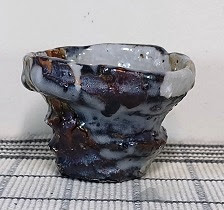
249.  WAKAO Toshisada  若尾利貞,  1933- , Shino kōgō 志野香合 (Shino-ware incense container)


For Wakao, see item 248. 

Light tan clay, Shino glaze, with some white areas, but mostly a light brownish red, with decoration in a dark brown glaze; the shelf on the lower part, the outer side of the flange, and the interior of the upper part that rests on the shelf and abuts the flange were left unglazed. Weight: 80 g (2.3 oz). Height: 5.1 cm (2 in). Width: 5.1 cm (2 in). 

The overall shape resembles an upside-down acorn without the cap. This sits on a foot ring 3.8 cm (1-1/2 in) in diameter; the inside of the ring has been hollowed out to a depth of 0.3 cm (1/8 in). The ring has no exterior wall. Instead the outside walls of the piece rise in a continuous convex arc to the top. The walls of the lower part end 1.75 cm (5/8 in) above the base. At this point there is a horizontal shelf 0.5 cm (3/16 in) wide, with a vertical flange rising 0.75 cm (1/4 in) above the shelf. The upper part is ringed with horizontal grooves, perhaps remnants of clay coils. The upper part ends in a blunted peak at the center top. The piece is pitted and bumpy from the Shino glaze. 

This has a Shino glaze, mostly colored a light brownish red, but with some areas of white. Wakao used a brown glaze to decorate the outside in four places with grass-like designs. These continue across the divide between the upper and lower parts. 

This came with a wooden box, inscribed by Wakao in two lines: 志野   香合 /  利貞 Shino kōgō / Toshisada (Shino-ware incense container / Toshisada) , with the artist’s seal stamped in red. Included in the box were a short biography and two wrapping cloths. 

Purchased from Dai Ichi Arts, New York City, May 2024 (invoice, shipping label, card from owner).

Tuesday, May 21, 2024

248. WAKAO Toshisada, 1933- , Oribe-ware incense container

248. WAKAO Toshisada 若尾利貞, 1933- , Oribe kōgō 織部香合 (Oribe-ware incense box)


Wakao was born in Tajimi. After graduating from junior high school, he worked at a ceramics factory while studying Shino-ware on his own. He went independent in 1970. He is a recipient of the Katō Kōbei Award, the Mino Newcomer’s Award, and the New Craft Award, among other honors. He has been a participant and award-winner at the Chūbu Art Exhibition, Gifu Prefectural General Design Exhibition, Asahi Ceramics Exhibition, Japanese Traditional Crafts Exhibition, and the Chūnichi International Ceramics Exhibition. He has had solo exhibitions held at the Nihonbashi Takashimaya, Nagoya Matsuzakaya, and Tokyo Tsubogen, among other venues. He is a member of the Japan Kōgei Association.

Cream-colored clay, with Oribe green, brown, and cream glazes; the edges where the two halves meet are unglazed. Weight: 102 g (3.6 oz). Height: overall, 4.3 cm (1-3/4 in). Width: 6 cm (2-3/8 in).                

Bottom part: This sits on a foot ring 3.7 cm (1-1/2 in) in diameter and about 0.3 cm (1/8 in) high on both sides. Within the ring is the artist’s sigil written with a brush in brown glaze. Above the foot ring, the walls flare outward at about a 45-degree angle to meet the sides 0.5 cm (3/16 in) above the base. The walls rise in more or less a straight line to the top of the bottom part 1.8 cm (3/4 in) above the base; at this point the piece has a diameter of 3.2 cm (1-1/4 in). There is a horizontal shelf about 0.5 cm (3/16 in) wide on which the top part rests. At the inside edge of this shelf is a vertical flange 0.8 cm (5/16 in) high. The interior of this part mirrors the shape of the exterior walls. 

Top part. Overall, this part is 3.2 cm (1-1/8 in) high. The bottom edge is flush with the top edge of the bottom part; The walls are 0.5 cm (3/16 in) thick. Above this, the walls curve inward in a high convex arc to a flat circular area at the top 3.4 cm (1-1/4 in) in diameter. In the center of this is a roughly circular small button less than a centimeter (3/8 in) in diameter. The interior of this part mirrors the shape of the exterior. 

There are eight vertical grooves extending from the circle at the top of the upper part across the body of the piece to the lower edge of the walls. The texture of the exterior is bumpy; the interior is smooth. 

The circle at the top and the upper half of the top part were covered with the green Oribe glaze. Below this each groove was filled in with the brown Oribe glaze; between each of these lines Wakao used the brown glaze to draw an irregular vertical shape. Wakao also used this glaze to draw his sigil on the base. Other than the edges where the halves meet, the rest of the piece has a cream glaze. 

This came in a small wooden box inscribed by the artist in two lines: 織部香合 / 利貞 Oribe kōgō / Toshisada (Oribe incense container / Toshisada), followed by the artist’s seal stamped in red. Included in the box were a blue wrapping cloth, also stamped with the artist’s seal in red, and a short biography.

Purchased from Dai Ichi Arts in New York City in May 2024. (invoice, shipping label)

Sunday, April 14, 2024

247. KIM Hono, 1958­- , tsubo

247. KIM Hono 金憲鎬 김헌호, 1958­- , tsubo 地球のためいき  “Chikyū no tameiki” (jug, “The Earth Sighs”)


Kim was born in 1958 in Seto City in Aichi Prefecture. He graduated from the Prefectural Ceramics School in 1977 and became an apprentice at a local kiln before establishing himself as an independent artist in 1982. He held his first solo exhibition in Nagoya in 1985. He has been exhibited at the Nihon Tōgeiten National Ceramics Exhibition, National Traditional Crafts Exhibition, Asahi Tōgeiten Exhibition, and Chūnichi Kokusai Tōgeiten, and his works have been shown in some of Japan's top galleries.  Hohnoho Magazine, a leading Japanese magazine on ceramics, once profiled fifty of the country’s emerging ceramicists and asked them to define their work. Most of the respondents wrote a few paragraphs. Kim cryptically replied only: kaze wo kanjiru koto (feeling the wind). 

Light tan clay. The interior has a patch of aquamarine glaze; the exterior is unglazed with mottled shades of tan and brown. Height: 42 cm (16-1/4 in): width: 40 x 34 cm (16 x 13-1/2 in). 

This sits on a flattish, roughly circular base. The artist’s name is written on the base in cursive roman script, “Kim Hono.” The walls are roughly a centimeter (3/8 in) thick. The pot is globular, with longer dimensions from right to left. Part of the clay was torn away to form a rectangular opening in the front. At the top end of the opening an irregular flap of clay was tilted upwards. 

The clay body is rough and unfinished; The surface is cracked and pitted. The pot emphasizes its origins as clay, muddy, coarse. It does, however, ping musically when tapped. 

This was unglazed, except for a patch of much cracked, glassy aquamarine glaze on one wall of the interior. The mottled surface probably results from a lighter colored slip.

This came in a box with a brown wrapping cloth. On the front of the box Kim drew a picture of the pot in rough outline, with a lotus seedpod on a long stem extending from the interior of the piece up and across the top of the box. He inscribed the top and the left side of the box in three lines: 地球の / ためいき / 김헌호 chikyū no / tameiki /kim heonho (the earth / sighs / Kim Heonho).  He wrote his name in the Korean hangul script, with the symbols for Kim in the upper right-hand corner of the left side of the box and continuing in a horizontal line with his given name in the lower left-hand corner of the lid of the box. To judge from other examples of his work online, this is how he decorates his tomobako. Given both the Chinese characters and the hangul, his given name in Japanese is read “hon-o.” 

Purchased from the Kura Monzen Gallery in Kyoto, Japan, in April 2024 (invoice, customs and shipping documents) 


Sunday, April 7, 2024

246. MURAKOSHI Takuma, 1954- , guinomi

246. MURAKOSHI Takuma  村越琢磨, 1954- ,  Shunjū sake-nomi 春秋酒呑 (colorful sake cup)


For Murakoshi, see item no. 234. 

Light gray clay, with glazes in white, blue, black, and a dark reddish brown; a few spots on both the external and the internal walls are unglazed with kiln effects in light pink (much like the color on the mizusashi by Murakoshi (item no. 235) and a pool of vitrified green-glass-like deposit in the bowl of the cup. Weight: 276 g (10 oz). Height: 6.7 cm (2-5/8 in). Widths: rim, 8.7 x 7.8 cm (3-1/2 x 3-1/8 in), base, 5 cm (2 in). Capacity: 90 ml (6 tablespoons, or 3/8 cup). 

This was formed by hand in Murakoshi’s crude, chunky style. It sits on a flat, circular base. The remains of the three posts used to separate the piece from the kiln shelf are visible. The center of the base was pushed in to form a cavity about 1.3 cm (1/2 in) deep. The walls were formed into a pedestal that slopes upward and outward before flaring out into the bowl of the drinking cup, starting about 3.7 cm (1-1/2 in) above the base. The pedestal area consists of deep grooves bordered by sharp ridges; the pedestal is roughly circular in cross-section. The bowl is an oval. The interior of the bowl is about 4 cm (1-5.8 in) deep. The surface of the piece is smooth and glossy with a few sharp spots. 

Murakoshi makes many pieces, especially those used for eating and drinking, with this style of decoration, which he labels shunjū; this translates literally as “spring and autumn,” but here means something more like “colorful.”  It features a creamy white base, with splashes of blue and black and sometimes a dark brownish red. The glazes are made with iron, feldspar, and sawtooth oak (kunugi) ash. The iron creates the dark red glaze; the feldspar alone a thick white glaze; and the oak ash comibed with feldspar the blue/light green glaze. The glazes on this particular piece exhibit more carbon capture than on other pieces with the same decoration scheme (at least to judge from the pictures), and hence the colors are somewhat darker and more muted in tone. This piece also has a nice pool of the vitrified, green-glass-like bidoro at the bottom of the bowl that occurs when the ash deposits melt during the firing. This vitrified green-glass deposit may be the result of shizuku 雫, a natural, unplanned, and unpredictable kiln event when built-up ash, usually on the ceiling of the kiln or on the underside of a kiln shelf, melts and falls onto a piece, creating a droplet or drip.

This fits nicely in the hand—the grooves and ridges in the pedestal area create comfortable areas for the fingers to hold this piece. The chaos of the decoration matches the chaos of the shape. 

This came in a wooden box inscribed by Murakoshi in his distinctive calligraphy. As is his wont, the inscription begins on top of the box and continues down the front side. The inscription, in three lines, reads 春秋 / 酒呑 /たくま shunjū / sake-nomi / Takuma (colorful / drinking cup / Takuma). The top is stamped in red with a seal with Murakoshi’s studio name: へうげも屋  (Hyōgemono-ya, “Jocular Fellow Studio”). He uses the kyūkanazukai, or old kana usage, to write hyō. Hyōgemono is also the name of a popular manga character. On the side of the box is another seal stamped in red, giving Takuma in characters, 琢磨. Included in the box were a brown wrapping cloth and a printed leaflet from Murakoshi. 

A gift from the Kura Monzen Gallery in Kyoto, Japan, in March 2024 (customs and shipping documents)

Thursday, April 4, 2024

245. NISHIHATA Tadashi, 1948- . Tamba-ware bucket-shaped vase

245. NISHIHATA Tadashi  西端正, 1948- . 丹波窯変桶形花入 Tamba yōhen okegata hanaire (Tamba-ware bucket-shaped vase)


Nishihata was born in the old castle town of Sasayama in the mountains of Hyōgo in 1948. He began potting in 1969, focusing on items for use. In 1986 he first entered the realm of public exhibitions with his entry into the Nihon Dentō Kōgeiten National Traditional Crafts Exhibition. He has received numerous awards at this and other exhibitions. He now resides in the ancient ceramics center of Tamba. 

Light gray clay, with some small white feldspar particles. Colors from kiln effects and ash deposits in the dark reddish brown to black range. Weight: 4.4 kg (9.8 lb). Height: 31 cm (12-1/4 in). Widths: top, 6.4 x 10.1 cm (2-1/2 x 4 in); widest, 21.5 cm (8-1/2 in); bottom, 17.5 x 19 cm (7 x 7-1/2 in). 

The base and any given cross-section of this are squarish. The piece itself has four walls. The positioning of the handle across the diagonal of the square reorients the piece, however. Viewed from the front or back, or the sides, each side is formed of two planes, with a seam running down the middle. 

This sits on a flat base; the sides of the base vary in length from 12.5 cm (5 in) to 14 cm (5-1/2 in). A flat scraping tool was used to make long, wide shallow indentations in the base. The artist’s sigil was incised into the base. The sides of the base rise outward at a 45-degree angle to a height of 1.3 cm (1/2 in). The four walls of the piece are long triangles, with the top lopped off. At the bottom each wall is about 15.3 cm (6 in) wide; at the lowest point of the opening, 25.4 cm (10 in) above the base, each is about 9.5 cm (3-3/4 in) wide; and at the top, the width is 7 cm (2-3/4 in). A long, vertical rib is positioned in the center of each wall, wider at the bottom and narrowing as it runs upward. The base of each rib is beveled upward at a 45-degree angle, continuing the movement of the sides of the base. These ribs continue as the sides of the chevrons at the top of the piece. The opening at the top is formed of evenly cut verticals and horizontals. It is a square, but again because of the positioning of the handle, it appears to be a diamond shape. The handle imitates the crosspiece at the top of a wooden bucket. It is 16.4 cm (6-1/2 in) wide. One end of the handle apparently became damaged after the firing, exposing the unaffected clay. The surface of this is rough, with some sharp edges at the seams joining the walls. 

Unglazed, with kiln effect colors in the reddish brown to black range. The blacker areas are stronger on one side, revealing the orientation of the piece in the kiln. All surfaces of the piece show kiln effects, except for the one end of the handle that was chipped after the firing. 

This came in wooden box, inscribed on the top by the artist, in two lines: 窯変桶形花入 / 丹波正造 yōhen okegata hanaire / Tamba Tadashi zō (bucket-shaped vase with kiln effects / made by Tadashi of Tamba), followed by the artist’s seal stamped in red. Included in the box were a short printed biography and a dark blue wrapping cloth. 

Purchased from the Kura Monzen Gallery in Kyoto, Japan, in March 2024 (invoice, customs and shipping documents)

Sunday, March 31, 2024

244. KOJIMA Kenji , 1953- , Iga-ware vase

244.  KOJIMA Kenji  小島憲二,1953- , 伊賀耳付花入  Iga mimitsuki hanaire (Iga-ware vase with ear-lugs)


Kojima Kenji was born in Aichi Prefecture in 1953 and graduated from the Tokoname Ceramics Vocational High School in 1971. In 1973 he spent a year in Iga before moving to Bizen for a five-year apprenticeship with Konishi Tōzō. He returned to Iga in 1979 and built an anagama. He has exhibited with the Nihon Tōgeiten National Ceramics Exhibition, Asahi Tōgeiten Ceramics Art Exhibition, and Chūnichi International Ceramics Exhibition, as well as an impressive list of solo exhibitions in some of Japan’s top galleries. Pictures of many of his works can be found online. 

Light gray clay, with the addition of many small feldspar-sand pebbles; kiln effects in the reddish brown range (hi-iro coloration) and natural-ash glazing in the cream to black range, with a glossy sheen on all parts of the exterior and some bidoro formation particularly on horizontal surfaces; the interior has some drips of natural-ash glazing and reddish-brown coloration from kiln effects, with very little sheen. Weight: 3.4 kg (7.7 lb). Height: 28.5 cm (11-1/4 in). Width: of rim, 12.7 cm (5 in); at widest point, 16.3 cm (6.5 in); of base, 13.3 x 15 cm (5-1/4 x 6 in). 

This sits on a flat base, an irregular oval. There are two small paper labels attached to the base, presumably inventory marks; one reads “2,” and the other "MC 534.”   The base is about a centimeter and a half high (1/2 in); the edges of the base extend beyond the bottom of the walls of the piece, forming a ledge of varying widths. The walls are divided into two, stacked sections, each a rough cylinder. The two are joined about 14 cm (5-1/2 in) above the base. The bottom section is roughly cylindrical. The top section is wider at the lower end, where it overhangs the bottom section a bit. Its walls move inward slightly toward the curled rim. The upper surface of the rim was flattened. The mouth is circular, but with five, irregularly shaped indentions, almost as if it were the outline of a five-petalled flower. Although Kojima called the handles by the traditional name of “ears,” they are straighter than most examples of pottery mimi, bowing outward slightly only toward the center of the vertical distance. The tops of the handles are attached at the join between the two sections, and the bottoms to the ledge formed by the upper surface of the base. Because of the orientation and shape of the upper section, from some angles the base appears to tilt. To judge from pictures of other examples of Kojima’s Iga-ware vases I found online, he often uses this two-part structure for vases.   

On the lower section, on both the front and the back (arbitrarily defined as the space between the handles, with the side with the most hi-iro coloration designated the front), Kojima made two deep, vertical incisions the length of the cylinder. Between these two grooves, he incised two X’s with somewhat shallower cuts, The decoration on the top section is more irregular. A groove circles the section near its bottom. There are five, irregularly spaced vertical grooves. These tend to slope to the right as they move downwards. On both the front and the back, off to one side, there is a dent shaped like the > symbol. On the front, this dent is filled with lines creating a pattern of squares. On the back this shape was obscured by a heavy coating of natural ash glazing. 

The surface texture of the piece ranges from quite smooth in the areas of heavy ash glazing to very rough at the edges and seams. The interior areas largely unaffected by the natural-ash glazing reveal that the clay used was very coarse. 

This was fired unglazed. The color of the unaffected clay shows through in a few spots on the base and underneath one of the handles. In general the bottom cylinder exhibits more of the hi-iro and less of the natural ash glazing. The ash glazing is heaviest on the upper section on the right-hand side of the piece. On the back of the piece, the ash glazing flowed down over the bottom section, became darker as it neared the base. The horizontal areas on the lip, the tops of the handles, the groove where the two sections are joined, and the ledge where the base and the lower section meet exhibit many areas of the dark-green glass-like vitrification known as bidoro.  Again, in looking at other examples of Kojima’s Iga-ware vases, this is a common pattern of kiln effects. He must have carefully placed the pieces in the kiln with the deliberate aim of creating such results. 

The double structure of the piece is mirrored in the double structure of the kiln effects. On this piece, the handles appear to be supporting the upper section and redistributing its weight away from the lower section, much as flying buttresses do.

This came in a wooden box, inscribed by Kojima on the lid in three lines on the upper left and center: 伊賀 / 耳付 / 花入  Iga / mimitsuki / hanaire (Iga[-ware] / ear-lugs / vase); and signed Kenji 憲二 with Kojima’s seal stamped in red.  Included in the box were a brown wrapping cloth and a short printed biography. 

Purchased from the Kura Monzen Gallery in Kyoto, Japan, in March 2024 (invoice and customs and shipping documents)

Pottery

Looking for suggestions

I need to dispose of my collection. I've tried to donate it to several local museums or schools with ceramics programs, but no one wants...