Wednesday, March 27, 2024

243. Bizen-ware "gold dust pouch" water container

243.  Bizen-ware water container for the tea ceremony 古備前耳付砂金袋水差  ko Bizen mimitsuki sakinbukoro mizusashi  (old[-style] Bizen-ware “gold dust pouch” water container, with ear lugs)


Roman Nikolaev, the seller, dates this to the 1950s. Here, the 古 in the inscription on the box refers not to the age of the piece but to the style of Bizen-ware. This imitates the older methods of making and firing Bizen-ware, which were revived in the twentieth century. Rather than a pottery lid (a 共蓋 tomo-buta) made of the same clay as the base, this has a black lacquered wooden lid (a 替蓋  kae-buta). 

Dark reddish brown clay, with natural-ash glazing on the exterior, with many patches of goma 胡麻, yellow sesame-seed-like deposits of ash, and some blackening of the exterior surface; the interior has no glazing. Weight: overall, 1680 g (3.75 lb); body, 1630 g (3.6 lb); lid, 50 g (1.8 oz). Height: 17.3 cm (6-7/8 in). Width: mouth, 9.8 cm (3-7/8 in); lip, 14.2 cm (5-5/8 in); narrowest, 10.3 cm (4-1/8 in); widest, 17.4 cm (6-7/8 in); base, 13.2 cm (5-1/4 in). 

This is shaped like a drawstring bag. It sits on the flat base, which is about 1 cm (3/8 in) thick. At one edge of the base, a small circle with an interior bar was incised into the clay; this may be a kiln mark. The surface of the base is lightly scored with lines, some of which continue up the sides of the piece. The walls extend upward in a convex arc, with the widest point occurring about 3.8 cm (1-1/2 in) above the base, extending to the narrowest width 10.7 cm (4-1/4 in) above the base. There is a pronounced groove encircling the pot at the narrowest width. Above this, the walls rise outward in a shallow arc to the lip. The body of the pot has horizontal striations at fairly regular intervals, perhaps remnants of finger marks if this was thrown on a wheel, or of the coils of clay if this was hand-shaped. The front of the pot has a large, irregular dent in the center, These striations are much more pronounced in the upper part of the body. Four deep vertical grooves were incised into the pot, two each on the front and the back, in the bottom section of the pot. There is another deep groove encircling the pot, at an irregular height above the base, just below the places where the bottoms of the ear lugs are attached. In contrast to most ears on Japanese pots, the widest points of the ears are at the lower end rather than the upper. The tops of the ears are 13.8 cm (5-1/2 in) and the bottoms 7.6 cm (3 in) above the base. The lid sits on a recessed gallery. The interior of the pot mirrors the shape of the exterior. The surface is relatively smooth. 

This was fired unglazed. All the surface colors and effects resulted from natural-ash glazing, ash deposits, and kiln effects. Most of the goma occur on the front of the piece. 

Like a drawstring pouch, this sags toward the base, a movement mirrored in the ear lugs, which also sag downward. “Gold dust” may be a nod to the golden goma spots. 

This came in a wooden box, inscribed in two lines, 古備前 / 耳付砂金袋水差  ko Bizen / mimitsuki  sakinbukoro mizusashi  (old[-style] Bizen-ware / “gold dust pouch” water container, with ear lugs). A paper strip pasted on the side of the box reads 備前焼 Bizenyaki  (Bizen-ware).

\Purchased from Treasures of Old Times, Perth, Australia in March 2024 (invoice, customs documents).


Tuesday, March 19, 2024

242. MATSUO Takaaki (1938- ), Iga-ware cylindrical sake cup, with natural ash-glazing, kiln effects, and dragonfly eyes

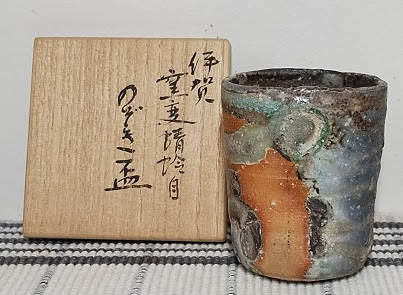
242. MATSUO Takaaki 松尾髙明  (1938- ),  伊賀自然釉窯変蜻蛉目のぞき盃  Iga shizenyū yōhen tombo no me nozoki-hai (Iga-ware cylindrical sake cup, with natural ash-glazing, kiln effects, and dragonfly eyes)


For Matsuo, see item 241. 

Light gray clay. Natural ash glazing over the exterior and upper portion of the interior, with kiln effects in the red range on the exterior and interior; some vitrification. Weight: 80 g (2.9 oz).  Width: of rim: 5.5 x 4.8 cm (2-1/4 x 1-7/8 in); of base, 3.5 cm (1-1/2 in). Height: 6.5 cm (2-5/8). 

This is similar to the preceding item, but slightly smaller. The inscription on the box explicity labels it a natural ash-glazed piece. It was also fired with the mouth facing the direction of the heat and ash flow. 

This sits on a very shallow, concave circular base. Above the base the walls flare out at a shallow angle to a diameter of 4.2 cm (1-3/4 in). From there the walls rise in more or less a straight line to the rim. The top of the cup is an oval. The movement from the round base to the oval rim creates a piece with two slightly flatter sides. The surface varies from smooth over the vitrified portions to rough over the areas with more ash deposits. Nozoki is one of the terms for labeling a cylindrical piece. 

Unglazed. This was apparently fired lying on one side with the mouth facing the direction of the heat and ash flow. The ash deposits are not as heavy as they are on the preceding item; they are heaviest on the side that faced upwards. The vitrification occurred at the edges of these ash deposits and ran down the sides in several long drips. The side facing downwards shows kiln effects in the red range. The interior shows some ash deposits at the rim; the rest of the interior shows kiln effects. The base was colored a dull red from the kiln effects. 

This came in a box, inscribed by Matsuo. The top surface of the lid reads, in four lines, 伊賀 / 自然釉窯変 / 蜻蛉目 / のぞき盃  (Iga / shizenyū yōhen / tombo no me / nozoki-hai;  Iga[-ware] / natural ash-glazing, kiln effects / dragonfly eyes / cylindrical cup). The underside of the lid is inscribed with the potter’s given name 髙明 (Takaaki) followed by an impression of his seal stamped in red. Included with the box were a short printed biography and an orange wrapping cloth. 

Purchased from Kura Monzen Gallery, in Kyoto, Japan, (Shipping label, invoices, customs documents)


241. MATSUO Takaaki (1938- ), Iga-ware cylindrical sake cup, with kiln effects and dragonfly eyes

241.  MATSUO Takaaki 松尾髙明  (1938- ),  伊賀窯変蜻蛉目のぞき盃  Iga yōhen tombo no me nozoki-hai (Iga-ware cylindrical sake cup, with kiln effects and dragonfly eyes)


Matsuo was born in Yokohama. In 1960 he began studying ceramics under Tsuji Seimei 辻清明 at Renkōji in Tama City and trained for over fifteen years. He constructed an ascending kiln at Renkōji in Tama in 1975 and became independent. He was selected for the Issuikai Exhibitions in 1967 and 1968. Since then he has mainly exhibited in private exhibitions. His work focuses on Shigaraki-ware, Karatsu-ware, and Hagi-yu glaze. 

Light gray clay. Natural ash glazing over the exterior and upper portion of the interior, with kiln effects in the red range on the exterior and interior; some vitrification. Weight: 96 g (3.5 oz).  Width: of rim: 5.6 x 4.8 cm (2-1/4 x 1-7/8 in); of base, 3.5 cm (1-1/2 in). Height: 7.2 cm (2-3/4). 

This sits on a very shallow, concave circular base. Above the base the walls flare out at a shallow angle to a diameter of 5 cm (2 in). From there the walls rise in more or less a straight line to the rim. The top of the cup is an oval. The movement from the round base to the oval rim creates a piece with two slightly flatter sides. The surface varies from smooth over the vitrified portions to rough over the areas with more ash deposits. Nozoki is one of the terms for labeling a cylindrical piece.

Unglazed. This was apparently fired lying on one side with the base facing the direction of the heat and ash flow. The ash deposits are heaviest on the base and the side that faced upwards. The vitrification occurred at the edges of these heavier ash deposits and ran down the sides in several long drips. The side facing downwards shows kiln effects in the red range. The interior shows some ash deposits near the rim and an area of kiln effects beneath this layer. The bottom area of the interior shows only the clay. 

This came in a box, inscribed by Matsuo. The top surface of the lid reads, in three lines, 伊賀 / 窯変蜻蛉目 / のぞき盃  (Iga / yōhen tombo no me / nozoki-hai;  Iga[-ware] / kiln effects dragonfly eyes/ cylindrical cup). The underside of the lid is inscribed with the potter’s given name 髙明 (Takaaki) followed by an impression of his seal stamped in red. Included with the box were a short printed biography and a blue wrapping cloth.

Purchased from Kura Monzen Gallery, in Kyoto, Japan, (Shipping label, invoices, customs documents)


Monday, March 18, 2024

240. BUNKYŌ Masaki (fl. 1772-89), “Hinode jūrō” chawan (Sunrise Longevity [God] teabowl)

240. BUNKYŌ Masaki  文京柾, fl. 1772-89. “Hinode jūrō” chawan 日の出壽老茶盌 (Sunrise Longevity [God] teabowl)


Description provided by seller: 

“This extraordinary tea bowl, eloquently named ‘Sunrise and Longevity,’ emerges as a masterful creation by the tea master Bunkyō Masaki. A visual symphony unfolds within the bowl, as a pristine white glaze delicately cascades over a vibrant reddish canvas, echoing the gentle hues of the morning sun. Amidst this enchanting surface, the discerning eye can trace the graceful figure of Jūrōjin 壽老神, the deity symbolizing longevity.

“Indeed, this tea bowl stands as a resplendent masterpiece, encapsulating the very essence of a sunrise. Bunkyō Masaki's meticulous craftsmanship and artistic vision radiate, transforming this piece into a profound testament to the beauty and artistry inherent in his pottery.

“Residing in Miyamachi near Nagoya Castle during the An’ei-Tenmei era (1772-89), Bunkyo Masaki was not merely a doctor but also a dedicated practitioner of the tea ceremony. His renown extended beyond medical expertise to encompass exceptional pottery craftsmanship, notably in the creation of tea utensils such as chawan (tea bowls), mizusashi (water jars), kōrō (incense burners), and lid holders. Notably, Bunkyō Masaki's approach embraced the artisanal technique of handcrafting (te-giri  手切 ) rather than relying on a wheel.

“Bunkyo Masaki's creative palette extended to various glazes, including Kisetō, Oribe, as well as traditional Setō iron and ash glazes. His aspiration to emulate Momoyama pieces, coupled with experimentation in glazing techniques, attests to the depth of his artistic exploration.

“Of particular intrigue is the indirect revelation within Bunkyō Masaki's work, shedding light on the rich tapestry of pottery techniques in Setō during his era. Remarkably, his pottery endeavors predate Katō Shuntai's birth by 20-30 years, the renowned artisan celebrated for his impeccable replicas of Momoyama pottery. This chronological distinction suggests that the techniques for Momoyama imitations had already taken root in Setō during the latter half of the 1700s. Bunkyō Masaki's contributions to the art form, coupled with his commitment to replicating historical styles, contribute significantly to the cultural legacy of Setō pottery.”

Dark brown clay. Glazed in orangish-pink and white with black figures; base and a narrow band around base left unglazed. Weight: 272 g (9.7 oz). Width top, 11.8 cm (4-5//8 in); base, 5 cm (2 in). Height: 6.3 cm (2-1/2 in). 

This was handmolded by pinching. It sits on an uneven base, roughly circular. The interior of the base was gouged out in an irregular shape. Because of the unevenness of the base, the bowl wobbles a bit. From the base, the walls rise in convex arc to roughly two-thirds the height and then continue in a straight line to the rim, flaring outwards slightly. The walls are quite bumpy and vary considerably in thickness. The rim is very irregular. A small chip in the rim was repaired at some point using red lacquer. On the back side, just above the base, a round stamp was pressed into the wall. It is slightly large in diameter than a quarter. There appear to be raised figures of characters within the stamp, but they may just be protrusions in the clay. There is a circle of the same size on the interior of the bowl, in a different location. The surface is quite smooth to the touch. 

A glaze that fired in the color range of orangish-pink to rusty pink was first applied to the interior and exterior of the pot. The figure of Jūrōjin was drawn in black (probably the iron-rich glaze used in Japanese pottery for such drawings) on the front. On the right-hand side of the pot a small circular squiggle was drawn just above the unglazed portion. A white glaze was then splashed over the exterior wall, largely obscuring the drawing of Jūrōjin. Some of this white glazed dripped down the interior. 

This came in a box, with two old wrapping cloths. The top of the box is inscribed, in two lines, 文京柾 / 日の出壽老茶盌文京柾  (Bunkyō Masaki  /  Hinode jūrō chawan).  The underside of the lid has a long inscription in larger characters, followed on the extreme left with lines in smaller characters. Both are written in Classical Chinese, and each is followed by the personal seal of the writer stamped in red. The first inscription is dated “the first ten-day period, September 1915.”  I am unable to read all the characters. The first inscription praises Bunkyō’s skills in general terms. The second supplies the correct character for “kyō” in the potter’s name.

Purchased from Treasures of Old Times, in Bangkok, Thailand, February 2024. (Purchase receipt)

Friday, January 19, 2024

239. MIWA Eizō, 1946‒99, Hagi-ware vase

239. MIWA Eizō 三輪栄造, 1946‒99, Hagi hanaire  萩花入 (Hagi-ware vase)


Miwa Eizō was the second son of Living National Treasure Miwa Kyūsetsu XI 十一代 三輪休雪. He graduated from the private Musashino Art University and was a member of the Japanese Traditional Crafts Society and often displayed his works at their national exhibitions (Nihon Dentō Tōgeiten). He was the recipient of the top prize at the Tanabe Museum’s prestigious Modern Tea Forms Exhibition (Gendai Cha no Yu Zōkeiten). ). Unfortunately, he died in 1999 at the early age of fifty-two. His brother Ryōsaku 龍作 succeeded to the family name as Miwa Kyūsetsu XII 十二代休雪. His works are held in the collections of, among others, the British Museum and the National Museum of Modern Art in Tokyo. For more on this artist, see The Ceramic Works of Eizo Miwa (2001), published posthumously by the Kuroda Tōen art gallery of Tokyo. 

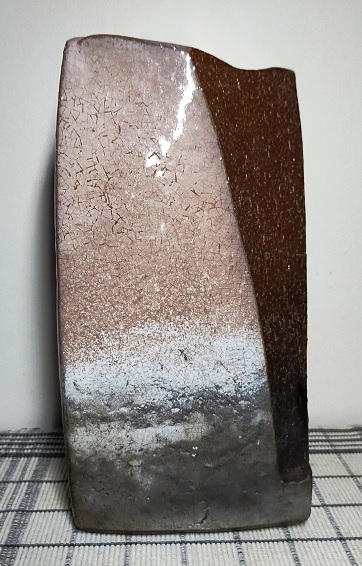
Dark gray clay, glazed on four sides with the white Hagi glaze, with two of these sides tinged pink from the flames (hi-iro); two of the sides and the bottom are a reddish brown; the lower parts of three of the sides were blackened by a build-up of ash deposits. Weight: 3.9 kg (8.7 lb). Height: 29.2 cm (11-1/2 in). Dimensions: of base, 13.8 cm (5-1/2 in) square; of top, 20 x 10 cm (8 x 4 in). 

This is a six-sided figure, sitting on a square base. The remnants of the four posts used to separate the piece from the shelf during firing are visible on the bottom. The base is slightly less than a centimeter (3/8 in) high. The edges are beveled outwards to form a square 15.7 cm (6-1/4 in) on a side. Four of the walls rest on the base. The vase began as a square; two of the corners were then sliced away to form long triangles, 11 cm (4-3/8 in) wide at the top and tapering down to a narrow ledge 3.2 cm (1-1/4 in) wide at the bottom, sited about 3.2 cm above the base. This left the remaining four sides with three 90-degree angles and one long sloping side; these are about 7 cm (2-3/4 in) wide at the top and 15.7 cm at the bottom. The top is a six-sided figure, a lozenge with two pointed ends, forming equilateral triangles joined to a longer rectangle. The hole, 4.7 cm (2-7/8 in) wide is a circular opening to a vertical shaft about 2.5 cm (1 in) long. The top slopes inward from all sides toward the opening. It’s impossible to get accurate measurements, but the walls appear to be about a centimeter thick. The surface of this varies from very smooth in the glazed areas to rough and pitted in the sections with ash buildup. 

The four-sided walls were glazed with the white Hagi glaze (Wikipedia has good information on this glaze; see under “Hagi ware”). On the front side (arbitrarily designated as the side with the most kiln effects), the glaze turned pink because of the kiln effects. On the back side and the top, the glaze remained white and exhibits much crackling. The two triangular sides are rich reddish brown. The bottoms of the two front four-sided panels were blackened by ash deposits during the firing and are mottled black, bluish gray, and white; the base of one of the back panels was lightly blackened during the firing. The interior was unglazed. 

This came in a wooden box inscribed in two lines, 萩花入 (Hagi hanairei, Hagi-ware vase) and 栄造 (Eizō), followed by the artist’s seal stamped in red. 

The appearance of this varies considerably depending on the side from which it is viewed. From the sides it appears to be a tall, rectangular vase, with dramatic contrasts of light and dark. Viewed from the front or back, with the triangular portions centered, the shape becomes much more complex. From the back side, it appears to be a highly glazed, mostly white piece; from the front, a richly colored vase dominated by a blush pink hue. A very substantial work. 

Purchased from the Kura Monzen Gallery in Kyoto, Japan, in January 2024 (invoice, shipping and customs documents).

Wednesday, January 3, 2024

238. SAKATA Jinnai, 1943­- , white clay colored, wave-patterned, flattened vase)

238.  SAKATA Jinnai 坂田甚内 , 1943­- , Hakudeisai hajō henko  白泥彩波状扁壺  (white clay colored, wave-patterned, flat-sided vase)


Sakata Jinnai was born in Tokyo in 1943 and apprenticed under Kamoda Shōji in 1964, establishing his first kiln in 1966. His work was selected for display at the Nihon Dentō Kōgei Shinsakuten (National Traditional New Crafts Exhibition) in 1969, and the following year at the Nihon Dentō Kōgeiten (National Traditional Crafts Exhibition). In 1971 his work was exhibited at the first Nihon Tōgeiten National Ceramics Exhibition. This event toured the United States and Canada as well. Two years later he was seen there again, and this time the show toured South America. In 1977 he moved away from the competitive world of mass exhibitions and focused more on private galleries. He was the first artist selected for display at the newly opened Takashimaya Gallery in New York in 1993. Work by him is held in the collections of the British Museum, Rockefeller Foundation, Sakuma Museum, and Waseda University Museum, as well as some of Japan's holiest sites such as the Ise Shrine, Izumo Shrine, Takachiho Shrine, Yakushiji in Nara, and both Kodaiji and Enryakuji in Kyoto. Not limited to clay, he also works in painting, washi handmade paper (from 1995), and glass (from 2000). 

White clay, with kiln effects in coral and brown on the sides and top; the base is largely free of color; the interior is blackened with soot. Weight: 4 kg (8.9 lbs). Height: 31 cm (12-1/4 in). Length: 22.7 cm (8-7/8 in). Width: 9.8 cm (3-7/8 in). 
This is a rectangular box, with longer front and back wall panels, and narrower side wall panels. The wall panels are about a centimeter (3/8 in) thick. The piece sits on the bottom edges of the walls. The bottom of the piece is recessed 2 cm (3/4 in) from the lower edges of the exterior walls. The joins where the bottom meets the side panels have been filled in with clay rounded in concave arcs. The artist’s seal, a square cartouche with the seal-script form of the character 甚, was impressed into the center of the bottom panel. The front and back panels have the same shape. At the bottom of each of these panels are three irregularly shaped indents. The sides of the panels rise in roughly straight lines to a height of 23 cm (9 in) and then curve inward. A rectangular piece was cut out of the tops of both panels, centered across the width, 13.4 cm (5-1/4 in) wide and 2.7 cm (1-1/16 in) deep. This creates four “horns” at the top. The two end sides are recessed about 1.3 cm (1/2 in) from the outer edges of the front and back panels. As with the bottom, the joins between the panels were filled in with clay rounded in concave arcs. At the top, the side panels curve inward, ending just before the peaks of the “horns.”  The top opening has two panels bordering the exterior walls, recessed 1.3 cm (1/2 in) below the lower edge of the rectangular cutout on the front and back panels. The two recessed panels measure roughly 9.2 x 3.8 cm (3-5/8 x 1-1/2 in), leaving an opening into the interior 8.8 x 7.3 cm (3-5/8 x 2-3/8 in). On the interior of the vase is a rectangular panel, running between the front and the back walls and from the center of the bottom to roughly two-thirds of the way up the piece, perhaps serving as a brace to strengthen the exterior walls. 

The exterior of the piece, including the bottom and the recessed panels at the top were scored with a metal comb-like tool to create wave patterns. These patterns are irregular and random. The surface of this piece is coarse and unfinished.

Kiln effects randomly colored the clay coral, with many patches of the white clay body showing through, creating a mottled effect. There are a few darker brown blotches. 

This came in a wooden box inscribed by Sakata, along with an orange covering cloth and a printed biography. The upper side of the lid is inscribed, in two lines, 白泥彩 hakudeisai (white clay, colored)  波状扁壺 hajō henko  (wave-patterned, flat-sided vase)/ The bottom side of the lid is inscribed 甚内  Jinnai, with Sakata’s seal in red.

 Purchased from the Kara Monzen Gallery in Kyoto, Japan, in December 2023. (Invoice, shipping and customs documents)

Pottery

Looking for suggestions

I need to dispose of my collection. I've tried to donate it to several local museums or schools with ceramics programs, but no one wants...