Tuesday, May 3, 2022

190. Caitlyn Kent, small pit-fired vase

190. Caitlyn Kent, small pit-fired vase


Kent is a Boston-area potter. For other examples of her work, see her Instagram account, @caitlynkentpottery.

White clay, colors from pit-firing. Weight: 216 g (7 oz). Diameters: maximum, 7.6 cm (3 in); of rim, 3.3 cm (1-5/16 in); of base, 5.4 cm (2-1/4 in). Height: 8.2 cm (3-1/4 in).

This sits on the flat base. The letters “NFS” were incised into the base. also incised into the base is an indecipherable squiggle. The walls rise in a shallow convex arc to the shoulders about 5.7 cm (2-1/4 in) above the base. The maximum width is about 0.7 cm (1-4 in) below this. The walls then slope inward to the neck, which begins 7.6 cm (3 in) above the base and is 3.2 cm (1-1/4 in) in diameter. Above the neck, the walls slant slightly outward to the rim. The letters “VIII” (Roman numeral 8?) have been incised into the side of the walls just above the base. The surface of this is smooth with the exception of a few small bumps from the pit-firing.

When I purchased this, Kent told me this was pit-fired in a backyard barbecue loaded with a pile of wood.  A banana peel was wrapped around the pot, which was then enclosed in an aluminum-foil saggar. The colors range from light and dark grays, through browns and reds.

A nice exploitation of the potentials of pit-firing.

Purchased at Feet of Clay’s annual spring show, 2022.


Monday, May 2, 2022

189. Kari Wojtanik, small wood-fired vase

189. Kari Wojtanik, small wood-fired vase


For Wojtanik, see item 91.

Gray clay; colors and glazing from wood-firing. Weight: 338g (12 oz). Width (maximum): 8.8 cm (3-1/2 in); of rim: 4 cm (1-5/8 in); of base: 5.4 cm (2-1/8 in). Height: 13.3 cm (5-1/4 in).

This sits on the flat base; the artist’s name “Kari” has been incised into the base. The walls rise outward from the base in more or less a straight line to the maximum width, which is 8.8 cm (3-1/2 in) above the base. From there they rise in a shallow convex arc to the neck, which is 3.2 cm (1-1/4 in) in diameter and begins 11.3 cm (4-1/2 in) above the base. The neck flares outward in a concave are to the rim, which is fairly wide. The interior of the vase mirrors the exterior. The exterior walls have a series of horizontal bands.  The texture of the portions covered by the ash glaze is smooth; those areas less affected by the wood-firing are slightly rough to the touch.

This was fired unglazed. The base color of the clay is visible on the bottom. The walls range in color from tan to brown to gray. There is a deposit of gray ash on one side at the shoulder. The mouth, rim, and the rest of the shoulder were covered with a melted ash glaze and are quite glossy and glassy. Some of this melted glazed flowed down the sides almost to the bottom, creating darker brown, lightly glazed patches.

A well-shaped, well-fired pot.  This was fired at a seminar on wood-firing in Maryland. Wojtanik is expanding her firing skills.

Purchased at Feet of Clay’s spring sidewalk sale, 2022.

Wednesday, April 20, 2022

188. Karatsu sherds

188. Karatsu sherds


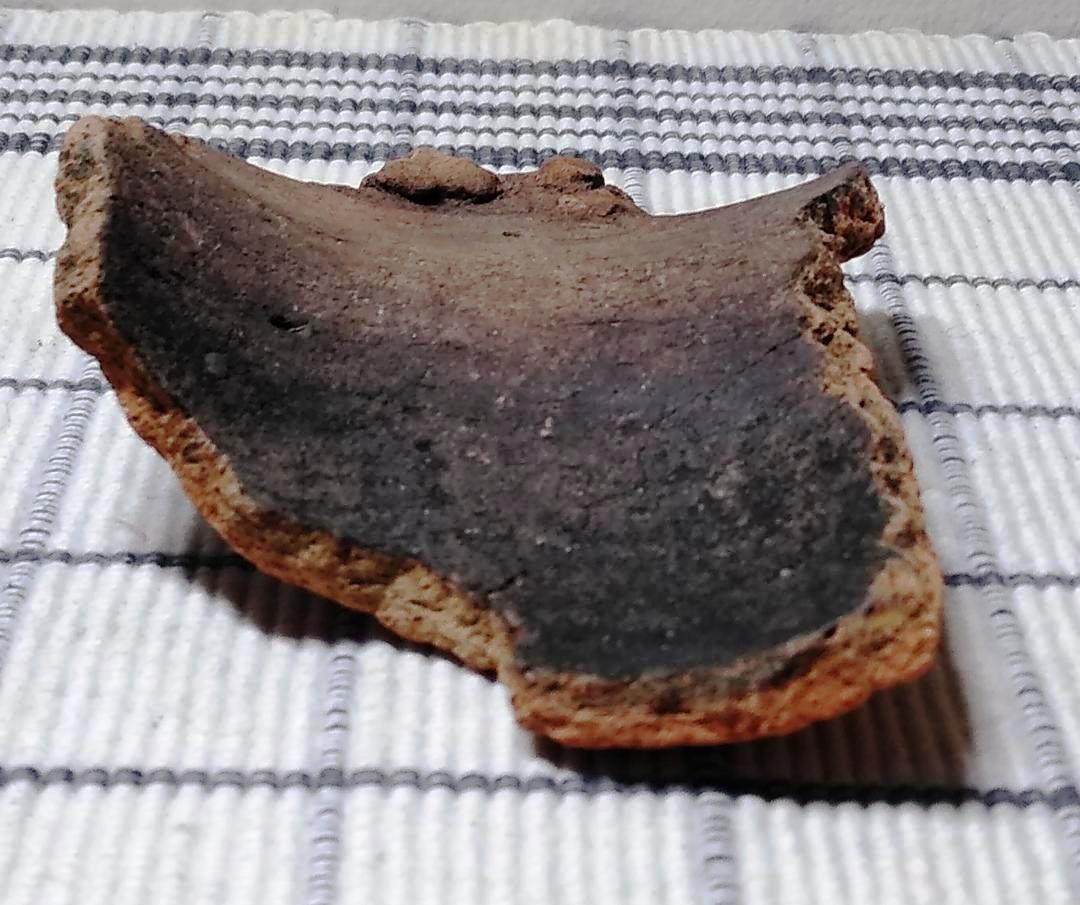
Twelve sherds from the Karatsu kilns (唐津焼, Karatsuyaki) in western Kyushu.  According to the seller, these came from a rubbish dump near a kiln that flourished in the sixteenth and seventeenth centuries. Three of the identifiable pieces are spouts from katakuchi, two are portions of a small teacup; three appear to be from the same flattish dish with curved sides; and the rest are portions of bowls of some sort.

Purchased in April 2022 from Art and Antique 28, Gifu City, Japan.


Tuesday, April 19, 2022

187. Jōmon sherds

187. Jōmon sherds


Jōmon pottery (縄文土器, Jōmon doki) is a type of ancient earthenware pottery made during the Jōmon period in Japan. The term "Jōmon" (縄文) means “rope-patterned” and describes patterns often pressed into the clay. Jōmon wares date from 10,500­-300 BCE, although pottery fragments from an earlier period that may also be Jōmon wares have been found.

The seller had no information on these particular sherds but thought they came from “northern Japan.”

The clay contains minute sparkling fragments, perhaps mica or quartz. Each piece is about 0.7 cm (1/4 in) thick.


a. Red clay; the interior and much of the exterior are blackened, either from soot or dirt. Weight: 122 g (4.4 oz). Dimensions: 9.5 x 13.3 (3-3/4 x 5-1/4 in).  The top left shoulder and the center of the top are the original rim on the pot; all the other edges are broken.  The vertical squiggles and the horizontal bands were coils of clay attached to the main body. The other decorations were incised or pressed into the clay.


b. Brown clay, with much blackening from soot or dirt. Weight: 18 g (0.6 oz). Dimensions: 8.7 x 4.5 cm (3-1/2 x 1-3/4 in). All the edges are broken. The central band was formed from a coil of clay attached to the main body. The other decorations were pressed into the clay.


c. Tan clay, with much blackening from soot or dirt. Weight: 160 g (5.7 oz). Dimensions: 10.2 x 11.3 cm (4 x 4-1/2 in). The upper edge is part of the original rim; all other edges are broken. The handle(?—perhaps an arm of a figure?), was formed from a separate strip of clay and attached to the main body. There is no open space under the handle; there is plug of clay on the inside of the handle closing what would normally be an opening). All the decorations were incised into the clay.


d. Gray clay, with reddish colors on the exterior; the interior is blackened. Weight: 86 g (3 oz). Dimensions: 8.3 x 7.9 cm (3-1/4 x 3-1/8 in). The upper edge is part of the original rim; all other edges are broken. The decorations were incised into the surface.


e. Tan clay. Weight: 160 g (5.7 oz). Dimensions: 12.7 x 11.7 cm (5 x 4-5/8 in).  The upper edge is part of the original rim; all other edges are broken. The design at the center top was from coils of clay attached to the body of the pot. All the other decorations were incised into the clay.

Purchased in April 2022 from Art and Antique 28, Gifu City, Japan.


Friday, April 15, 2022

186. Andrew Sartorius, “Firebox Sculpture 6”

186. Andrew Sartorius, “Firebox Sculpture 6”


For Sartorius, see item 143.

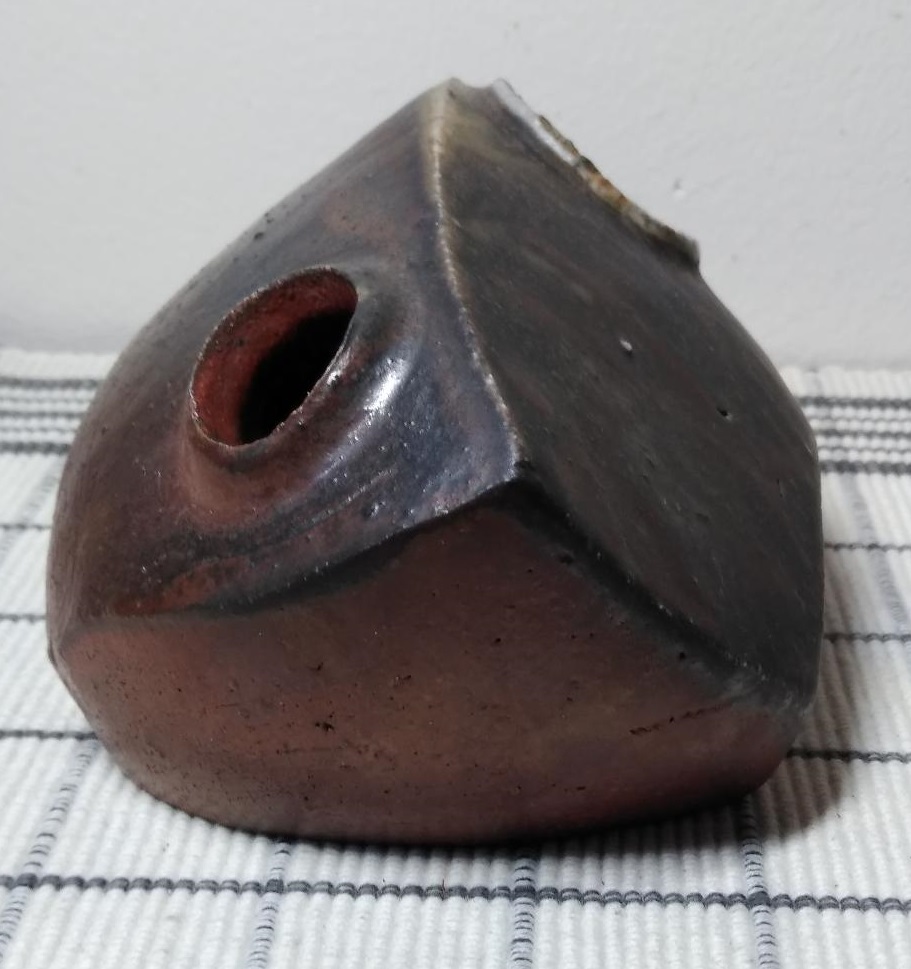
Wild clay harvested in North Carolina, with a slip of wild New York clay. Weight: 1168 g (2.6 lb). Dimensions: 20 x 11.5 x 8.8 cm (8 x 4.5 x 3.5 in).

This sits on the flat edges of the bottom. The bottom is a rough rectangle with a deep concave arch in the center. The artist’s mark, a small circle with his initials inside it, was pressed into the base. The two pieces that form the sides are shallow convex arcs that meet at a sharp seam in the middle. Each side has a circular opening in it. The openings are surrounded by a narrow rim. The surface is pitted and rough.

This is unglazed. After it was formed, it was coated with a slip. It was wood-fired for four days in the lower front area of an anagama kiln, in a “fairly heavily reduced” atmosphere. The colors, which range from an ashy gray through reds to browns and blacks, result from the wood-firing and the natural ash deposits.

Like the other items in this series, this exploits the interactions among, shape, clay/slip, and the firing process.

Purchased from the artist in April 2022.


Saturday, April 2, 2022

185. Andrew Sartorius, “Firebox Sculpture 7”

185. Andrew Sartorius, “Firebox Sculpture 7”


For Sartorius, see item 143.

From the artist: “This series of sculptural vessels explores shape and form allowing each sculpture to emerge through my coiling and carving process of hand building. The sculptures reveal themselves to me in shifting form and merging and meeting lines that lend themselves to focusing on kiln placement and the interaction between clay choice and kiln effect.”

Dark clay from West Virginia (in the other two pieces by this artist that I own, the clay was harvested on his grandparents’ farm in West Virginia—this appears to be the same clay.). Weight: 1842 g (4.1 lb). Width: 15.2 x 16.4 cm (6 x 6.5 in). Height: 14.5 cm (5-3/4 in).

This sits on a flat base. roughly an oval 9.5 x 7 cm (3-3/4 x 2.3/4 in). The base is slightly concave. The central portion of the body is generally circular. The two “sides” are concave circles. The circular opening in the top is about 3.2 cm (1-1/4 in) in diameter. The shape of the interior more or less follows that of the exterior. The surface is pitted but not particularly rough, except on the smaller concave side, whose surface is much rougher than the other areas of the piece.

This appears to have a lining glaze on the interior. The exterior has a natural glaze from the wood-firing, with colors ranging from black to gray to a rusty red. The piece was fired in the lower front of a train kiln for two days and was coated with fine ash particles to create a unique layer of ash effects on the exterior.

A great piece, exploiting the potentials of clay and wood-firing. It gives a strong feeling of being a part of a larger structure, a machine perhaps. The surfaces flow naturally into each other.

Purchased from the artist in March 2022.

Pottery

Looking for suggestions

I need to dispose of my collection. I've tried to donate it to several local museums or schools with ceramics programs, but no one wants...