Wednesday, December 1, 2021

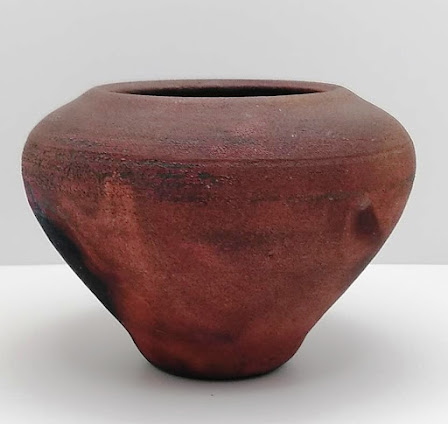
158. Iga-ware vase, wood-fired, early twentieth century

158. Iga-ware vase, wood-fired, early twentieth century


Iga-ware is a long-established tradition of Japanese pottery made in what is now Mie Prefecture in central Japan, east of the Kyoto-Osaka-Nara region. The seller dated this to the Meiji period.

Dark coarse clay with small, white embedded pebbles; interior and upper part of exterior glazed in a bluish-gray ash glaze; other colors from wood firing. Weight: 2190 g (5 lb). Widths: mouth, 5.7 cm (2-1/4 in); lip, 8.8 cm (3-1/2 in); neck, 7.5 cm (3 in); maximum, 12.5 cm (5 in); base, 11.3 cm (4-1/2 in). Height: 28 cm (11 in).

This sits directly on the base. The interior of the base is hollowed out in a concavity to the depth of about 2 cm (3/4 in). Above the base the walls curve outward in a convex line to the maximum width, which is 2.5 cm (1 in) above the base, and then curve inward to the minimum width of 10 cm (4 in), which begins 7 cm (2-3/4 in) above the base. The walls rise more or a less in a straight line to the base of the ear lugs   18.3 cm (7-1/4 in) above the base, before widening slightly to 11.3 cm (4-1/2 in) at the shoulders, which begin 24.5 cm (9-3/4 in) above the base. At the shoulders, the walls turn abruptly inward in a straight line to the neck, which consists of two parts. The lower part is 7.5 cm (3 in ) in diameter and about 1 cm (3/8 in) high. The upper part is 8.8 cm (3-1/2 in) wide and about 1.5 cm (5/8 in) high. The upper part of the neck is squarish in shape, as is the mouth. The ear lugs were formed from rectangles roughly 2.5 cm (1 in) wide and 10 cm (4 in) long, folded down at the top and attached at the shoulders and then curved outward and down to reconnect with the body of the pot about 6.8 cm (2-3/4 in) down.

The exterior of the pot was not smoothed and shows throw marks along the entire length. A spatula was used to scrape six long vertical gouges on the walls of the pot, two on each face, and one under each ear lug.  The ear lugs were attached in a deliberately haphazard manner. They are not exactly opposite each other; nor are they precisely vertical. The surface of the pot is rough and pitted.  As is characteristic of Iga ware, small white pebbles were embedded in the surface of the clay at random points.

The interior and the upper part of the exterior were glazed in what looks like an ash glaze, bluish gray in color, with a fair amount of carbon capture. The glaze ran down the exterior in a series of long drips. This was wood-fired, and the other colors on the exterior, which range from a light reddish tan to a sooty dark brown, result from the interactions in the kiln among heat, smoke, and clay.

A blunt statement of what can be done with clay. The molding is deceptive—seemingly careless, but not carefree or whimsical in the way that some Oribe is. The pot is heavy and coarse as a principled statement of an aesthetic. Skill and experience went into the making of this. It only looks rough-hewn. It is the result of a highly conscious and well-conceived “ineptitude.”

This is a heavy pot to lift. It’s very solid and earthbound (in many senses). I wouldn’t say that it’s a pleasure to hold—it feels dusty and dirty, rough, coarse. It shifts abruptly from round to squarish shapes. It’s unbalanced. The curves of the gashes along the walls impart motion to the vase and make it look as though it leans to one side (this is an optical illusion—the body is symmetrical). The pot appears to be divided into ill-sorted segments, put together in a slapdash fashion. It is, as current jargon has it, full of wabisabi.

This came with a box, quite old to judge from its appearance. The characters on the lid are, on the upper right  伊賀 耳付 (Iga;  mimitsuki), Iga[-ware], vase with attached ears. The column to the left of this appears to read 花生 (hanasei), “flower life,” another term for a vase. The characters were also written on a strip of paper glued to the side of the box.  Written on the bottom of the box in ink are the small characters 日.山.  (in Japan, these would be read right to left). There are dots after each character, presumably to indicate these are separate components and not one word. The characters are read hi or nichi (“sun/day/Japan”) and yama or san (“mountain”). There is a small circle O on a separate line beneath the characters.

Purchased from Treasures of Old Times in Bangkok, November 2021.


Wednesday, November 17, 2021

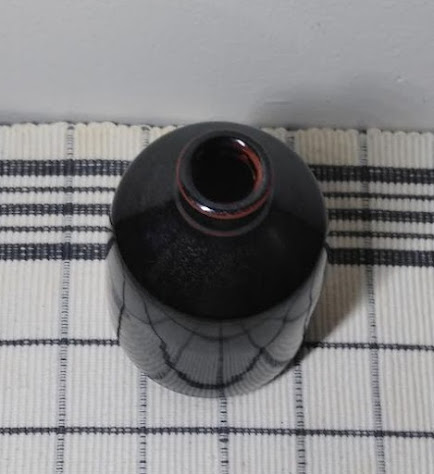
157. Catherine Weir, small raku-fired pot, ca. 1995­‑2000

157. Catherine Weir, small raku-fired pot with a matte copper glaze on the exterior, and a glazed interior, ca. 1995­‑2000


Color of clay unknown. Interior glazed with a protective glaze; exterior coated with a matte copper glaze, with colors resulting from wood- and raku-firing. Weight: 156 g (5.5 oz).  Rim diameter 5.7 cm (2-1/4 in); maximum diameter: 9.5 cm (3-3/4 in); base diameter: 3.6 cm (1-3/8 in).  Height: 6.7 cm (2-5/8 in).

Weir practices and teaches ceramics in the Hamilton, Ontario, area. For more on her and other examples of her work, visit her website: www.catherineweir.ca.  She specializes in raku ware.

This sits directly on the base, which was slightly hollowed out to form a small concave dent in the center. The artist signed the pot, using a brush to write her surname “Weir.” Above the base the walls of the pot extend outward at about a 45-degree angle for the distance of 1 cm (3/8 in); a definite break sensible to the fingers is apparent at this point. The walls then move outward at a steeper angle in more or less a straight line to just below the shoulder. The maximum width is at the shoulders, 5.2 cm (2 in) above the base. The shoulders are rounded. Above the shoulders, the wall moves in a straight line to the opening at the rim for a distance of 1.7 cm (5/8 in). The lip of the rim is rounded. The interior of the pot shows throwing marks. The exterior was smoothed off. The interior is smooth to the touch, the exterior is slightly rough from the wood-firing and the raku process.

The interior of this has a protective glaze, presumably to allow the pot to hold water. The mottled colors range from black through a grayish-blue to a dark scarlet.  The exterior of this was coated with a matte copper glaze. The wood-firing and the raku process added other colors. A coppery sheen is visible over much of the pot. Other colors on the exterior are black, russets, browns, and blue.  The artist’s signature appears to have been written in gold over the finished pot. The artist (pers. comm.) informed me that this was reduction fired.

This is much lighter than one would expect for a pot of this size. The shaping of the pot reflects a high degree of skill in throwing and trimming. This small object moves in many different directions, but each section is consistent and even.  Through careful control of the glazing and the firing, Weir managed to achieve a wide range of coloring.

Purchased from Ver Sacrum Studio in Philadelphia, in November 2021.


Friday, November 12, 2021

156. John Charles Karrasch, 1934-2010, weedpot vase with Tenmoku glaze, ca. 1972

156. John Charles Karrasch, 1934-2010, weedpot vase with Tenmoku glaze, ca. 1972


From the seller: “This lethal vase form was created in Reno, Nevada when John and Susan Karrasch worked together creating world class ceramics. John Karrasch is historically one of Nevada's most significant potters. From Vasefinder: John Charles Karrasch (1934-2010) was born in Missouri. He received the first technical B.F.A. in Ceramics from the University of Southern California in 1956, where he was a student of Susan Peterson and Vivika Heino. He received his M.F.A. from the Rhode Island School of Design in 1963, where he was a student of Lyle and Dorothy Perkins. John was a scholarship student at the Haystack Mountain School of Crafts. For a brief period, John studied glass technology with Harvey Littleton, when he was a student at the Toledo Museum of Art. He received a Georg Jensen Grant to study glass technology in Finland. John also worked as a marketing assistant for the League of New Hampshire. He was a designer for the Metlox Pottery. He has taught at Chouinard, as well the University of Nevada Reno to just mention a couple locations. John worked in several clay mediums, such as porcelain, stoneware and earthenware. He founded the Nevada Clay Arts Guild in the mid-1970s. Prior to 1961, we show John exhibiting at the Missouri State Fair in 1955 and 1956. In 1956, he had a one-man show at the Fisher Gallery of USC, Los Angeles, California. He also exhibited in one-man shows in Reno and Las Vegas in 1959 and exhibited at the Nevada State Silver Centennial, Virginia City, Nevada. John exhibited at the Syracuse Ceramic Nationals in 1962, 1964 and 1966.”

Light tan clay, brown Tenmoku glaze; base left unglazed. Weight: 396 g (14 oz). Width of rim: 3 cm (1-1/16 in); maximum width: 8.2 cm (3-1/4 in); width of foot ring: 5.7 cm (2-1/4 in). Height: 13.4 cm (5-1/4 in).

This sits on the foot ring, which is about 0.7 cm (1/8 in) high on the outside and about half that depth on the inside. The initials “JK” and “SK” and something resembling the Greek letter pi are written in black on the inside of the ring foot. Above the foot ring, the walls flare out in a straight line at about a 30-degree angle for about 1.7 cm (5/8 in). The maximum width is at the top of this section, about 1 cm (3/8 in) above the base. From there the walls slant inward in more or less a straight line to the shoulders, which are 9.4 cm (3-3/4 in) above the base. At the shoulders, the vase is 7 cm (2-3/4 in) in diameter. The walls then slant inward at a 45-degree angle to the base of the neck, which is 11.3 cm (4-1/2 in) above the vase. The diameter at the base of the neck is 3.3 cm (1-1/4 in). The neck is 1.7 cm (5/8 in) high. It slants inward to just under the rim, reaching a diameter of 2.5 cm (1 in) at the narrowest point. The rim is rolled outward.  There is a paper sticker near the bottom on one side with “John Karrasch” and a logo matching his initials on the bottom of the vase. printed in black. This is very symmetrically shaped and very smooth to the touch.

With the exception of the ring foot and its interior, this was evenly glazed in a dark brown Tenmoku glaze. At the rim, the base of the neck, and around the bottom edge of walls, the glaze has pulled away from the clay and appears as lighter reddish-brown bands. In most lights, the vase looks almost black in color. Under a strong light, innumerable pinpricks of the lighter reddish-brown color show through in the characteristic “oil spots” of this glaze.

A beautiful example of very formal studio pottery with a flawless glaze, more typical of the output of studio potters in the 1970s than it is now.

Purchased from Charlie B. Studio of Carson City, Nevada, in October 2021.  Charlie B. purchased the vase directly from the artist around 2005.


Tuesday, November 9, 2021

155. Evelyn Aronson, handbuilt vase, ca. 1970

 155. Evelyn Aronson, handbuilt vase, ca. 1970


Brown clay, heavy brown glaze over most of surface; bottom unglazed. Weight: 696 g (1.5 lb). Maximum width: 10.7 cm (4-1/4 in); width of mouth: 3.5 cm (1-3/8 in); width of neck: 6.3 cm (2-1/2 in); width of base: 5.6 cm (2-1/4 in). Height: 8.7 cm (3-1/2 in).

This sits directly on the base. The walls rise in a convex arc to the shoulders (also the point of the maximum width) 5 cm (2 in) above the base. From there the walls move inward in more or less a straight line to the neck, which is 8.3 cm (3-1/4 in) above the base. The angle of the inward movement becomes steeper at the neck, which is about 1.3 cm (1/2 in) wide.  The bottom of the pot is incised with the artist’s initials “EA”; a square label printed with the peace sign in blue covers most of the incised letters. Written in ink on this label are “EA” and “$8.00.”  A circular label above this has “Evelyn Aronson” and “Princeton” written on it, also in ink. “Princeton” could refer to any number of places in the United States.

The edges of the base and the lower sides of the walls have many short, straight lines incised into them. They look like the type of marks that would be left by the tines of a fork. The shoulders and neck of the vessel are similarly scored with many short, straight lines. Just below the midpoint of the walls, a heavy, irregular groove has been gouged into the walls about three-quarters of the way around the circumference.

The walls of the pot are very bumpy and rough to the touch.

Most of the interior appears to have been glazed with the same glaze as on the exterior. The neck and the incised grooves show a much darker color, black in places, where the glaze is thinner. The glaze was splashed against the upper shoulders of the vessel and allowed to drip down. The base is unglazed. The glaze was quite thick. This shows some characteristics of the type of carbon capture found in wood-firing, but if the date is correct, wood-firing was much less common in the USA than it is today.

This is a very heavy, solid pot. Unusually for the time, it is quite “crude”; most potters ca. 1970 were throwing pots on wheels and aiming for symmetry and even glazes. Aronson was ahead of her time.

Purchased from the Charlie B. Gallery in Carson City, Nevada, October 2021.


Monday, November 8, 2021

154. Lauryn Axelrod, “Nike,” wood-fired ceramic sculpture

154. Lauryn Axelrod, “Nike,” wood-fired ceramic sculpture


For Axelrod, see item 147.

Gray clay, colors from wood-firing and ash glaze. Base: made from a 4 x 4 beam of wood; 15.3 x 9 x 9 cm (6 x 3-1/2 x 3-1/2 in). Height: overall 28.5 cm (11-1/4 in). Sculpture proper: height: 19.5 cm (7-3/4 in); width across front: 17.6 cm (7 in); width across side: 17 cm (6-3/4 in).

The wooden base was painted black. The sculpture appears to be glued to the base. The sculpture was made of one piece of clay, bent into two “wings” roughly in the middle. The sculpture is about 5 cm (2 in) thick in the center. The centers of the wings are about 2.5 cm (1 in) thick; the thickness decreases toward the edges, reaching about 0.2 cm (1/16 in) at the ends. The outer surface appears to have been rolled on a patterned surface, or perhaps with a patterned roller.  The edges are much torn and broken. The exteriors of the wings are much smoother than the interiors.

The color and the sheen derive entirely from the wood-firing. The colors range from reds through russets to a dark brown. The sheen is primarily present on the higher surfaces of the wings.

Purchased from the artist in 2021.


Thursday, November 4, 2021

153. Christopher Wilder, “Grift,” ceramic wood-fired sculpture, 2021

153. Christopher Wilder, “Grift,” ceramic wood-fired sculpture, 2021


Wilder is a potter in Lexington, Kentucky. For other examples of his work, see his Instagram account, @christopherwilder6.

Gray clay, ash-glazing and color from wood-firing. Weight: 3885 g (8.7 lb). Height: 27.7 cm (11 in). Width dimensions: 19 x 15 cm (7-1/2 x 6 in).

This is highly irregular in shape. The base is hollow inside and roughly 19 x 13 cm (7-1/2 x 4-1/2 in) wide and 8.8 cm (3-1/2 in) high. The upper part is 13.7 x 15 cm (5-1/2 x 6 in) wide and 21.5 (8-1/2 in) high. The two parts appear to have been separately formed and joined together.

The piece is unglazed and acquired its color and glaze from the wood-firing.

Purchased from the artist in October 2021.


Wednesday, November 3, 2021

152. Jason Edmonds, “Wood fired hanaire, bud vase.

152. Jason Edmonds, “Wood fired hanaire, bud vase. Miniature Japanese flower vase for tea ceremony"


For Edmonds, see item 146.

Dark gray clay, exterior unglazed, colors from wood-firing; the interior was glazed. Weight: 1202 g (2.7 lb). Base: 6.3 cm (2-1/2 in) square. Height: 16.5 cm (6-1/2 in).

This sits directly on the base. The body consists of nine tiers. The tiers vary in size, ranging from largest to smallest as they ascend. The largest is the base tier; the smallest the top tier, which is 4.5 cm (1-3/4 in) on a side. The tiers also vary in height, from about 1.7 to 2 cm (5/8 to 3/4 in). Each tier is offset slightly from the one below it, creating a spiral pattern with four sides. A hole about 1.2 cm (1/2 in) wide was bored from the top tier down through all but the base tier; it is 15 cm (6 in) deep.

The colors on the exterior result from the wood-firing and range from a dark reddish-brown to a grayish black. To quote Edmonds’s description: “It was wood-fired for nine days. The interior has a glaze liner. The exterior of the piece was unglazed when it was loaded in the kiln. The glaze that has formed on the piece is a result of the natural wood ash produced during the wood-firing method. The piece is completely water tight and is high-fired (above cone 10) stoneware.”  The interior glaze and the high-temperature firing allow the interior to hold water.

Purchased from the artist in October 2021.

Pottery

Looking for suggestions

I need to dispose of my collection. I've tried to donate it to several local museums or schools with ceramics programs, but no one wants...